The short version: On Thursday night, October 15, at SpaceX’s rocket test site in McGregor, Texas, Tesla’s new Roadster drove upside down along a curved ramp, let go, rolled over in midair on bursts of compressed gas and landed on its wheels. Then a second car kickflipped over a row of Teslas, Semi truck included. It is the most cyberpunk thing a carmaker has staged in years. It is also a hop, not a flight: the thrusters on the version you can reserve empty in about six seconds and need a station to refill, nobody was inside either car, and the flying version carries Tesla’s own note: “Not approved for public road use.”
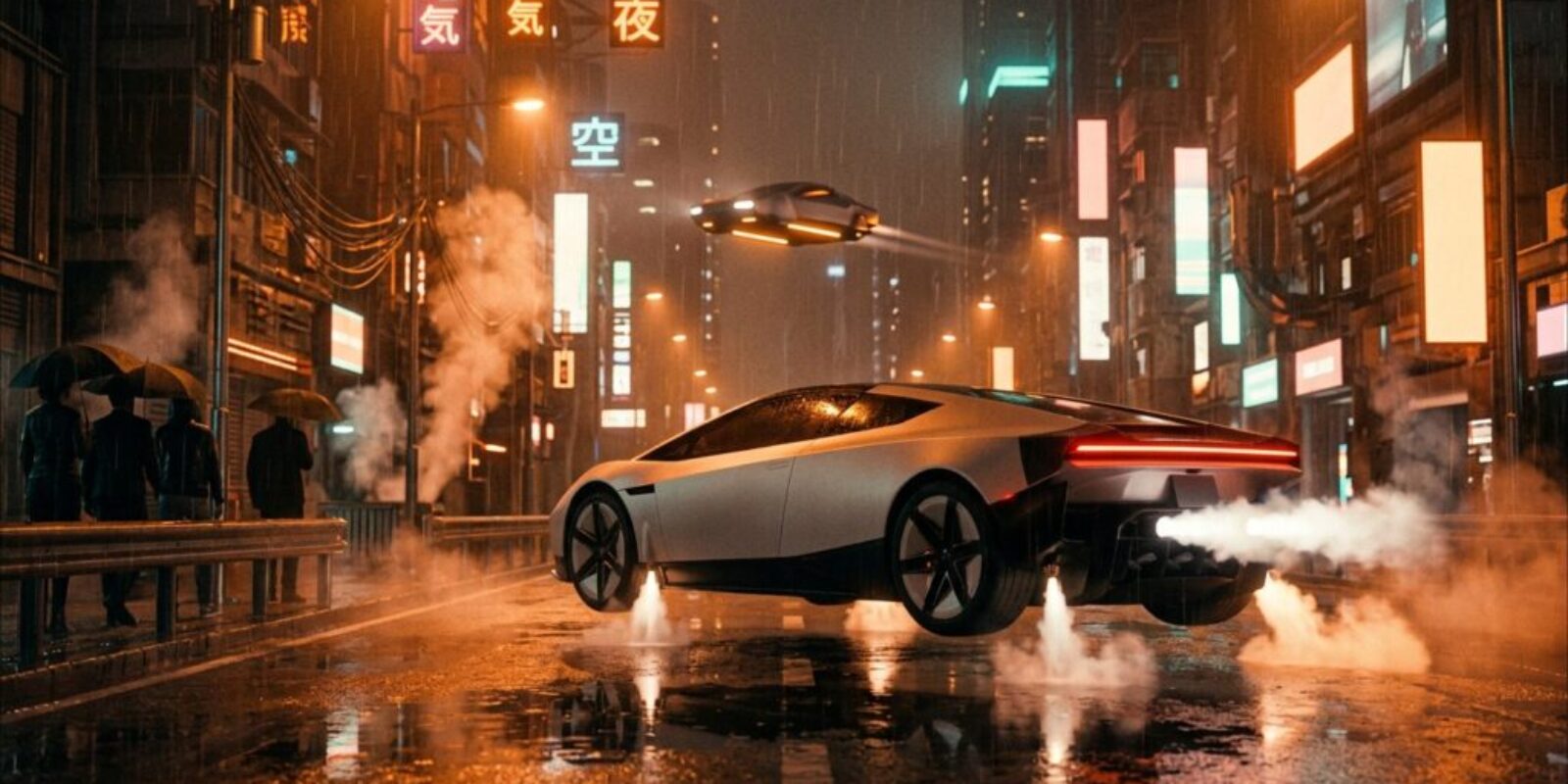
None of that makes it less fun to watch. It just means the spinner from Blade Runner is still parked in 2019’s version of the future, and this is a very good trailer for it.
What actually happened in McGregor
Picture the setting first, because it does half the work. A rocket test range at night, crowds in earplugs hundreds of feet back according to Electrek, and a low two-seater climbing a ramp that curls over on itself like a wave. The car does not fall off at the top. A fan system under the floor pulls air out from beneath it and pins it to the ceiling. Tesla’s own Roadster page says the suction is strong enough “to hold the vehicle upside down, even when stationary,” and Tesla engineering chief Lars Moravy put the pull at up to 2 G on stage, as Euronews reported.
At the end of the curve the car lets go. Thrusters fire, it rolls 180 degrees in the air and comes down right side up. The second stunt sends a car off a ramp and flips it over a lineup that, per Fortune, included a Cybertruck and a Semi.
The driver’s seat held a mannequin in a SpaceX spacesuit, a callback to the Starman dummy Musk shot into orbit in a Roadster in 2018. Musk said the car drove itself for safety, and he was candid about the product: “This is not necessarily a safety-optimized car, OK?”
Are those really rockets?
Not in the fire-and-smoke sense, and that is the most interesting detail in the whole show. Tesla calls them cold-gas thrusters. There is no combustion. A tank stores gas at very high pressure, and valves let it blast out of nozzles, which pushes the car the other way. SpaceX uses the same principle for fine attitude control in space, where you need a nudge and not an explosion. It is the cleanest, simplest kind of thruster there is, and it is why the plumes in the footage are white clouds rather than flame.
There is a fun legal footnote here. The Federal Aviation Administration’s own definitions, in 14 CFR 1.1, describe a rocket as an aircraft propelled by expanding gases “generated in the engine from self-contained propellants.” A cold-gas thruster generates nothing; it releases gas that was pumped in at a station. Read plainly, the top trim named Rocket is not a rocket.
How many times can the thrusters fire?
On the Thrust version, the one with a public reservation button, once. Top Gear, which saw the car before the event, reports a 200-liter tank in place of the trunk, feeding four rear nozzles, that is emptied in about six seconds and has to be refilled at a station, calling it a one-shot deal. That one shot buys a claimed 0 to 60 mph in 0.85 seconds.
The Rocket version swaps the passenger seat for another 400-liter tank, 600 liters in all, and adds six more nozzles at the front and sides so the car can steer, brake and point thrust downward. More gas, more nozzles, and still a short burst. Tesla has not said how long or how far the car can stay airborne, and it has not published a refill time. Electrek noticed that each stunt was performed by a different car, which tells you something about turnaround on the night.
So the honest unit of measure for this car’s flight is the hop. A spinner cruises across a city. This clears a truck.
Is the flying Tesla Roadster legal?
The short answer is that nobody has approved it for anything, and nobody has to. Here is what each layer says, read October 17, 2026:
- Tesla itself: the Rocket trim is labeled “Not approved for public road use.” The Thrust trim is described as “race ready,” and the reservation page adds that availability is “subject to each region’s legal requirements and applicable laws.”
- The FAA: according to Fortune, the agency told CBS News and Politico that the car does not meet its definition of an aircraft, so no airworthiness certificate applies. That is striking next to the definition itself, which calls an aircraft any device “used or intended to be used for flight in the air,” and next to Tesla’s own product copy for the Rocket: “So yes, it can fly.”
- Federal car safety: the National Highway Traffic Safety Administration does not pre-approve cars. Automakers certify their own compliance with federal standards. The Transportation Department told Fortune that NHTSA “will continue to monitor the situation.”
- States: road rules are state law, and no state has said anything specific about a car that hops.
Put together, Tesla is selling the Rocket the way track cars and stunt rigs are sold: for closed courses, not the grocery run. Who answers for a thruster misfire on private ground is a question no regulator has publicly answered yet. The Performance trim, without thrusters, is the one Tesla calls road ready.
Was that even the car?
Within a day, people pausing the footage were asking a sharper question than whether it can fly: whether the thing that flew was really a Roadster. Two automotive outlets went through Tesla’s own video frame by frame. Autoevolution‘s Cristian Agatie found a bare metal structure under the car where an electric car normally has the flat floor of its battery pack. That suggests the demo car had no full pack between the wheels and was much lighter than the car Tesla described. He also spotted a white line on the ground that the car seemed to follow in every stunt. He believes the demo was real, and still concludes the car that flipped “will never head to a Tesla delivery center.” In an opinion piece for GearJunkie, republished by ExplorersWeb, Kyle Hyatt wrote that the underside “appears to be a hollow shell fixed to a ladder frame.”
Add what Electrek had already noticed, a different car for each stunt and nobody inside, and the likeliest reading is one Hollywood knows well: purpose-built stunt rigs wearing a Roadster body, each built for one trick. That isn’t proof of fakery. The hardware plainly worked, and Tesla never said these were the cars it will deliver. But as of October 17, Tesla hasn’t said what was under the skin. Until it does, the fair description is a demonstration of the thruster and suction ideas, not of the car you’d be reserving.
What it costs to get in line
Tesla’s reservation page asks $5,000 up front for any trim, then the rest of the deposit within 10 days: another $45,000 for the Performance trim, another $245,000 for Thrust, limited to one order per customer. Rocket is invite only. No final prices have been announced, and Fortune reports production is now planned for 2028, eight years after the original 2020 target.
Cool gimmick, or the first spinner?
Both, in a way. As a product, it is a marketing gimmick of the highest order: a car that does something useless and unforgettable, staged at a rocket range days before Tesla’s quarterly results. As an object, it is the first car with a reservation page listing flight hardware from a rocket company and a ceiling-walking fan system, which is a sentence that belongs in a Night City sourcebook, not a press release.
The genre has always loved the gap between the ad and the street. The spinner was a police car in a city of rain; this is a $250,000 deposit for six seconds of thrust. Somewhere in that gap is the most cyberpunk story of the week, and it was written by a car company. If you want the fiction at full volume while you wait for 2028, Neon Nights will do it in 20 hours.
Frequently Asked Questions
Can the new Tesla Roadster really fly?
Only briefly. The Rocket trim uses cold-gas thrusters fed by 600 liters of stored compressed gas to lift, roll and land the car, as shown at Tesla’s October 15, 2026 demo in McGregor, Texas. Tesla has not said how long or how far it can stay in the air, and nobody was inside the cars during the demonstrations.
How many times can the Roadster’s thrusters be used?
On the Thrust version, once per fill. Top Gear reports its 200-liter tank empties in about six seconds and must be refilled at a station. Tesla has not published a refill time or a use count for the larger 600-liter Rocket system.
Is the flying Tesla Roadster street legal?
Not the flying version. Tesla labels the Rocket trim “not approved for public road use.” The FAA reportedly told CBS News and Politico it does not consider the car an aircraft, NHTSA relies on automakers to certify their own cars, and the Transportation Department says NHTSA will monitor the situation. The thruster-free Performance trim is the one Tesla calls road ready.
How much does the Tesla Roadster cost to reserve?
As of October 17, 2026, Tesla’s reservation page asks $5,000 up front plus $45,000 within 10 days for the Performance trim, or $5,000 plus $245,000 for the Thrust trim, one per customer. The Rocket trim is invite only. Final prices have not been announced, and production is planned for 2028.
Was the car in the Tesla Roadster demo a real Roadster?
Tesla has not said. Autoevolution and GearJunkie, reviewing Tesla’s footage, reported an exposed frame under the car instead of the flat battery floor an electric car normally has. Electrek noted that a different car was used for each stunt, with nobody inside. That points to purpose-built stunt rigs wearing the Roadster’s body, though Tesla has not confirmed or denied it.
Would you put a $250,000 deposit down for six seconds of thrust, or are you holding out for a real spinner? Tell us in the comments.