
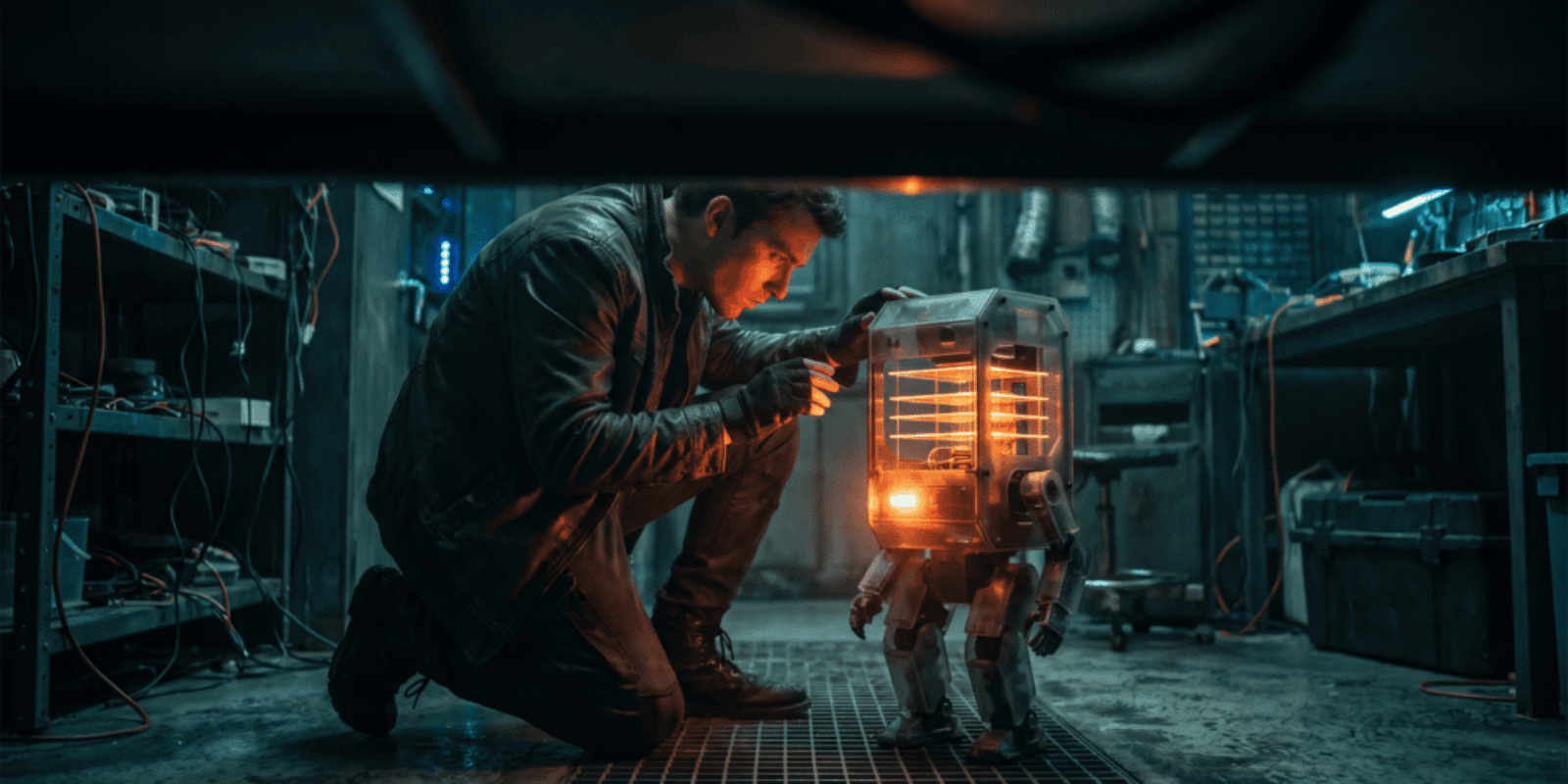
The most revealing detail about Hugging Face’s new robot is not that it waddles, and it is not the $399 price. It is one line in the training repository on GitHub, where the license reads Apache 2.0, followed by a small parenthetical: the 3D models use Creative Commons BY-SA-NC. Two licenses in one product, and those last two letters stand for noncommercial.
The short version: Hugging Face and Pollen Robotics have opened pre-orders for Microduck, a 25 centimeter bipedal open source robot priced at $399, with first deliveries targeted before Christmas. The software that runs it and the reinforcement learning stack that trains it are genuinely open under Apache 2.0. The simulation assets in the same repository are not, they carry a noncommercial restriction, and the manufacturing design files have not been published. None of that is a scandal. It is an ordinary commercial decision, and reading it correctly is the same skill that decides whether the AI tools you adopt this year can be swapped out next year.
What is Microduck, specifically?
Microduck is a small bipedal robot built by Pollen Robotics, the French company Hugging Face acquired in April 2025 to make affordable open hardware. It stands about 25 centimeters tall, weighs roughly 800 grams, and carries 15 motors, a wide-angle camera, a LiDAR sensor, two inertial measurement units, a microphone and a speaker, along with 32GB of storage and 1GB of onboard RAM.
Out of the box it ships with seven trained behaviors: walking, sitting, standing, kicking, grasping an object with its beak, roller skating, and getting back up after a fall. You can drive it with a gamepad or let it chase a laser dot. Engadget reports a 2,600 mAh battery good for about an hour of continuous use, which is the number that keeps this story honest. This is not a machine that works a shift.
It is the third piece of hardware in the same effort. Reachy Mini arrived in July 2025 at $499, with a $399 Lite version, and it sat on a desk. Microduck walks.
Why does one open source robot carry more than one license?
Because “open source” describes software, and a robot is not only software. Look at what was actually published and you find three different legal positions stacked inside one product.
The runtime and the reinforcement learning training environments are Apache 2.0. That is a permissive license in the strongest sense: inspect it, modify it, redistribute it, build a commercial product on it, no permission required. The public training repository is real and substantial, not a marketing gesture. It contains 13 task variants covering velocity-commanded walking, fall recovery, stand-up sequences, ground picking, ball kicking, forward rolls and skating modes, with flat and rough terrain versions of each. Training runs on MuJoCo Warp through the mjlab framework using PPO, and the quickstart notes that 4,096 parallel simulated ducks produce a usable gait in one to two hours.
The 3D model files in that same repository are Creative Commons BY-SA-NC. Share them, adapt them, credit the source, share alike, but do not use them commercially. So the code you could build a business on; the simulated duck it trains against you could not.
And the mechanical and electronic design files are simply not in the release. You can retrain the brain. You cannot manufacture the body.
What this means for the AI tools a small business buys
Most owners will never buy a robot duck, so here is the part that transfers. “Open” is doing an enormous amount of work in AI marketing right now, and it covers at least four distinct situations: code you may use commercially, weights you may run but not resell, assets restricted to noncommercial use, and components that were never published at all. Vendors are not usually hiding this. They publish it plainly, in a line most buyers never read.
The difference is not academic, because it decides one thing: whether you can leave. A tool built on permissively licensed components can generally be moved, self-hosted, or handed to a different vendor when the price changes. A tool resting on noncommercial or unpublished pieces cannot, and a cheap subscription quietly becomes a dependency. We made a similar point when Moonshot AI published the weights for Kimi K3, where the license mattered more than the file size, and again when Meta released an open-weight model small enough to run offline on hardware you own.
The practical version takes about five minutes. Before you build a recurring process on any AI product, find out which parts of it are actually open, and ask the vendor what happens to your data and your workflows if you cancel. Ask it while you are still a prospect, when the answer is cheapest to get.
Is a $399 open source robot useful to a business yet?
No, and it is worth being blunt about that rather than dressing it up. An hour of battery, a beak that lifts small objects, and seven demonstration behaviors do not add up to a task anyone is currently paying a person to do. Nobody’s job is threatened by a 25 centimeter duck, and treating this as the leading edge of physical automation replacing staff gets the story backwards.
What is genuinely happening is more interesting and slower. The published training stack means the behaviors themselves are inspectable and retrainable, which is the precondition for a shared library of robot skills that circulate the way model weights circulate today. That is the same sequence text AI followed: open weights appeared first, the commons grew, and then the price of the commercial version collapsed. Physical AI has just started that sequence, several years behind. If robot capability follows the curve language models followed, the useful question for an owner is not what a duck can do in December. It is what the same $399 buys in 2029, and whether the skills it runs are owned by everyone or rented from three companies.
There is a reason to watch who ends up holding that commons. Nvidia has reportedly agreed to buy Hugging Face for $12.9 billion, which would put the company publishing this open robotics stack inside the company selling the chips it trains on. That deal is not signed, and the open licenses already granted cannot be revoked. But the direction of the next release is a decision someone new gets to make.
Frequently Asked Questions
What is Microduck and what does it cost?
Microduck is a 25 centimeter tall bipedal robot from Hugging Face and Pollen Robotics, priced at $399, with pre-orders open now and first deliveries targeted before Christmas. It weighs about 800 grams and carries 15 motors, a wide-angle camera, a LiDAR sensor, two inertial measurement units, a microphone and a speaker, and it ships with seven pre-trained behaviors including walking, sitting, kicking, grasping, roller skating and recovering from falls.
Is Microduck really an open source robot?
The software is genuinely open, and the rest is more limited. The runtime and the reinforcement learning training stack are published under the Apache 2.0 license, which permits commercial use, modification and redistribution, while the simulation 3D models in the same repository carry a Creative Commons BY-SA-NC license, where NC means noncommercial. The mechanical and electronic design files have not been published, so you can retrain the robot’s behavior but you cannot manufacture the robot itself from the released material.
Can a small business actually use a robot like this today?
Realistically, no. Microduck runs for about an hour on a full charge, lifts only small objects with its beak, and its seven shipped behaviors are demonstrations rather than jobs, which makes it a research and learning platform rather than a piece of equipment. The reason for an owner to pay attention is the price trend it represents and the licensing lesson it illustrates, not a task it can take off your hands this quarter.
Why does an AI tool’s license matter when I am just buying a subscription?
Because the license decides whether you can leave. A product built on permissively licensed components can usually be moved, self-hosted or transferred to another vendor if the price rises or the service degrades, while one resting on noncommercial or unpublished components cannot, which turns an inexpensive subscription into a dependency you cannot exit. Checking which parts of a tool are actually open, and asking what happens to your data and workflows on cancellation, costs a few minutes before you commit and prevents a far more expensive discovery later.
Which tool in your business would be hardest to walk away from if its price doubled tomorrow, and do you actually know what you would replace it with?


Open Source AI for Small Business: The Data Came Too
September 7, 2026 @ 12:45 pm
[…] not academic once one word is carrying legal weight. We have been here before on a smaller scale: a $399 robot billed as open source turned out to hold three different licenses, one of which quietly forbade commercial […]