Nintendo Is Completely Ignoring AI and Doing Fine for Cyberpunk Culture and Industry
Why a legacy games company saying no to generative AI feels like a glitch in the simulation, and why that glitch matters for cyberpunk creators and businesses.
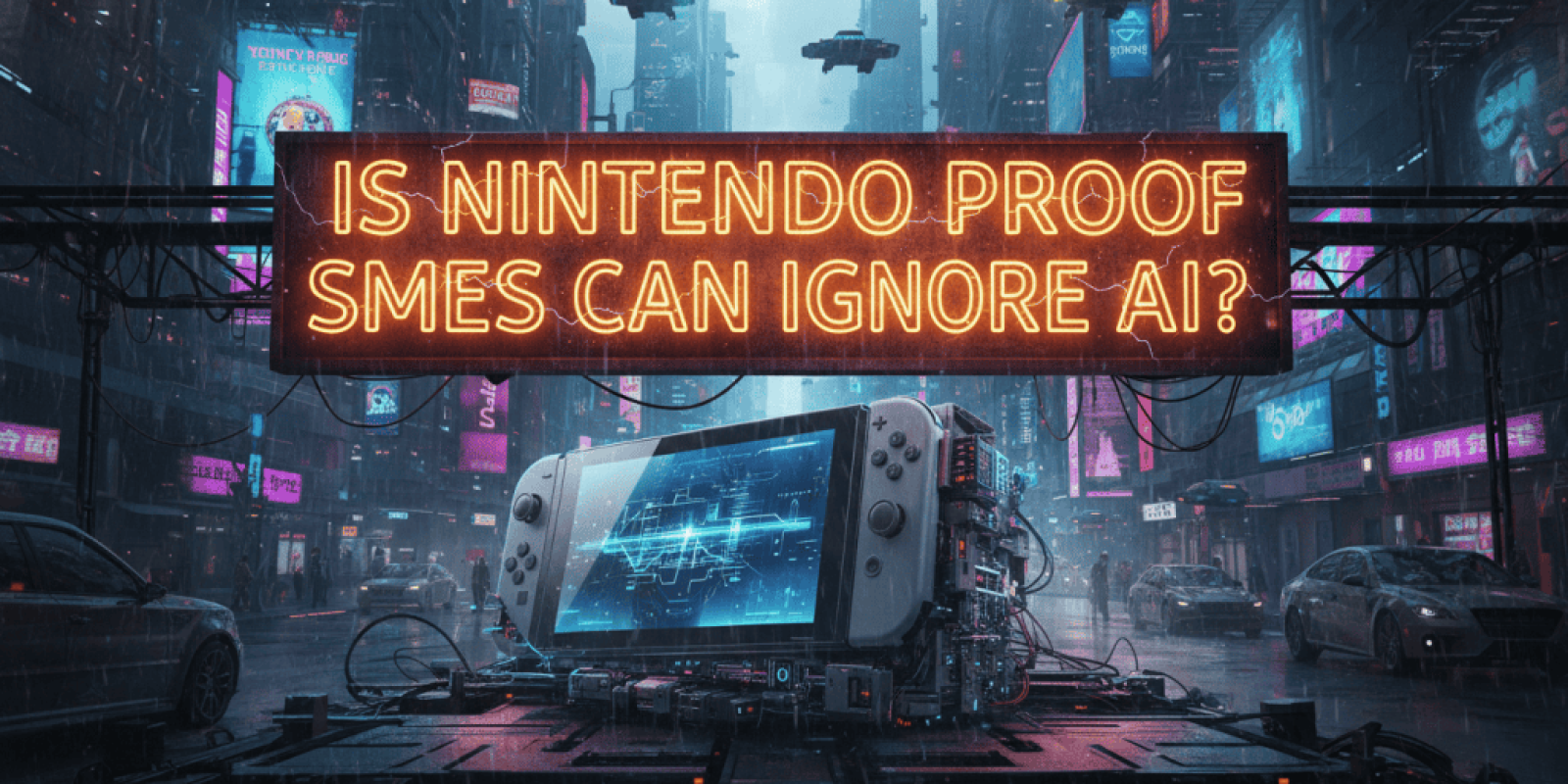
A downtown arcade at 2 a.m., neon humming through rain-streaked windows, a teenager in a patched jacket trading cartridge copies with a friend while a voice in a podcast argues that artificial creativity will eat authors next week. Nintendo sits across from that scene, politely refusing to take a bite. The refusal is not theatrical; it is a careful, corporate decision with legal padding and decades of IP guardianship backing it up.
Most commentators framed Nintendo’s answer as an old-guard company being stubborn about technology. That headline misses the more consequential angle: Nintendo’s stance is a market signal that reshapes the economics of creative labor, fan culture, and the secondary markets that cyberpunk aesthetics rely on. The question now is not whether Nintendo will adopt AI eventually; it is how an influential no restructures incentives for artists, modders, indie studios, and small tech businesses.
A clear corporate line: what was actually said and when
At an investor Q and A in early July 2024, Nintendo president Shuntaro Furukawa said generative AI “can be used in creative ways” but raised explicit concerns about intellectual property and declared there were no plans to use GenAI in first party titles as of that session. The company posted the English translation of the meeting notes on its investor relations site on July 3, 2024. (nintendo.co.jp)
That public posture was then echoed and slightly gamified by executives in 2025 when Nintendo of America’s Doug Bowser told CNBC that AI might help productivity but that the “human touch” would remain central to how Nintendo creates games. That interview helped the statement land beyond investor circles and into mainstream gaming press. (nintendolife.com)
How the industry read the polite refusal
Most trade outlets reported the line as a conservative stance in a market where rivals are weaponizing AI to speed up dialogue, create textures, and prototype levels. Digital Trends summarized the Q and A as Nintendo prioritizing developer artistry over the quick gains AI promises. (digitaltrends.com)
Decrypt and similar outlets framed the move as a defensive play rooted in IP anxiety rather than pure technophobia, noting that companies under cost pressure are deploying AI to shave development time and headcount. That framing matters because it positions Nintendo’s decision as strategic rather than merely nostalgic. (decrypt.co)
Why cyberpunk culture notices this more than mainstream gaming does
Cyberpunk aesthetics and communities thrive on bricolage, remixing, and a certain legal grey area where fans transform corporate IP into new, darker urban myths. When Nintendo tightens the gate around its characters and production methods, it is constraining the raw material that fuels much of the cyberpunk visual language. Fewer sanctioned inputs create scarcity, and scarcity breeds black markets and uncanny fan creations that often look algorithmic anyway, which is deliciously inconvenient for lawyers.
Meanwhile, the refusal encourages a market of handcrafted authenticity. That yields two contradictory outcomes for cyberpunk creators: an elevated premium on human-made assets, and an incentive to find workarounds using open IP or original universes. Either route reshapes where cyberpunk talent congregates, which is exactly what happens when a megacorp quietly reroutes cultural flow.
The competitive landscape: who is already using AI, and why Nintendo’s absence matters
Microsoft, Electronic Arts, and several western studios are embedding AI into dialog systems, asset generation, and testing workflows to accelerate pipelines and reduce cost. These moves create a competitive delta in time to market and per unit cost. Nintendo’s refusal reduces pressure on those margins for a segment of the market that prizes experience over rapid iteration. That protective posture lets Nintendo keep higher-touch production values without being forced to match AI-driven output volume.
For cyberpunk IP holders and creative studios, that means two simultaneous economies: one AI-accelerated, cheaper, and fast; the other artisanal, pricey, and highly curated. The split is fertile for genre experimentation, and also for friction when fans cross from one economy to the other.
The cost nobody is calculating for small studios and shops
If a small studio of 10 people wants to build a cyberpunk title that visually competes with big-budget trilogies, using AI tools could cut art and text production time by roughly 40 to 60 percent. That saving could translate to tens of thousands of dollars per month in labor costs for a 6 to 12 month project. Conversely, choosing to avoid generative AI to match Nintendo’s ethics means absorbing those costs and signaling to publishers a premium product that may or may not find a buyer.
A local VR arcade with 20 employees planning a cyberpunk event must weigh two staffing models: hire three contract concept artists at 40 dollars per hour for 400 hours to handcraft assets, or license AI-generated assets at a fraction of the cost plus a legal buffer. The former preserves an artisanal badge that customers will pay for; the latter compresses capital needs but increases exposure to contested IP claims. That tradeoff is tangible math, not philosophy.
What businesses of 5 to 50 employees should model concretely
A boutique studio of 12 staff aiming for a 9 month release can budget labor at 80 percent of costs. If switching to AI-assisted art reduces art hours by 50 percent and saves 2000 developer hours, payroll savings at an average of 45 dollars per hour equal 90,000 dollars. Factor in subscription fees for AI models at 2,000 to 10,000 dollars per month and legal mitigation costs of 10,000 dollars upfront, and the net savings still look meaningful for cash-strapped teams.
Alternatively, if that studio aligns with Nintendo style human-first design to access certain co-branding or marketplace audiences, it must instead price its game higher, seek higher margin publishing deals, or accept longer burn. This choice affects recruitment, investor conversations, and the studio’s bargaining position for licensing deals. Businesses should run both scenarios as a three year projection and highlight cash runway differences in hiring plans.
Risks and open questions that stress-test the claim Nintendo is simply ignoring AI
Legal uncertainty remains the largest variable. If courts or legislation make training on copyrighted material more permissive, the IP rationale weakens. Conversely, if regulators favor stronger IP protections, Nintendo’s stance becomes a defensive moat. Another risk is talent migration; developers attracted to the efficiency of AI might leave companies that refuse to adopt it, creating a skills gap. Finally, there is reputational risk: a public refusal could be read as principled or as stubborn, and that perception affects partnerships with indie creators and licensors.
Nintendo’s no is both a cultural veto and an accidental invitation for new underground economies to form.
Practical compliance and business policy suggestions for small teams
Small companies should document any use of third party models, maintain provenance records for assets, and define acceptable use policies for contractors. Budget legal contingencies equal to 2 to 5 percent of project spend for IP review when using GenAI. If a studio wants brand-safe positioning similar to Nintendo, contractually require human-in-the-loop signoffs for all creative output and insist on model licensing that includes indemnity clauses.
Where this leaves cyberpunk creators in 2026
Nintendo’s posture will not kill generative AI in games, but it will carve out a premium lane for human-crafted experiences that cyberpunk culture prizes. That lane will be narrow, lucrative for some, and anarchic for others. Small businesses should map their audience, run concrete cost scenarios, and decide whether authenticity or efficiency is the business model.
Key Takeaways
- Nintendo publicly declined plans to use generative AI in first party titles in a July 2024 investor Q and A, citing intellectual property concerns. (nintendo.co.jp)
- The company’s stance reconfigures scarcity for cyberpunk visual culture and boosts the market for handcrafted assets. (digitaltrends.com)
- Studios of 5 to 50 employees must run two financial scenarios that quantify labor savings versus legal and reputational costs. (decrypt.co)
- Executive comments in 2025 reinforced that Nintendo views AI as a productivity tool only where it preserves a human creative core. (nintendolife.com)
Frequently Asked Questions
Will Nintendo’s refusal to use AI make cyberpunk games more expensive to produce?
Yes, avoiding generative AI typically raises labor and time costs because tasks that could be automated remain manual. The premium may translate to higher retail prices or slower release schedules.
Can indie studios profit from Nintendo’s stance by offering human-made assets?
Yes, there is a premium market for handcrafted, non AI-generated assets among fans and licensors; studios can monetize uniqueness, but must prove provenance and quality to command higher fees.
Is there legal risk if a small business uses GenAI for cyberpunk assets?
Yes, IP disputes can arise depending on model training data and output similarity; budget for legal review and secure model licenses to reduce exposure.
Should a small studio adopt AI now or wait to follow Nintendo?
That depends on the studio’s audience and cash runway; if speed to market matters, use AI with clear legal safeguards; if brand and craft are the product, prioritize human creation and price accordingly.
How will Nintendo’s position affect modding and fan content?
Tighter enforcement of IP and public corporate warnings will push some fan activity underground or toward original IP, changing the ecosystem that fuels cyberpunk remix culture.
Related Coverage
Readers interested in the intersection of creative labor, legal risk, and emergent technologies should explore coverage of AI copyright litigation and the economics of game production tools. Also look at analysis of how middleware AI is reshaping QA and localization for narrative-heavy games on The AI Era News.
SOURCES: https://www.nintendo.co.jp/ir/pdf/2024/qa2406e.pdf https://www.digitaltrends.com/gaming/nintendo-president-generative-ai-statement/ https://decrypt.co/238458/no-nintendo-will-not-use-ai-in-its-upcoming-titles-president-says https://www.nintendolife.com/news/2025/04/nintendos-bowser-comments-on-ai-and-its-uses https://tech.yahoo.com/gaming/articles/nintendo-isnt-ruling-ai-game-101248135.html