
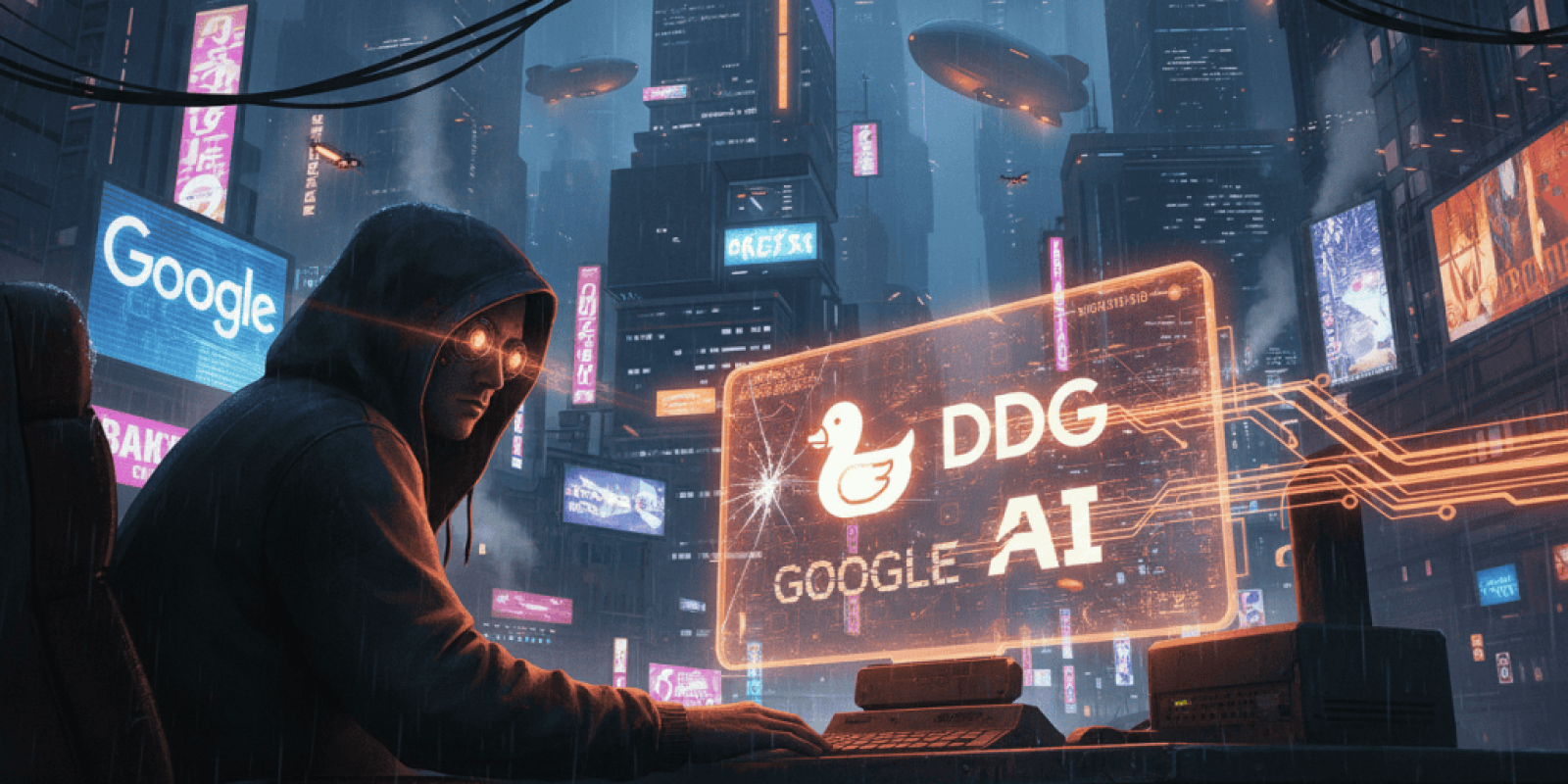
DuckDuckGo Installs Spike as Google Moves to Replace Search With AI: What Cyberpunk Culture and Industry Stand to Gain
A late night feed fills with screenshots of one search engine refusing to summarize the world for you. A new wave of installs follows, not because the interface is flashier, but because the machine that decides what is visible just got less trusted.
A mainstream read of the moment is simple: users unhappy with Google being more prescriptive about answers are trying alternatives. That explains the immediate bump in DuckDuckGo downloads and traffic, and it is the headline most outlets will run with. The overlooked story, and the one that matters to cyberpunk creators and companies, is that this is cultural signal as much as it is product churn; the choice of search is now a political and aesthetic move about how knowledge, agency, and visibility are mediated in a post-AI public square.
Why cyberpunk scenes care when a search box changes behavior
Search is not neutral for communities that trade in counterfactuals and marginal narratives. When an algorithm summarizes a thread, it decides which voices become legible and which become noise. Cyberpunk writers, archivists, and indie studios rely on such legibility to surface obscure transcripts, subcultural zines, and ephemeral art. The sudden migration toward an AI-free search experience is therefore a cultural defense as much as a UX preference.
The instant reaction: numbers, timing, and what they reveal
DuckDuckGo reported that U.S. app installs jumped roughly 30 percent in the week after Google pushed a major AI overhaul, with a peak day showing a 30.5 percent increase. That single headline number captures the immediate consumer rejection of a forced AI-first search path. (techcrunch.com)
Visits to DuckDuckGo’s AI-free page rose dramatically in the same period, with week over week increases to the no-AI endpoint peaking at around 27.7 percent and average app installs in the U.S. up 18.1 percent in one measured week. That pattern looks like a targeted flight to a different search modality rather than a diffuse, global migration. (pcgamer.com)
Google’s I O presentation framed the change as the biggest upgrade to Search in more than 25 years, a marketing-safe way to explain why generative overviews will now sit atop many queries. The timing of DuckDuckGo’s surge aligns tightly with those announcements, which many users complained came without an easy opt out. (9to5mac.com)
Competitors and the shifting terrain of discovery
Bing, independent search engines, and hybrid tools now jockey to attract users who want alternatives. DuckDuckGo has leaned into framing itself as a privacy-first, AI-optional option while offering its own private chat tools that connect to third-party models. The market is suddenly bifurcating into platforms that presume user consent to AI summarization and platforms that treat summarization as an opt-in feature. (engadget.com)
The cost nobody is calculating for indie creators
For independent studios and cyberpunk publishers, discoverability changes fast. If AI overviews reduce clickthrough to niche sites by consolidating answers on a single page, the long tail of small creators loses traffic and ad revenue. Creators who earn revenue from page views could see traffic fall by a measurable percent within weeks if AI overviews are prioritized for high level queries; revenue models built on microtransactions and patronage will need to adjust. The math is mundane and unforgiving: a site that gets 10,000 visits a month and monetizes at $5 per 1,000 pageviews would lose roughly $50 for every 1,000 visits AI overviews siphon away, which scales quickly for small teams. The audience erosion is a distribution problem, not a creative one.
How the core story affects cyberpunk businesses with 5 to 50 employees
Small studios that produce content, run niche communities, or sell cyberpunk merchandise must decide whether to follow users or push visibility through other channels. Consider a 12-person design and narrative studio that relies on organic search for 40 percent of monthly leads. If search driven leads drop by only 10 percent, and the average lead converts at $2,000 lifetime value, the studio could lose the equivalent of one sale every two months. Changing search defaults for a team of this size takes minutes per device but the marketing work to replace lost discovery could require a part time hire at $30 to $50 per hour for several months. Practical moves include configuring browser defaults to trusted alternatives, registering and optimizing content for AI-friendly snippets, and investing in platform diversification now rather than later.
The cultural hardware question: what counts as “authentic” visibility
Cyberpunk aesthetics prize marginal archives, glitch art, and unauthorized reuse. AI-overview centric search pushes canonical answers front and center, making the maintenance of subcultural archives a curator’s problem. This is an opportunity for small teams to build indexable repositories and metadata schemes that play to both human researchers and model consumption patterns. Building that infrastructure costs time but strengthens cultural resilience. Also, saying no to an AI-generated answer is a choice that signals values, which can be monetized into brand identity if done genuinely and not just as marketing theater. A lot of firms sell authenticity; few have the receipts to back it up.
For communities built around the margins, the move away from an AI-first search is a defense of playable space rather than a nostalgia trip.
Risks and open questions that stress test the hype
The spike in installs may be short lived if Google adjusts the UI or adds a clear opt out. Market share and default relationships with browsers and device manufacturers still favor incumbents, which could blunt long-term displacement. The quality of alternative search results is uneven and DuckDuckGo’s own AI product ecosystem raises questions about whether users are trading one set of model-mediated decisions for another. Regulatory pressure could reorder defaults, but regulations are slow and uneven across jurisdictions, leaving creators and small companies to manage discovery in real time.
Why small teams should watch this closely
Small teams can move faster than platforms. Changing a browser default across 30 devices is logistics, not strategy. Establishing content hooks that work whether results are human curated or model summarized is strategy, and that takes editorial rigor. Ignore discoverability at your peril, and yes, a single misplaced metadata tag is more dangerous than a plot hole in a noir novella. The immediate work is cheap; the lost market visibility later is not.
Practical next steps for cyberpunk professionals and firms
Audit where your traffic comes from and model a 5 to 20 percent hit to organic search over 6 months. Prioritize fixation of core pages and think beyond SEO to community and direct channels. Experiment with publishing formats that are model friendly such as structured FAQs and canonical Q A pages while preserving an archival layer for human readers. Test DuckDuckGo and other alternatives internally, and document the differences; if nothing else, the internal memo will be a good read at the next creative meeting.
A forward-looking close
This moment is less about a single product gap and more about a redistribution of cultural authority over what is visible online; cyberpunk culture is both vulnerable and unusually well positioned to respond because it already designs for opacity, graft, and alternative archives.
Key Takeaways
- A sharp increase in DuckDuckGo installs followed Google’s AI-first Search announcements, indicating a user backlash captured by alternative search adoption. (techcrunch.com)
- Cyberpunk communities treat search modality as cultural infrastructure, not a neutral utility.
- Small firms should model modest but material drops in organic discovery and invest in direct channels and metadata that survive both human and model reading.
- The spike is an early warning, not a guaranteed migration; platform fixes and defaults still favor incumbents. (pcgamer.com)
Frequently Asked Questions
How big was the DuckDuckGo install spike after Google’s AI changes?
Reports show installs rose sharply in the immediate week after Google’s announcements, with a peak single day increase commonly reported around 30 percent in the U.S. Different outlets measured different windows, but the pattern was clear. (techcrunch.com)
Should a 10 person cyberpunk studio switch browser defaults for everyone?
Switching defaults is low friction and worth doing for experimentation and staff preference. The bigger task is addressing discoverability by diversifying channels and optimizing critical pages for both human readers and model summaries.
Will this change help independent creators find audiences?
Potentially, because niche search engines can resurface marginal content more readily than consolidated model overviews. However, creators must still optimize metadata and cultivate direct audience relationships to capture the benefit.
Is DuckDuckGo completely free of AI influence?
DuckDuckGo offers an AI-free search endpoint and also provides private AI chat tools that connect to third-party models, so the distinction is nuanced; users can choose AI or non-AI experiences depending on the product path. (engadget.com)
What immediate technical steps should a small company take?
Audit traffic sources, set browser and device defaults where appropriate, and create structured content that answers common queries directly. These measures are cheap and can blunt early revenue loss from discovery shifts.
Related Coverage
Readers interested in how discovery shapes subculture should explore how content moderation filters affect archive management and how local LLM deployment changes edge compute economics. Also consider deep dives into model attribution and the copyright challenges that arise when generative systems summarize creative work; each of those topics connects directly to the visibility risks described here.
SOURCES: https://techcrunch.com/2026/05/26/duckduckgo-installs-are-up-30-as-users-reject-being-force-fed-googles-ai-search/, https://www.pcgamer.com/hardware/duckduckgos-ai-free-search-saw-nearly-28-percent-more-visits-in-the-week-following-googles-insistence-that-people-love-ai-mode/, https://www.tomsguide.com/ai/google-is-force-feeding-ai-with-no-way-to-opt-duckduckgo-ceo-says-installs-are-surging-after-google-i-o, https://9to5mac.com/2026/05/26/duckduckgo-sees-iphone-installs-spike-in-the-us-following-ai-announcements-at-google-i-o/, https://www.engadget.com/2181849/duckduckgo-installs-surge-after-google-ai-search/