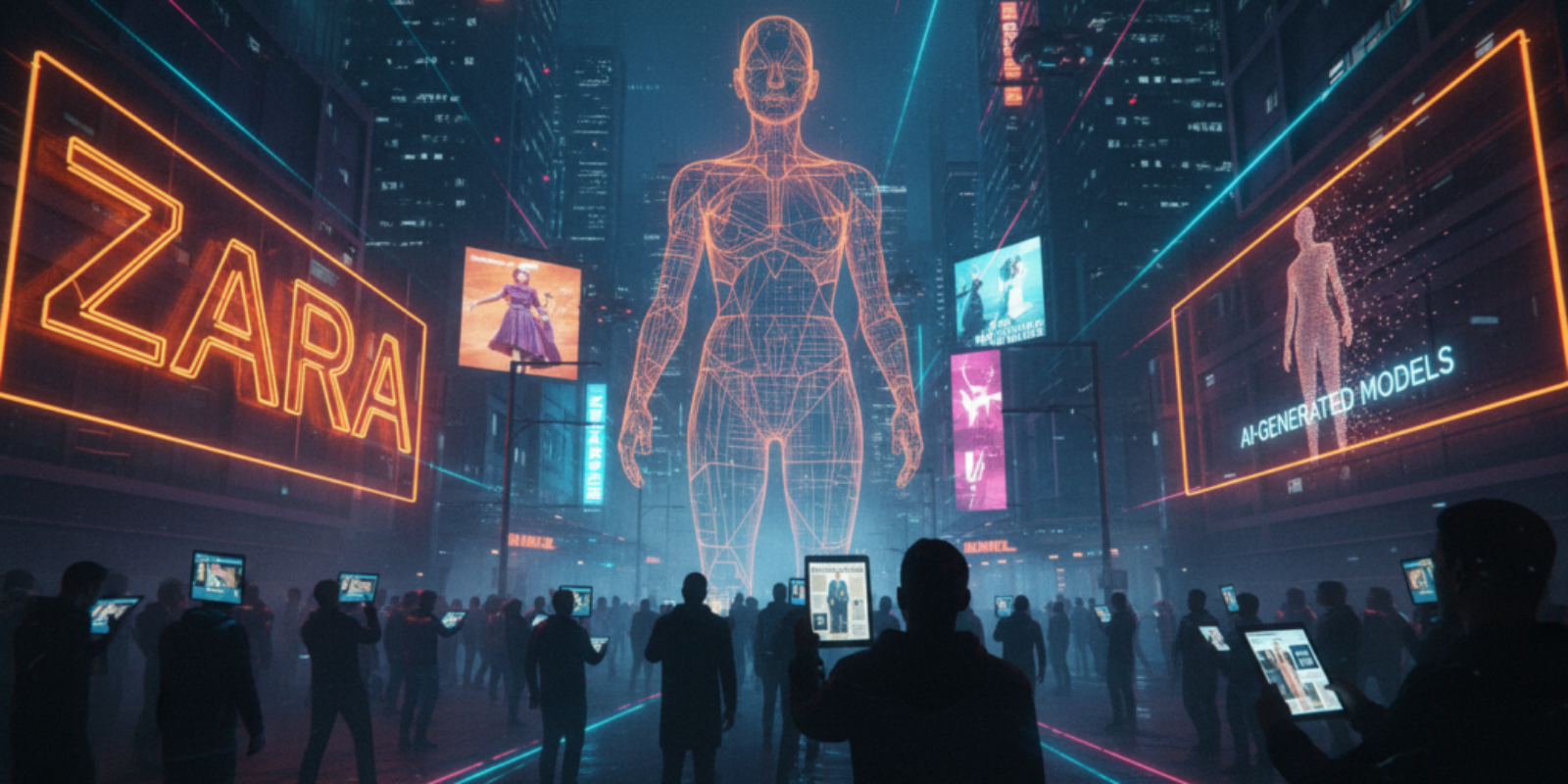
Zara Experiments With AI-Generated Model Images
A quiet studio in A Coruña becomes a repeatable asset: one shoot, dozens of looks, no flights, no set calls, and a shrinking invoice for everyone who used to show up in person.
A photographer in Madrid opens an email that reads like a gentle demand for modern efficiency: would the agency allow Zara to reuse last season’s images and digitally dress the same faces in new garments? The moment is small and contractual, but it carries an industry-sized shock wave for production teams and the companies that build the tooling behind them. The obvious reading is operational: faster content, fewer shoots, lower cost. The risk-tilted reading that actually matters for AI businesses is different and deeper. It is not only about replacing a photoshoot; it is about converting a one-time human data capture into a perpetual synthetic asset that pays for its development many times over.
The retail press first reported that Zara has begun using AI to edit photographs of real models so the same base images can show multiple outfits and settings, with models asked for permission and reportedly paid standard fees. (cityam.com) This move sits squarely beside earlier campaigns from rivals that built “digital twins” and large-scale AI image pipelines. (businessoffashion.com)
Why the fashion industry is suddenly the fastest place for applied generative AI
Fast fashion runs on speed and inventory turns. When a company can swap a garment on a photographed body in hours instead of scheduling a new shoot and airline tickets, marketing calendars compress and margin math improves. The technical challenge is straightforward for modern generative pipelines: isolate the subject, preserve facial and body geometry, map new garments convincingly, and composite a believable background. The commercial payoff is not a fancy demo; it is the ability to update localized catalogs for dozens of markets with near-zero incremental shoot cost.
European retailers have already shown what this looks like at scale. Zalando and H&M publicly described programs to create reusable AI representations of models and use those assets across digital channels. (businessoffashion.com)
How Zara’s approach differs from making fully synthetic models
Zara appears to be leaning into a hybrid method: start with real-model captures then use AI to redress and relight those captures rather than inventing entirely new synthetic faces from scratch. This preserves human authenticity while turning each shoot into a lasting data product. That distinction matters commercially because it reduces friction in talent negotiations and helps brands stay on the right side of likeness and regulatory risk.
The numbers owners and engineers should be watching
An industry source reported that content-production cycles that once took weeks can shrink to days when AI is used to generate multiple variants from the same base images. The headline efficiency claim for competitors has been production time dropping from around 6 to 8 weeks to three to four days, and content-production costs falling by a reported order of magnitude in some cases. (businessoffashion.com) Those are not magic numbers for every workflow, but they do illustrate the scale of potential savings for retailers who run thousands of SKUs.
The engineering product: turning a photoshoot into a perpetual model
The underlying product looks like this: a multi-angle capture of a model plus metadata, a cloth-simulation or texture-mapping engine, generative image or 3D rendering that applies garments to body geometry, and a content management layer that produces localized variants. When built well, it becomes an internal API that product teams call to render galleries, social assets, or store displays. The architecture is familiar to engineers who have built content-as-service platforms, but it depends on a new cost center: high-quality labeled captures that eventually amortize across seasons and regions.
AI converts ephemeral creative labor into replicable digital capital that a company can deploy without repeating the same human input.
Practical math for a typical retailer rollout
For a mid-sized retailer that shoots 1,000 catalog images per season, average shoot cost might be 200 to 400 per image including crew and location. If an AI pipeline reduces repeat shoots by 70 percent, the immediate savings are in the hundreds of thousands to low millions per year. Add faster A/B testing and localized variants that increase conversion rates by a few points, and the ROI moves from hypothetical to boardroom-grade. The caveat is software and compute costs, which include cloud GPU hours, model fine-tuning, and quality assurance; these are nontrivial but increasingly predictable.
Why vendors and AI builders should pay attention now
The customer here is not only a CMO chasing creative volume. It is a digital commerce team that values throughput and predictable visual consistency. Vendors who package robust rights-management, audit trails, and per-asset provenance will win early contracts. Fashion brands and agencies are already wary of reputational risk; tools that make consent auditable and reversible are table stakes if this becomes mainstream.
The cost nobody is calculating for model marketplaces
If brands convert a single shoot into a perpetual royalty-bearing asset, the downstream market for freelancing gigs shrinks. Photographers, stylists, and production crews will see fewer repeat bookings, and model agencies face a new revenue negotiation where a single license may replace serial hire. The social and economic consequences are real and already being discussed in press coverage focused on talent impacts. (latimes.com)
Risks, regulatory gaps, and the credibility of images
Generative edits complicate truth in advertising and regulatory compliance. Ad watchdogs have already acted against problematic images for unrelated reasons; composited or altered images invite new scrutiny. Without rigorous provenance, brands risk consumer trust and regulatory intervention. Creative teams also risk brand dilution if algorithmic outputs drift into uncanny valleys or regional missteps that human art direction would have caught.
Why small AI teams should watch this closely
Small teams can build the safety and rights-management features that big platforms will later commoditize. A compact product that bundles consent workflows, per-asset audit logs, and cost forecasting for cloud rendering will solve painful operational problems for retailers. There is a second-order market for stitched services: model capture studios that produce pre-validated training sets, and verification firms that certify outputs for compliance.
Forward-looking close
Zara’s quiet shift from reshoots to reusable visual assets shows how generative models move from novelty to infrastructure by changing who gets paid, how creative work is scheduled, and which companies capture long-term value from human likenesses. For the AI industry, the conversation should pivot from whether this can be done to how it will be governed, priced, and integrated into commerce systems.
Key Takeaways
- Zara’s move converts one model photoshoot into a durable digital asset that can be redressed and reused across campaigns, dramatically lowering per-variant cost.
- Vendors that deliver consent, provenance, and predictable rendering costs will control the early market for retail AI imagery.
- The efficiency gains are real, but so are social and marketplace consequences for photographers and freelancers who depend on repeat shoots.
- Regulation and brand risk management are now product requirements, not optional extras, for teams building generative-image platforms.
Frequently Asked Questions
How does Zara’s use of AI affect my ecommerce conversion rates?
AI allows more localized and varied imagery, which can increase click-through rates by serving visuals that are culturally or seasonally relevant. The conversion improvement depends on test design, but retailers that deploy targeted creative tend to see measurable uplifts.
Can brands legally reuse a model’s image to create new AI-edited photos?
Yes if the brand obtains explicit consent and specifies usage rights in the contract, including clauses about derivative works and duration. Ambiguities in contracts are the most common legal exposure for brands and talent agencies.
Will this technology make photographers and stylists obsolete?
Not immediately. Early wins are in volume-driven catalogue work where uniformity matters more than high-concept direction. Creative shoots for campaigns will still need humans, but the volume of commissioned shoots could fall, shifting job composition.
What should an AI vendor include to win retailer business today?
Include clear consent workflows, per-asset provenance logs, cost-estimation tools for rendering, and a human-in-the-loop quality gate. Retail customers prize auditability and predictable unit economics.
How quickly should a small brand adopt similar tooling?
Start with pilot projects focused on evergreen SKUs where the ROI from fewer reshoots is highest. Build integrations to your CMS and catalog systems first; add advanced draping and localization as the model proves out.
Related Coverage
Readers who want to go deeper should examine how Zalando and H&M have operationalized digital twins and what that meant for campaign cadence and creative staffing. Exploring tools for model provenance and consent workflows will clarify what product features matter in the coming year. Finally, coverage of ad-regulatory decisions offers a practical view of how compliance shapes creative choices.
SOURCES: https://www.cityam.com/zara-turns-to-ai-edited-models-amid-shop-closures/, https://www.heise.de/en/news/AI-images-instead-of-fashion-photography-11125848.html, https://www.businessoffashion.com/news/technology/zalando-generative-ai-imagery-digital-twin-models//, https://www.latimes.com/business/story/2025-08-25/fashion-models-reckon-with-guess-ai-model-in-vogue-and-digital-clones, https://petapixel.com/2025/07/08/hm-unveils-ai-generated-models-that-wont-replace-photography/