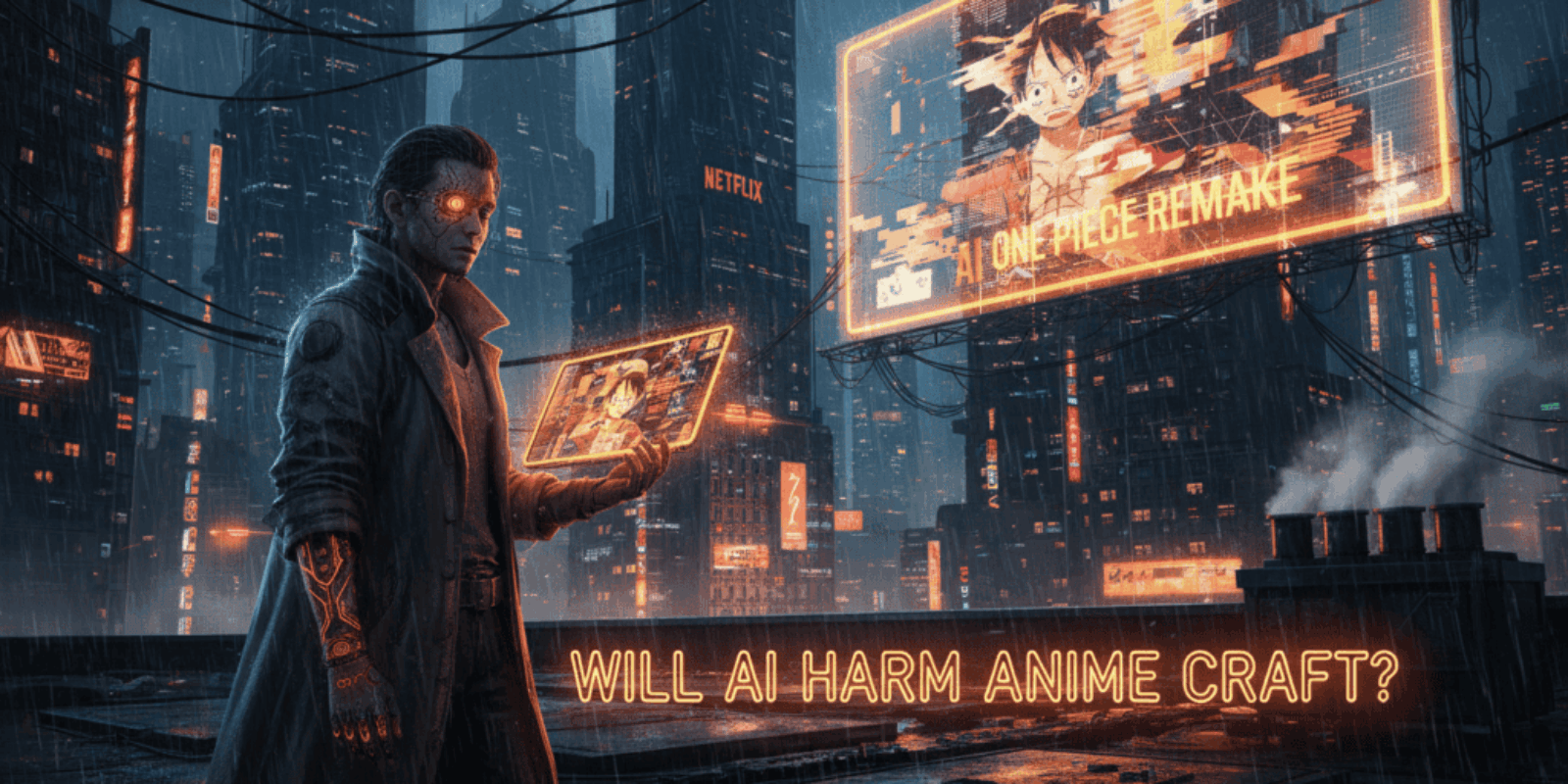
When the One Piece Remake’s Studio Admits to Using Generative AI, the AI Industry Loses Its Quiet Test Case
WIT Studio’s April admission that generative AI was used in a recent opening sequence reverberates far beyond anime fandom; it is a live experiment in how creative AI will be regulated, outsourced, and monetized across media supply chains.
A fan notices a background that looks slightly off: too photoreal, too repetitive, a texture that repeats like a coughing chorus line. A social post calls it out, a thread goes viral, and three days later the studio posts an apology and a pledge to redraw and replace the shot. That small, visible mistake is the moment theory hits production reality and investors, unions, and lawyers all squint at the same spreadsheet. The obvious reading is this is a fandom fight about purity of hand drawn work; the overlooked, and more consequential, angle is how this admission functions as one of the clearest, public tests of responsibility for generative models inside mainstream content pipelines. WIT Studio’s statement shows that the era of secret, internal AI experiments is over, and industry governance will have to catch up fast. (witstudio.co.jp)
Why one apology matters to the entire AI sector
Studios have been experimenting with assistive AI for years, but WIT’s April 10, 2026 notice made the technical visible and the organizational accountable. The statement confirmed generative AI created background assets for cuts in an opening sequence and that the studio will replace those backgrounds starting with Episode 2. That admission converts a private production choice into a public case study on audit trails, provenance, and liability. (witstudio.co.jp)
What competitors and vendors are watching right now
Netflix’s own experiments with AI-assisted background generation in short projects showed how large platforms view the tech as an efficiency lever rather than a novelty. That collaboration, which credited AI plus human touch in background work, signaled an industry willingness to pair internal studios with AI vendors for rapid iteration. Players such as Preferred Networks in Japan and U.S. model vendors are watching studios like WIT and Toei for hard outcomes that validate or kill deals. (futurism.com)
The wider Japanese studio reaction and the investment angle
Toei Animation’s recent financial disclosures and moves into AI partnerships have already leaked into public debate, including investments tied to Preferred Networks and stated plans to apply AI across storyboarding, in-betweening, and background generation. These moves make the WIT case far from isolated; Japanese incumbents are publicly positioning AI as a structural response to long standing labor shortages and production bottlenecks. That positioning attracts vendors and investors while inviting scrutiny from creative labor advocates. (dexerto.com)
The consumer reaction that forces corporate choices
Fan communities have turned corporate AI experiments into reputational risk in under an afternoon. Coverage framed WIT’s change as both a concession and a signal that surveillance of deliverables now happens at consumer scale. This is not merely about aesthetics; it touches subscription retention curves, licensing deals, and how streaming platforms disclose AI usage to partners and customers. A viral complaint can accelerate a correction that would otherwise take months of internal review. (gamerant.com)
WIT’s short public inventory of error did something models never manage: it created a traceable, dated example of where machine assistance crossed an industry red line.
The core story with names, dates and what actually happened
On April 10, 2026 WIT Studio published a notice acknowledging that a generative AI produced background materials for some cuts in the Episode 1 opening of Ascendance of a Bookworm, and that the studio would redraw and replace the affected footage from Episode 2 onward. The studio also emphasized that, beyond the identified cuts, it has not confirmed other AI use in that work and promised tighter management checks. The admission follows earlier industry experiments such as Netflix’s 2023 short that explicitly used AI for backgrounds, which set a precedent that major streamers would treat AI as an experimental production tool. (witstudio.co.jp)
Practical implications for businesses and the math they should run
A quick scenario helps. Assume a 24 minute episode has 6 notable background scenes that each require 1200 pixels worth of hand paint time totaling 20 hours of artist work per scene at an effective fully loaded cost of 40 USD per hour. Replacing those six scenes by human artists costs roughly 9,600 USD per episode. If an AI pipeline trims human time by 75 percent on background tasks, the episode-level saving is about 7,200 USD. Multiply that by a 12 episode season and the studio saves roughly 86,400 USD. That is real money for mid tier productions, and accounts for why licensers and platforms push pilots. The trade off is the cost of governance: auditing data provenance, legal clearance for model training data, and potential remediation when AI output uses unlicensed styles or imagery. Those compliance costs can easily eat 10 to 30 percent of the projected savings in the first year, depending on legal exposure. No one likes doing spreadsheets with moral line items, until a rights suit redraws the balance sheet. (Also tell the interns they will not be replaced by “friendly ghosts from a server farm.”)
The cost nobody is calculating and where AI vendors fit
Vendors sell throughput gains and demo reels, but most do not price long tail risk: indemnities, forensic logging, and human-in-the-loop review. Buyers who assume a flat cost decline miss an embedded expense: convincing global licensors and creators that the output does not appropriate protected works. That friction slows adoption or forces more expensive proprietary training datasets. In short, there is a hidden compliance tax that will be a major revenue opportunity for model auditors, metadata provenance platforms, and legal insurers. Financial teams should model a conservative sensitivity that adds 15 to 25 percent to total AI onboarding cost for the first two to three projects. The accountants will celebrate once the insurers approve the forms. Then the lawyers will celebrate when the insurers deny the claims. Very efficient cycle.
Risks, unresolved questions and stress-testing the claim
Key open questions remain: who supplied the model, what datasets trained it, who commissioned the asset, and who inspected deliverables before release. A studio-level apology does not answer whether the AI asset was an explicit choice or an outsourced contractor shortcut. It also leaves unanswered whether studios will adopt standardized labels for AI-assisted assets. Without mandatory provenance metadata, audits are slow and expensive. Finally, legal regimes in different markets treat generative output differently; a practice acceptable in one country may constitute infringement in another. Those regulatory arbitrage opportunities are brief windows and will be closed quickly once a major litigation sets precedent. (witstudio.co.jp)
What should product teams and AI vendors do now
AI vendors must bake provenance and log export into their product, and studios must require signed attestations from subcontractors. Licensing teams should negotiate IP safe harbors or confirm licensed datasets. Tech leads should instrument models to produce an immutable manifest for every generated asset. Negotiating these terms up front costs less than litigating them after a viral takedown. The pragmatic firms will do the boring work now and get the bragging rights later.
Where this leads in the near future
WIT’s admission reframes the conversation from hypothetical ethics to operational discipline. Expect more public notices, more contractual clauses about AI provenance, and a small market for “AI use disclosure” certifications appearing in quarterly filings. Studios will not abandon AI, but they will professionalize its use, and the vendors who help them do that will capture the long tail of compliance revenue.
Key Takeaways
- Studios are publicly admitting limited generative AI use and pledging redress, turning experiments into governance problems.
- Short term savings from AI background work can be meaningful, but compliance and provenance costs reduce net benefits.
- The commercial opportunity is shifting toward auditing, provenance, and insurance for AI-generated media.
- Public blowups accelerate policy adoption faster than quiet pilots ever could.
Frequently Asked Questions
Will using AI in backgrounds get a show cancelled?
Not by itself. Most platforms treat limited AI use as operational choice, but reputational and licensing fallout can delay releases or force rework if provenance is unclear. Contracts and clear disclosure reduce cancellation risk.
How much money can a studio realistically save by replacing some background work with AI?
Savings vary by scale, but a mid production could save thousands of dollars per episode on background art alone before accounting for compliance. Add auditing and legal checks, and net savings fall; model a conservative 50 percent of the headline operational gains for budgeting.
Do creators lose royalties when AI is used?
Royalty mechanics depend on contracts. If models were trained on licensed creator work, legal claims could seek compensation. Clear contractual language now about AI use and training datasets prevents future disputes.
Should investors view studio AI admissions as a red flag?
Not automatically. Admissions indicate operational transparency, which is healthier than hidden practices. Investors should pressure studios to document provenance and risk mitigation rather than demand an immediate ban.
What must AI vendors change to work with major studios?
Vendors need immutable logging, dataset provenance, and contractable indemnities or licensed datasets. Without those, studios will either build in-house capabilities or avoid the tech for high risk assets.
Related Coverage
Readers interested in the intersection of creative labor and AI should follow policy debates about model training data, coverage of studio-level AI investments, and evolving insurance products for AI-produced creative works. The AI Era News will continue tracking how provenance standards and licensing tools shift budget lines in media.
SOURCES: https://www.witstudio.co.jp/news/2026/04/1709.html, https://futurism.com/the-byte/netflix-ai-replace-human-animators, https://www.dexerto.com/tv-movies/toei-animation-ai-one-piece-controversy-explained-3197248/, https://gamerant.com/one-piece-toei-studio-confirms-ai-use-in-anime/, https://www.cbr.com/toei-animation-anime-ai-production/