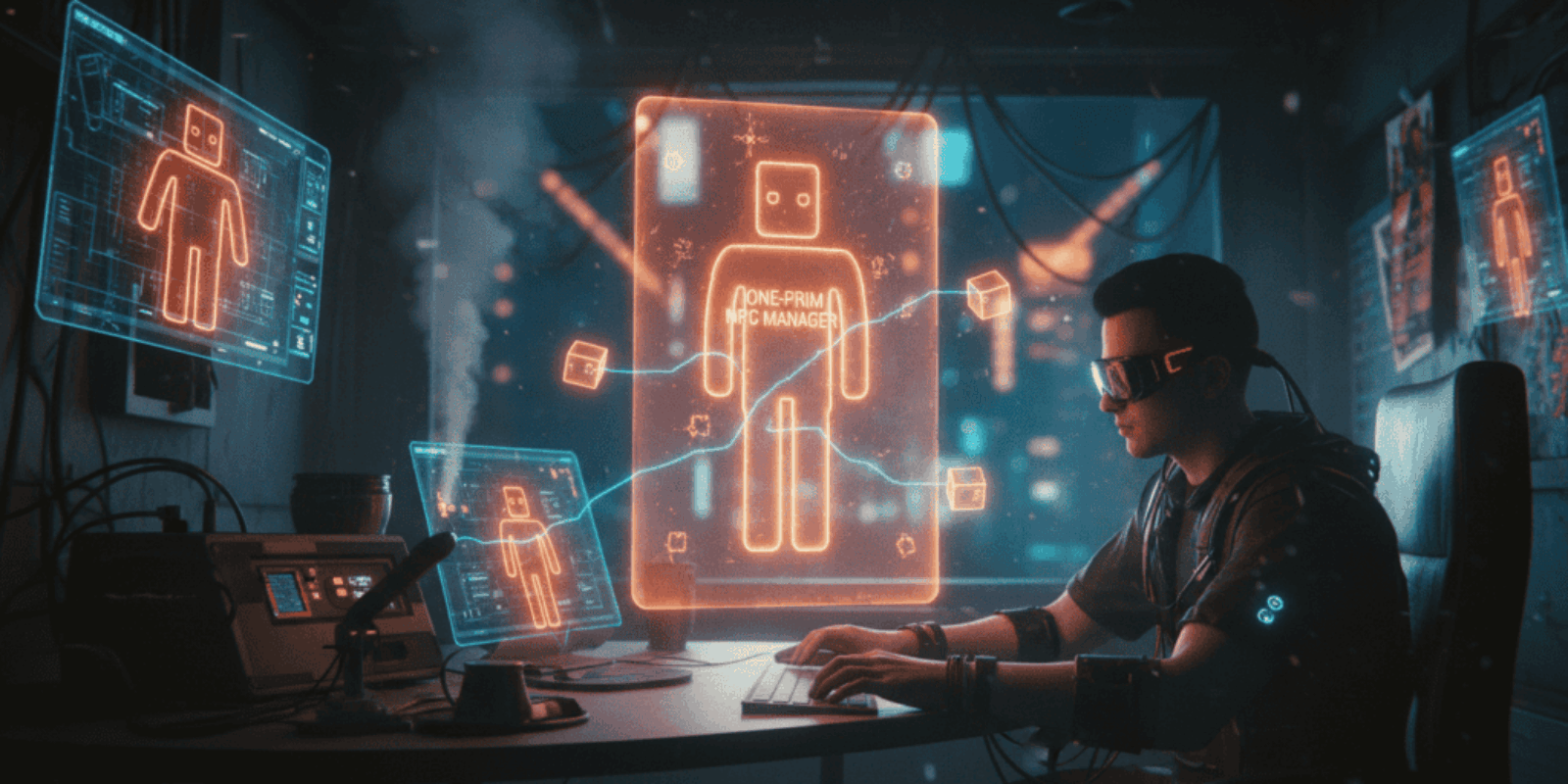
OpenSim builders get a one-prim NPC manager that solves a long-standing cleanup problem
A deceptively small tool is changing how community grids populate regions, removing scripting headaches and orphaned bots while lowering the technical bar for immersive spaces.
A visitor touches a single linked cube and, within seconds, a gallery of ready-to-use NPCs appears, each one a compact snapshot of an avatar’s appearance and pose. The scene looks ordinary until one remembers how many hours and fragile scripts used to follow every NPC into oblivion, like digital socks in a dryer that never came back.
Most readers will take this as a tidy quality-of-life improvement for hobbyist builders and role-play regions, a useful convenience that trims fiddly work. The subtler business consequence is that a one-prim, owner-only NPC manager turns NPCs from expensive bespoke features into low-friction products that small grid operators can deploy at scale without hiring a senior scripter. (hypergridbusiness.com)
Why builders cheered an apparently small tool
The IMAGE-NPC Machine, released in mid April 2026 by creators active on the OpenSim community sites, packages avatar snapshots into notecards, previews NPCs from a library, and cycles animations for posing all from a single linkset. That consolidation replaces a multistep workflow that previously required multiple scripts and manual cleanup. (hypergridbusiness.com)
The release went live through community channels and the project’s download page, where builders can grab the machine and its assembler script. The practical result is less time spent debugging orphaned scripts and more time arranging who gets to be the slightly judgmental shopkeeper. (opensimworld.com)
The orphan problem finally gets a leash
Older NPC toolkits often spawned bots via child-prim scripts that depended on permission exchanges and multi-script handoffs. When a script failed or lost state, NPCs could be left stranded in a region with no owner or control, forcing grid admins to manually remove them. The new approach leans on OSSL level server functions to create and manage NPCs from a single root prim, avoiding the permission handshakes that historically caused orphans. That change is small in code but large in operational stability for long-running grids. (opensimulator.dev)
Why now matters for the metaverse industry
OpenSimulator has slowly carved out a niche as the low-cost, open alternative to more commercial virtual worlds. The platform’s advantage has been flexibility, but that came with a technical threshold. Tools that remove that threshold change the product calculus for grid owners, educators, and small studios. If deploying believable inhabitants is now a matter of a few touches rather than a hiring decision, product roadmaps and budgets shift quickly. (hypergridbusiness.com)
What the tool actually does for projects with 5 to 50 employees
A five-person educational startup running a private OpenSim grid can now staff creative work separately from scripting tasks. Assume a developer charges 40 dollars an hour for scripting work and that creating and testing a multi-script NPC system previously took 12 hours for a single deploy. Converting that work into a one-prim workflow drops that to about one hour of setup and testing, saving roughly 440 dollars per NPC deployment. Multiply by 10 NPCs and the project saves 4,400 dollars that can be reallocated to content or moderation. That is the kind of arithmetic that makes small teams choose one platform over another.
For a 50-person experiential studio running multiple regions, the operational gains compound. Reduced cleanup means fewer region restarts, lower support tickets, and less time lost by builders tracking down orphans. That time translates into measurable productivity gains measured in billable hours and faster time to market for events and exhibits. (Yes, this assumes one likes saving time; many builders emotionally prefer to suffer through their own scripting mistakes, which is a hobby and not a recommended business model.)
A single trusted linkset that handles NPC creation and cleanup changes NPCs from an ongoing operational headache into an ordinary deployable asset.
How the IMAGE framework links to AI-driven NPC work
The IMAGE-NPC Machine is part of a broader IMAGE framework that includes iMinstrel, a command-and-control layer that can be connected to local AI models for conversational behavior. That matters because recent community projects have shown it is technically feasible to give NPCs environment awareness and chat integration without centralized cloud dependencies. Combining a simple deployment surface with modular AI back ends lowers both the technical and privacy barriers for institutions that want interactive tutors or guided exhibits. (hypergridbusiness.com)
Where this sits in the existing tooling ecosystem
The OpenSim ecosystem already hosts dozens of NPC utilities and manager scripts in public libraries, from pose dancers to chatbot adapters. The addition of an owner-only, one-prim manager does not render prior work obsolete; instead it standardizes the simplest case and lets more advanced modules focus on behavior rather than housekeeping. That specialization is healthy for an open community that values composability. (outworldz.com)
Risks and open questions that will determine real impact
Scaling remains the core technical wild card. Server-side limits like script memory and event throughput still cap how many conversational NPCs can run concurrently. Integrating AI adds recurring costs and latency considerations, and different grids will choose different tradeoffs between local models and cloud providers. There is also a governance angle: easier NPC deployment raises moderation and identity questions that grid operators must answer with policies and tooling rather than optimism. (opensimulator.dev)
Why platform incumbents should watch this quietly
Commercial metaverse platforms are not likely to copy a one-prim trick directly, but they will watch outcomes. If open-source grids prove that inexpensive, well-behaved NPCs materially increase session length, commerce, or educational outcomes, that is a product signal vendors cannot ignore. For now the advantage sits with nimble grid operators who can iterate in public. One suspects the incumbents will borrow the idea, slightly polishing it until the community sighs with mixed feelings and admiration.
Practical forward-looking close
For small and mid-size virtual world operators, the IMAGE-NPC Machine is a pragmatic tool that converts a recurring technical nuisance into a routine content task; the resulting productivity and reliability gains are the sort of improvements that quietly change vendor choice.
Key Takeaways
- The IMAGE-NPC Machine turns NPC deployment into a single-owner, one-prim workflow that eliminates common orphan bot issues while simplifying setup.
- Small teams can save hundreds to thousands of dollars in scripting labor by converting multi-script NPC deployments into a one-prim assembly.
- The tool pairs with modular AI frameworks to make conversational NPCs feasible without centralized cloud dependency.
- Operational risks remain around scaling, moderation, and AI costs, so measurement and staged rollouts are essential.
Frequently Asked Questions
How quickly can a small team deploy NPCs with this tool?
Deployment is built to be fast: builders rez a small linkset, insert the assembler script, and touch once to initialize. With basic animations added, preparing a new NPC appearance can take minutes rather than hours.
Does this remove the need for scripters on my team?
No. Advanced behaviors, multi-NPC coordination, and AI integrations still require experienced developers. The tool reduces repetitive setup work but does not replace behavior programming.
Will this work across the Hypergrid and different OpenSim versions?
The release targets OpenSim 0.9.x and is designed for owner-only use; cross-grid behavior depends on region and grid configuration. Grid operators should test in staging regions before wide rollout.
Are there privacy or cost implications for using AI with these NPCs?
Connecting NPCs to AI introduces recurring compute and potentially API costs plus data handling obligations. Local model options reduce exposure but require more server resources. Budget and privacy choices should align with organizational policy.
Can educators use this for classroom simulations without heavy tech support?
Yes. The simplified setup lowers the technical bar, letting educators focus on scenarios and pedagogy. Still, initial integration and moderation planning are advisable for live classes.
Related Coverage
Readers interested in the operational side of community metaverse platforms should explore reporting on AI-driven NPC frameworks and how hypergrid interoperability affects content portability. Coverage of small grid economics and open-source toolchains will help teams plan deployment and staffing decisions for immersive projects.
SOURCES: https://www.hypergridbusiness.com/2026/04/opensim-builders-get-new-one-prim-npc-manager-no-scripts-no-orphans/, https://opensimworld.com/service/downloads/, https://opensimulator.dev/wiki/NPC, https://www.hypergridbusiness.com/2025/12/new-ai-driven-npcs-can-see-navigate-and-chat/, https://outworldz.com/lib/