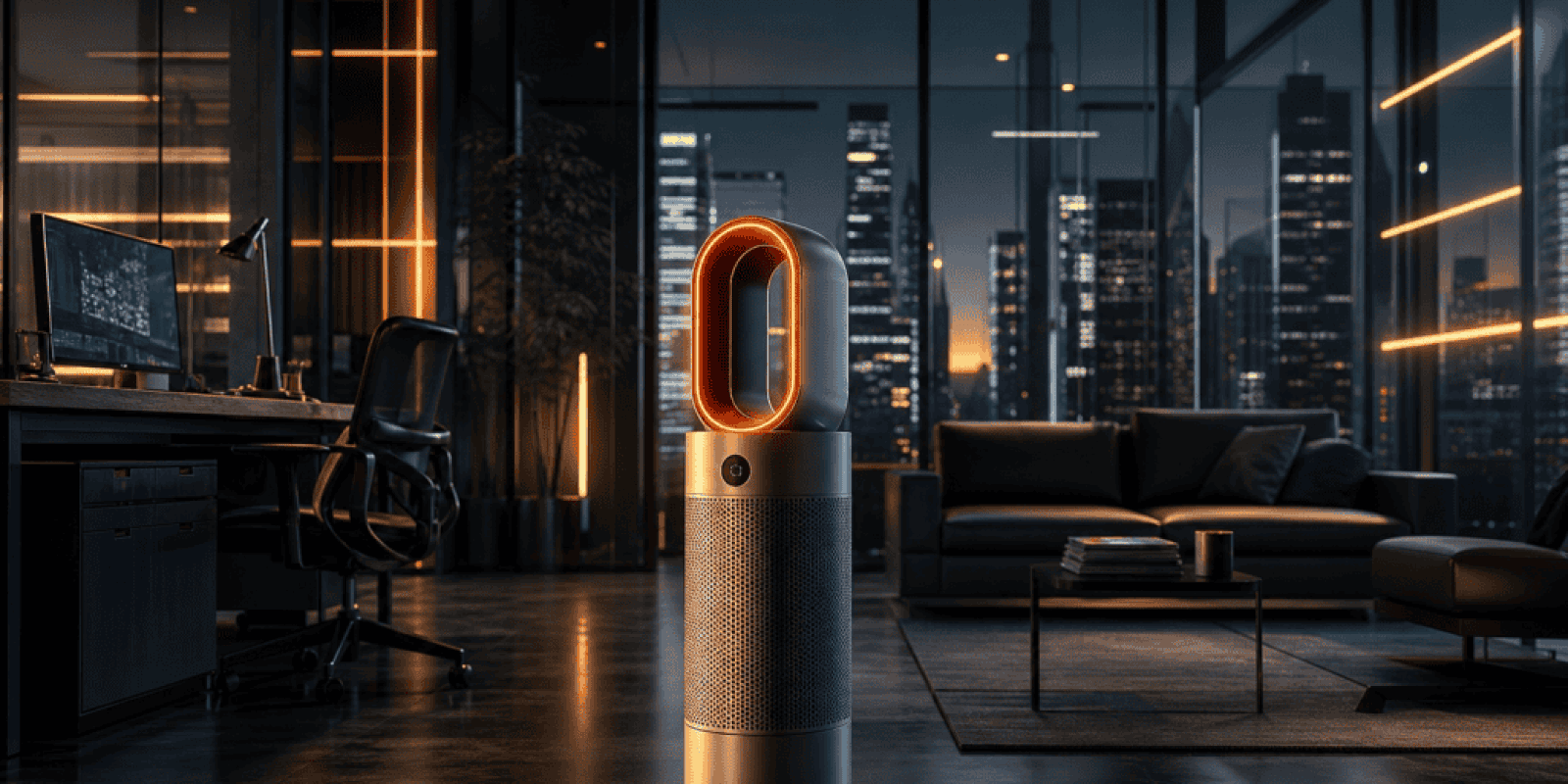
Dyson’s purifier follows you around the room and the AI industry notices
A bladeless fan tracks a person, redirects purified airflow, and raises questions about where sensing ends and surveillance begins.
A living room in late afternoon: a family moves from couch to kitchen island, someone opens a window, a dog trots through. The new Dyson purifier registers changes, alters fan speed, and then redirects a focused stream of cool, filtered air to where a person just sat down. It feels uncanny because the device is doing something previously reserved for clumsy motorized phone stands and sci fi extras. According to Dyson’s product materials, the company leans on integrated sensors and algorithmic controls to sense and react to air quality and airflow needs. (dyson.com)
Most headlines treat this as incremental convenience. A purifier that targets occupants is a better fan and a smarter filter, the conventional reading goes. The sharper business story is less about cool air and more about what happens when consumer appliances add human-tracking as an off the shelf capability for edge AI teams and product managers. That single design choice forces firms to decide whether devices will be primarily assistive sensors or miniature surveillance platforms, and it reshapes procurement, edge compute roadmaps, and regulatory risk assessments in unexpected ways.
Why small shifts in home hardware matter to big AI teams
Smart appliances are proliferating faster than a firmware update, and each one is a new data source for models that want context. Competitors already ship movement-aware airflow systems that explicitly orient clean air to people in the room, and those product briefs show the same engineering pattern: fused sensors, on-device inference, and prioritization of low-latency control over cloud round trips. Dreame’s product blog describes a family of purifiers that use movement detection to steer airflow where people are sitting. That’s not a coincidence; it is the playbook. (homeair.dreametech.com)
For AI teams this means two strategic bets. One option is local-first intelligence where tiny models run on a microcontroller to decide where to point air. The alternative is cloud-assisted orchestration that aggregates sensor inputs across homes to create smarter models but increases privacy and compliance burdens. The product designers who pick the first route get faster response times and simpler data minimization; those who pick the latter get richer analytics but a larger legal bill and a more interesting class action. Sell your server credits or your lawyers, pick one.
The patent trail that explains how following you is technically solved
This is not just marketing spin. Years of patent filings show how airflow systems are engineered to orient toward occupants by using imagers or radar and then automatically controlling vanes or projection to follow a head or torso. Dyson and other manufacturers have described fan-driven devices that can change the direction of airflow in response to a detected user orientation. Those documents read like a recipe for occupant tracking as a control input rather than a privacy afterthought. (patents.google.com)
A broader class of patents goes further by modelling people as dynamic entities inside a simulated airflow field and then controlling HVAC or purification to limit pathogen spread or optimize comfort metrics. Those methods explicitly include capturing movement and behavior as inputs to control systems, which converts human motion into actionable telemetry for automated systems. That legal record matters because it maps capability to intent and thus to responsibility. (patents.justia.com)
What this looks like in the field
When the purifier detects someone moves across a room it can reduce overall runtime while maintaining perceived comfort by concentrating clean airflow. That raises the possibility that single units replace multiple devices, or conversely that homes install more sensors to achieve continuity across rooms. The engineering tradeoffs break down into compute, sensor cost, and data flow, and each choice has consequences for AI platform roadmaps and lifecycle support.
The device is not just a fan anymore; it is a tiny camera and a real-time decision engine with a taste for where humans prefer cool air.
The real math operations teams should do today
A simple scenario helps product and facilities managers run the numbers. Assume a purifier at max draws 70 watts and runs eight hours a day at full power, which is about 0.56 kilowatt-hours per day. If occupant-aware targeting reduces effective fan duty to the occupied zone equivalent of three hours a day at peak, daily consumption drops to 0.21 kilowatt-hours, saving 0.35 kilowatt-hours per day. At an electricity price of 20 cents per kilowatt-hour, that saves roughly 25 dollars per year per unit. Multiply by thousands of units across office leases and the operational savings become a procurement argument, not a lifestyle claim.
Those figures are illustrative and depend on occupancy patterns, device efficiency, and comfort tolerances, but they show why facilities teams will listen to engineers who can prove targeted airflow reduces energy and improves perceived air quality.
The cost nobody is calculating loudly enough
The hidden costs are not kilowatt-hours. They are firmware security, model updates, and privacy compliance. A movement-aware purifier that keeps heatmaps or video frames locally looks very different from one that uploads that data for analytics. If manufacturers choose cloud aggregation to improve models, they must budget for secure transmission, long-term storage, and regulatory processes that can trip up launches in Europe and parts of the United States. That budgeting is rarely in the same line item as manufacturing, yet it often determines whether features ship. Dry observation: product managers love feature lists and accounting hates surprise subpoenas.
Risks and governance pressure that will land on AI teams
These devices live in private spaces where people expect a baseline of privacy. Surveillance narratives scale quickly; civil society and press scrutiny will target devices that can plausibly be repurposed to track movement beyond thermal comfort. The broader surveillance ecosystem already captures movement more aggressively than most consumers appreciate, and that backdrop shapes how regulators and corporate counsel judge novel sensing features. Expect demands for opt-in defaults, on-device-only processing options, and clearer data deletion guarantees. (archive.vn)
Security risks are practical too. Any networked actuator is an attack surface. An adversary who can alter where a fan points can create noise, annoy occupants, or exploit sensor fusion to infer presence patterns for criminal reconnaissance. AI teams should treat firmware and model updates as high priority incident response vectors.
Where product and AI teams should focus next
Internalize three engineering priorities: build small trusted inference engines, adopt transparent consent surfaces in the device UI, and make telemetry deletable by default. Investment in explainability matters because compliance teams will ask for simple logs that show what decision the model made and why. The market will reward teams that make the privacy tradeoff explicit and simple to control.
Forward-looking close
This new class of occupant-aware purifiers is less about comfort and more about practice: it accelerates edge AI expectations inside homes and forces a reassessment of how small devices collect operationally valuable signals. Teams that treat sensing as infrastructure and privacy as a design constraint will win the enterprise and consumer conversations that follow.
Key Takeaways
- Movement-aware purifiers convert human motion into low-latency control inputs that reshape edge AI roadmaps.
- Patents and product pages show the technology is mature enough to deploy and legally documented.
- Energy math favors targeted airflow but corporate budgets must also cover security and compliance.
- Privacy architecture will decide whether these devices are trusted assistants or controversial trackers.
Frequently Asked Questions
Does the purifier actually use cameras to follow people?
Many designs use imagers or radar as one possible sensor modality, but manufacturers vary. Some systems use low-resolution occupancy sensors while others rely on more expressive inputs; check the product privacy policy and spec sheet for specifics.
Will the device send my movement data to the cloud?
That depends on the manufacturer and configuration. Some units process movement on-device by default while others offer cloud-enabled analytics; look for local-only processing options if privacy is a concern.
How much energy can targeted airflow save for an office?
Savings depend on duty cycle and occupancy patterns. A simple model assuming a 70 watt motor shows per-unit annual savings in the low tens of dollars under common U S electricity rates, but fleet-level savings can justify investment in smarter controls.
What should AI teams do to reduce regulatory risk?
Build opt-in defaults, limit data retention, document model decisions, and run independent audits. Those steps reduce legal exposure and improve customer trust without killing functionality.
Is this a new threat vector for security teams?
Yes. Any networked actuator with sensing and control increases attack surface. Prioritize secure boot, signed firmware, and robust update mechanisms during design.
Related Coverage
Readers who want to go deeper should follow reporting on edge AI chip suppliers, privacy policy trends in smart home ecosystems, and the intersection of appliance patents and product launches. The AI industry beat at The AI Era News will cover how sensor-rich devices change model development cycles and procurement decisions for enterprise buyers.
SOURCES: https://www.dyson.com/air-treatment/air-purifiers/purifier-cool-formaldehyde-tp09, https://homeair.dreametech.com/blogs/blog, https://patents.google.com/patent/US9984540B2/en, https://patents.justia.com/patent/11703818, https://archive.vn/2026.01.09-012246/https%3A/www.wired.com/story/how-to-protest-safely-surveillance-digital-privacy/