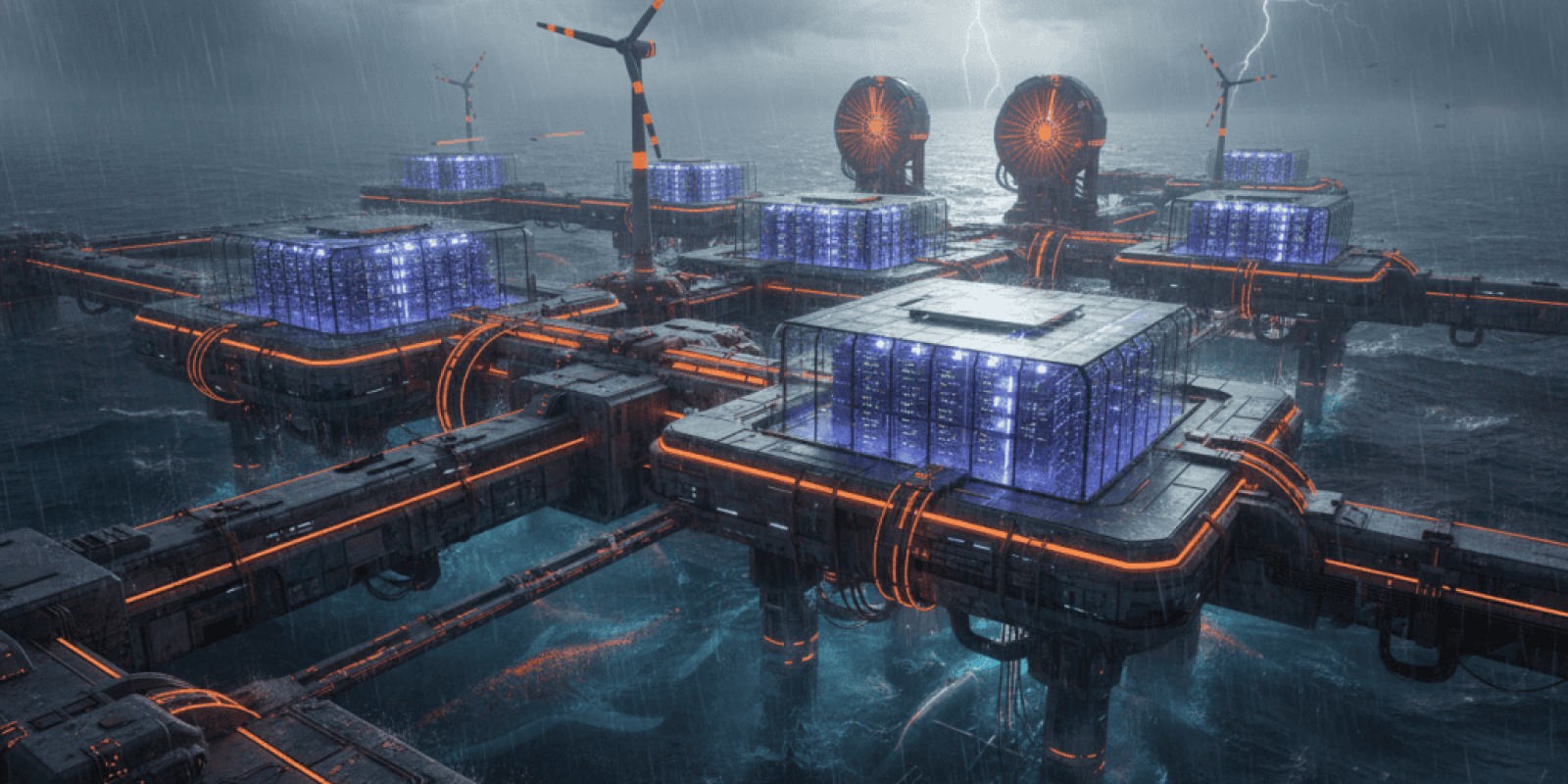
In the Scramble to Power AI, Investors Bet $140 Million on Data Centers at Sea
What wave‑driven floating servers mean for cyberpunk culture and the industries it feeds
A damp dawn on a Portland shipyard feels like a film set: cranes, plate steel, and a crate labelled AI that might as well be a relic from a neon future. Outside, an 85‑metre hull rocks in a test basin while a technician jokes about training a model on saltwater recipes; the joke lands and then slides off like a boat on oil.
Mainstream headlines read like infrastructure optimism: move compute to the ocean to solve power and cooling shortages. The less obvious consequence is cultural and industrial: this is not just a power play, it is an infrastructural reimagining that rewrites where data lives, who polices it, and what aesthetic and ethical tributaries feed cyberpunk communities and adjacent industries. Reporting below leans heavily on company releases and investor statements while evaluating what that reliance means for skeptics and designers of tomorrow. (tomshardware.com)
Why the ocean looks like the next datacenter park for AI companies
Silicon Valley and venture capitalists are reacting to a blunt problem: land is crowded, grids are strained, and hyperscalers have real deadlines to hit. Panthalassa’s $140 million round led by Peter Thiel crystallizes that reaction into capital and hardware. (tomshardware.com)
The engineering pitch that sounds like a science fiction setup
Panthalassa plans floating nodes that convert wave motion into electricity, use seawater for passive cooling, and run inference stacks directly at sea. The company says this lets servers avoid terrestrial grid delays while shipping inference results back via satellites. (itpro.com)
Who else is sketching floating server ships and what that means for competition
Big industrial players have sketched similar ideas; shipyards and conglomerates are building floating hull concepts while hardware makers talk about modular compute. Samsung’s floating data center model and other industrial demonstrations show the idea is spreading beyond scrappy startups to established supply chains. (techradar.com)
The timing is not accidental
The wave of interest aligns with an industry facing power shortages, long permitting cycles, and social pushback on land builds. Those constraints are driving experiments offshore where permitting, while novel, bypasses some municipal chokepoints. The investor roster and near billion dollar valuations imply backers believe the market incentive is large enough to justify maritime complexity. (computeforecast.com)
The core story with dates, names, and scale
On May 4, 2026 Panthalassa closed a $140 million Series B led by Peter Thiel’s Founders Fund to finish a pilot factory near Portland and accelerate deployments of Ocean‑3 nodes. The company has run prototypes called Ocean‑1 and Ocean‑2 in 2021 and 2024 and expects initial pilot deployments in the northern Pacific in 2026 to 2027. Investors named in reporting include John Doerr and corporate partners that suggest hardware supply chains are already lining up. (tomshardware.com)
Moving inference to the high seas changes who controls compute, and that rewires the social contract around privacy, jurisdiction, and artistic practice.
How cyberpunk culture will see itself reflected in floating infrastructure
Cyberpunk has always loved liminal spaces: the docks, the back alleys, the geopolitical no man’s lands. Floating datacenters are literal liminal infrastructure, existing where maritime law, satellite networks, and corporate property blur. That changes the motifs artists use and where technologists build—expect more narratives, installations, and films that locate servers under sodium streetlights and above tidal charts. A spike in aesthetic license is inevitable; a spike in governance headaches is even more likely.
Practical implications for small teams with 5 to 50 employees, with real math
A boutique AI startup running a customer chat model might serve 100,000 inference calls per month. If standard cloud inference pricing is $0.01 per call, the bill is $1,000 monthly. If a sea‑based provider offers dedicated inference hardware for a premium of 20 percent because of specialized maintenance and satellite uplink costs, the bill becomes $1,200 per month. That premium could be offset if the sea operator sells capacity with carbon credits or SLA guarantees attractive to regulated customers. For a 20 person design firm using image generation heavily, saving 10 percent on energy pass throughs could quickly fund a developer or two. Latency and bandwidth matter: satellite links add measurable round trip time relative to fiber, which changes product architecture for real time applications and nudges teams toward batch or async processing. These are straightforward tradeoffs; decide by multiplying your monthly inference volume by provider unit cost and add an estimated 30 percent for network premium to model a conservative total cost of ownership.
The cost nobody is calculating yet
Beyond capex and opex sits a hard‑to‑price ledger item: regulatory arbitrage and legal uncertainty. Who holds liability if a node is tampered with in international waters? What happens when a coastal state objects? Insurance, salvage, and cyber liability will be new line items in budgets that previously only worried about racks and cooling. Expect insurers to be mercilessly curious. Also expect a new market for maritime security and hardened firmware, because if cyberpunk taught anything, it is that the bad actors will scan the horizon. (itpro.com)
Environmental and ethical risks that stress test the pitch
Wave energy is not benign by default; marine ecosystems and fishing industries will lobby and litigate. Corrosion, biofouling, and waste heat could create unanticipated ecological externalities, and satellites that funnel inference outputs raise questions about interception and data sovereignty. There is also social risk: moving compute offshore may be read as an attempt to avoid local democratic processes, which will inflame community opposition in clever and predictable ways. Regulatory whitespace is both an invitation and a trap.
What cyberpunk professionals should be prototyping now
Designers and installation artists should prototype low bandwidth experiences that tolerate satellite latency, because these will be the forms most likely to be hosted offshore. Security teams should build threat models that include physical maritime attack vectors as well as supply chain insertion at coastal factories. Legal teams need templates for cross‑border custody and incident response that assume the compute node is beyond any single shore’s immediate reach. No one needs to take a rowboat to a rack; one can design defensible, compliant workflows from shore that treat ocean compute as a specialized cloud region.
Where this could go in the next 36 months
If Pilot nodes demonstrate reliable uptime and manageable maintenance costs in 2026 and 2027, expect a nearby market of niche providers offering dedicated inference islands, and a separate fleet of hybrid operators that mix undersea cable transit with satellite fallback. That will create space for independent art labs, boutique AI hosts, and competitive hyperscaler moves.
Key Takeaways
- Ocean‑based AI compute seeks to solve grid and cooling constraints but swaps terrestrial bottlenecks for maritime, regulatory, and latency tradeoffs.
- The $140 million round led by Peter Thiel pushes Panthalassa toward commercial pilot builds and signals investor seriousness about ocean compute. (tomshardware.com)
- For businesses with 5 to 50 employees, compute cost differences will be decided by volume, latency tolerance, and contractual risk allocation.
- Cyberpunk culture will absorb and amplify the aesthetics and anxieties of offshore infrastructure while professionals must prepare for new security and legal vectors. (computeforecast.com)
Frequently Asked Questions
What is the $140 million funding for and who led it?
Panthalassa raised $140 million in a Series B to complete a pilot factory and accelerate Ocean‑3 node deployments, with the round led by Peter Thiel’s Founders Fund. The capital is aimed at scaling manufacturing and field testing in 2026 to 2027. (tomshardware.com)
Will sea‑based data centers reduce carbon footprints for AI?
They may reduce grid emissions by generating on‑site renewable power, but full life cycle impacts depend on manufacturing, maintenance sailings, and decommissioning. Environmental impact claims require independent assessment beyond marketing materials.
Can a small company rely on ocean compute for real time customer applications?
Not without design changes. Satellite links introduce higher latency than fiber, so real time systems should be redesigned for local caching or async inference to remain responsive.
How should a 10 person studio budget for switching to an offshore inference provider?
Model current monthly inference volume, multiply by the provider’s unit price, and add an estimated 20 to 30 percent premium for network and specialized SLAs. Compare that to your cloud bill to decide if the tradeoff is worth it.
Who governs data handled on floating nodes?
Jurisdiction is complicated and will be case specific; maritime law, flag state rules, and the terms of commercial contracts will all interact. Expect protracted legal clarifications as deployments scale. (itpro.com)
Related Coverage
Readers who want to follow the broader infrastructure shifts should explore reporting on orbital data centers and undersea cable geopolitics, plus investigations into hyperscaler energy procurement. Coverage of art and design responses to new compute geographies will be valuable for anyone trying to map cultural impact to industrial practice.
SOURCES: https://www.tomshardware.com/tech-industry/artificial-intelligence/palantir-co-founder-peter-thiel-backs-usd140m-wave-powered-ai-data-center-startup-panthalassa-aims-to-run-offshore-compute-nodes-using-ocean-energy https://www.techradar.com/pro/were-now-ready-peter-thiel-backed-company-raises-usd1bn-to-send-data-centers-out-to-sea-to-harness-tens-of-terawatts-of-new-capacity-potential-in-the-power-of-the-open-ocean https://datacenters.economictimes.indiatimes.com/news/energy-cooling-sustainability/thiel-backs-140m-wave-powered-ai-data-centers-at-sea/130842600?next=1 https://www.itpro.com/security/panthalassa-has-opened-the-ocean-frontier-thiel-backed-startup-secures-usd140-million-to-deploy-floating-ai-data-centers https://www.computeforecast.com/news/panthalassa-wave-powered-ai-data-center-peter-thiel-140-million/