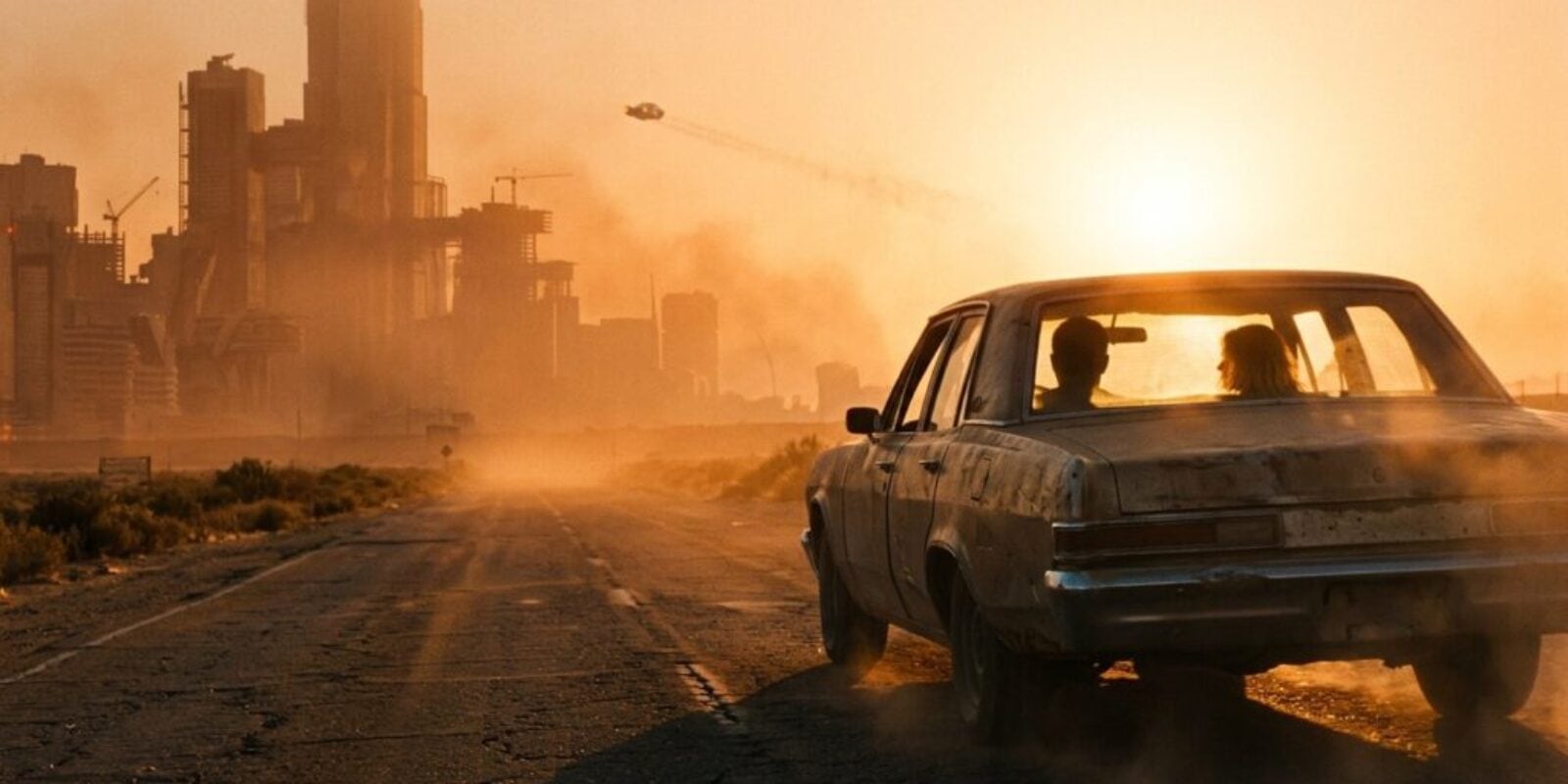
The short version: Blade Runner 2099, Prime Video’s eight-episode limited series, arrives all at once on Wednesday, November 25, 2026, the night before Thanksgiving. Michelle Yeoh plays Olwen, a replicant Blade Runner with days left to live. Hunter Schafer plays Cora, a human fugitive who has to pass as a Blade Runner to survive. It is set fifty years after Blade Runner 2049, in a Los Angeles the replicants won, and the final trailer, released November 9, makes the one change longtime fans will notice first: the rain is gone. This is a hot, bright, crowded city, and it does not belong to us anymore.
For a franchise built on two films about what it means to be human, the premise is a clean reversal. In 1982, Ridley Scott’s Blade Runner sent a human detective after replicants who wanted more life. In 2017, Denis Villeneuve’s Blade Runner 2049 made the detective a replicant himself. Blade Runner 2099 completes the turn: the replicants run the city, humans are the second-class citizens, and the hunter we follow is a human pretending to be one of the people who hunt her kind.
What is Blade Runner 2099 about?
The official logline from Prime Video is brief. Fifty years after the events of Blade Runner 2049, Los Angeles has been reborn, though not by humanity. Cora, a fugitive making one last attempt to stop running, takes on one final identity: a Blade Runner. She is forced to partner with Olwen, a replicant who is days from dying, and together they hunt a runaway who is hiding a truth that could collapse a fragile city, according to the studio announcement published with the final trailer.
The setup inverts the first film twice over. Cora has spent her life running from Blade Runners and now has to wear the badge. Olwen is on the hunting side of the law and is running out of time, the same clock that drove Roy Batty in 1982, now strapped to the detective instead of the fugitive. The replicants of 2099 are also not the fragile Nexus models of the earlier films. In an interview with Empire, Yeoh described them as longer-lived, stronger and faster, improvements she said are the reason they won the war.
What changed most is the city itself. The first two films made Los Angeles a place of permanent rain, smog and darkness. Luisa wanted the opposite. “The idea here is that we’re doing sunshine noir,” she told Empire, as JoBlo reported, describing a city coming back to life that is hot, sticky and chaotic. Rather than a dying world, this is a rebirth, just not one built for the people watching.
What does the final trailer show?
The final trailer is short and bleak. As GamesRadar’s Lauren Milici describes it, replicants kill humans in broad daylight while Cora volunteers to go undercover as a Blade Runner under Olwen’s supervision. Over a montage of violence, Olwen reflects that looking something in the eye is harder than killing it. Another voice promises that what Cora is doing will win the world back for humans.
The trailer ends somewhere the franchise rarely goes: out of the city. Olwen drives a frightened Cora into the open desert and tells her she has to see the lie in front of her. Whose lie, and which side is telling it, is the question the series is built to answer.
This is the third look at the series. A first teaser debuted with the premiere date at San Diego Comic-Con in July, and a second trailer arrived at New York Comic Con in October. The final one is the first to show where the hunt leads once it leaves Los Angeles.
Who made Blade Runner 2099?
Silka Luisa created the series and serves as showrunner and executive producer. Ridley Scott, who directed the original film, is an executive producer and advised on the show, alongside producers from his company, Scott Free Productions. Michael Green, who co-wrote Blade Runner 2049, helped develop the project, according to Dark Horizons. Isa Dick Hackett, the daughter of Philip K. Dick, whose 1968 novel Do Androids Dream of Electric Sheep? started all of this, is also among the executive producers.
Jonathan van Tulleken, who directed episodes of the acclaimed series Shogun, directed the first two episodes and is an executive producer. The series comes from Amazon MGM Studios and Alcon Television Group; Alcon also financed Blade Runner 2049.
Beside Yeoh and Schafer, the series regulars are Dimitri Abold and Lewis Gribben. The recurring guest cast includes Sheila Atim, Tom Burke, Johnny Harris, Matthew Needham, Daniel Rigby, Amy Lennox, Katelyn Rose Downey and Maurizio Lombardi.
Yeoh is the obvious draw. Her Oscar for Everything Everywhere All at Once came from playing a woman living many lives at once; Olwen, a being built with a fixed end date, is close to the opposite problem. Schafer, best known for Euphoria, carries the point of view: Cora is the human the audience follows into a city that no longer has room for her.
Do you need to watch the Blade Runner films first?
No. GamesRadar describes the series as a standalone limited series, with new characters at its center, and reports that Ryan Gosling’s K will not turn up in a cameo. The show stands on its own, and the logline gives you everything you need on day one: replicants won, humans lost, and a human is about to pretend to be the enemy’s police.
That said, the films will make the series richer. The original Blade Runner is set in November 2019, eighty years before this story, and its replicants were built to die after four years. Blade Runner 2049 introduced a replicant who could have a child, which is the thread that makes a replicant-ruled Los Angeles plausible. If you only have time for one, 2049 is the more direct bridge. If you have time for both over the long weekend, watch them in order.
Where does 2099 fit in the Blade Runner timeline?
The franchise is bigger than the two films, and the gaps between them are already partly filled. Before Blade Runner 2049 opened in 2017, three short prequels covered the thirty years it skips: Blade Runner Black Out 2022, an anime short directed by Shinichiro Watanabe of Cowboy Bebop, about the blackout that wiped the world’s records; 2036: Nexus Dawn, in which a new manufacturer brings replicants back to market; and 2048: Nowhere to Run, which sets up a character from the film’s opening scene. The anime series Blade Runner: Black Lotus, released in 2021, is set in 2032.
Read in order, that history runs from 2019 to 2049: replicants built to die young, then banned, then rebuilt as obedient workers, then shown to be capable of having children. Blade Runner 2099 picks up after the half-century in which that last revelation apparently played out. How the replicants went from hiding to winning is fifty years of history the series inherits. Whether it explains much of it on screen is one of the things viewers will find out on November 25.
Is there going to be a Blade Runner 2099 season 2?
Not as planned. Luisa told Collider after the Comic-Con panel that the show was always conceived as a limited series with a beginning, a middle and an end, written to play like a single long film. Eight episodes, she said, was the right length for the story, and her lucky number besides. Treat it as a complete story, not the start of a franchise you will be waiting years to finish.
How to watch Blade Runner 2099
When: All eight episodes release together on Wednesday, November 25, 2026, the day before Thanksgiving in the US.
Where: Exclusively on Prime Video, in more than 240 countries and territories.
What it costs: Prime Video is included with an Amazon Prime membership, which costs $14.99 a month or $139 a year in the US. That plan streams with ads. To watch without ads, and in 4K, Amazon’s Prime Video Ultra add-on costs $4.99 a month, or $45.99 a year for annual Prime members, according to Amazon’s own announcement, read November 9, 2026. Amazon also sells Prime Video on its own without full Prime. Prices can change, so check your account before you subscribe.
Format: A limited series, eight episodes, standalone. Expect violence; the trailer shows killings in the street, and the films it follows are rated R.
One small piece of advice for a release that drops whole: resist finishing it in one night. A story about beings who know exactly when they end is worth letting land between episodes.
Frequently Asked Questions
When does Blade Runner 2099 come out?
All eight episodes of Blade Runner 2099 premiere together on Wednesday, November 25, 2026, exclusively on Prime Video in more than 240 countries and territories.
Do I need to see Blade Runner and Blade Runner 2049 first?
No. The series is set fifty years after Blade Runner 2049 but follows new characters as a standalone limited series. Watching 2049 first adds context about how replicants came to rule Los Angeles.
Will there be a Blade Runner 2099 season 2?
No second season is planned. Silka Luisa told Collider the show was always conceived as a limited series with a complete beginning, middle and end across eight episodes.
How much does it cost to watch Blade Runner 2099?
Blade Runner 2099 streams on Prime Video, which is included with Amazon Prime at $14.99 a month or $139 a year in the US, with ads. Ad-free viewing with 4K requires the Prime Video Ultra add-on at $4.99 a month, per Amazon’s announcement, checked November 9, 2026.
Will you binge Blade Runner 2099 over Thanksgiving, or ration it one episode a night?