Anthropic CEO Warns of a “Tsunami” on the Horizon and Why Cyberpunk Culture Should Pay Attention
When the executive who helped build the newest generation of language models uses coastal imagery, even the neon-lit alleys start to feel unsettled.
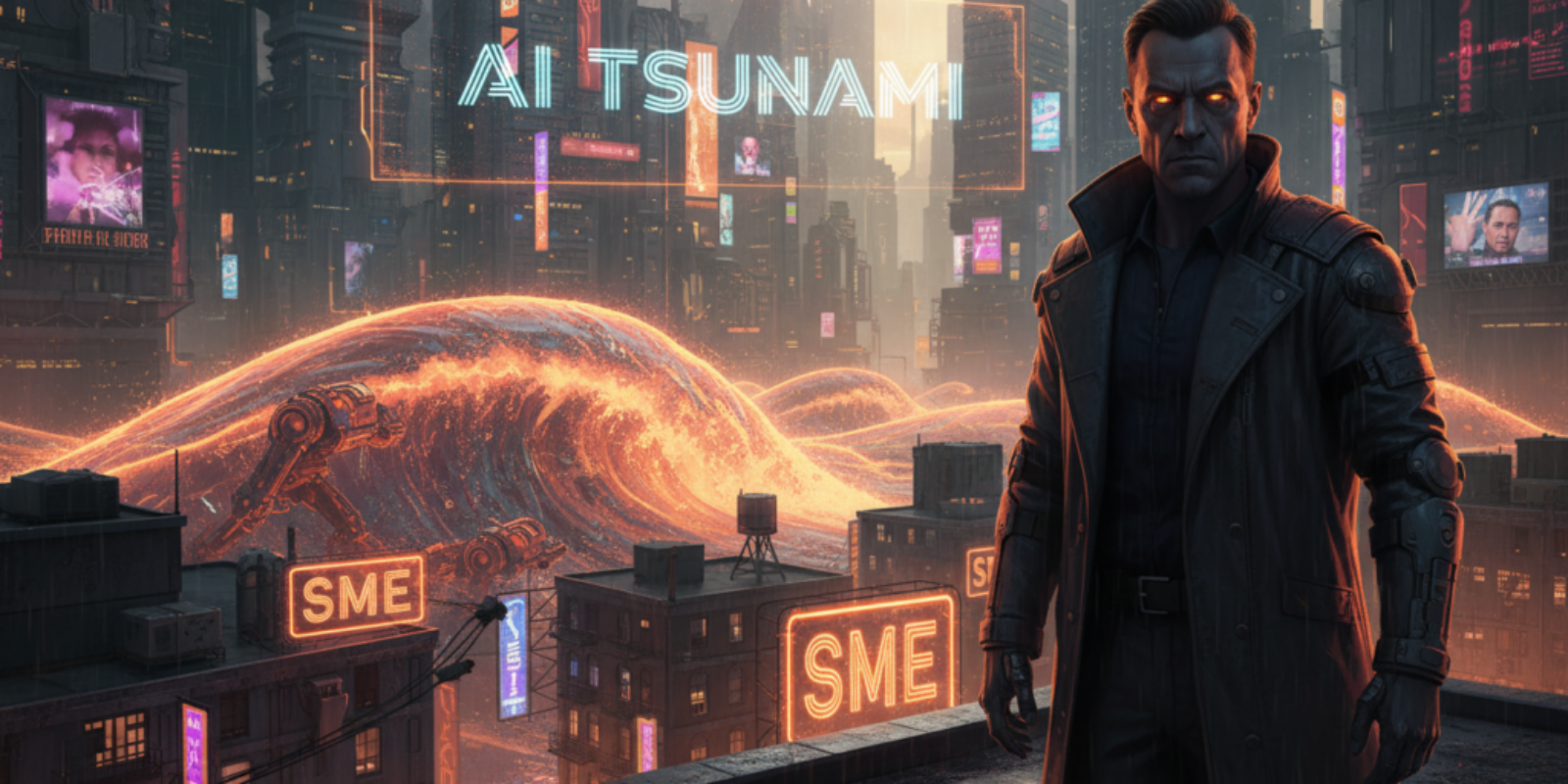
A small bar in a converted warehouse, synth music leaking out between rusted shutters, and three coders arguing about whether an assistant that writes flawless game scripts is a feature or the beginning of a profession’s obituary. That scene is already real in many cities, and the tone shifted when Anthropic CEO Dario Amodei told a podcast audience that, quote, “it’s as if this tsunami is coming at us.” This is not modest hyperbole; the remark landed in mainstream press and industry feeds the same way a surprise patch drops at midnight. According to Fortune India, the exchange laid out both urgency and an odd corporate handwringing that benefits from being heard. (fortuneindia.com)
Most readers took the line as the familiar Silicon Valley warning: powerful tools, big risks, regulate wisely. That reaction is sensible but incomplete. The underreported angle for cyberpunk communities and small creative and tech firms is not only existential dread but a compressed timetable for commoditization and cultural appropriation that will change how aesthetics, labor, and infrastructure interact in underfunded, guerrilla, and artisanal segments of the industry. LiveMint flagged the concentration of power in a handful of labs as a structural problem; that concentration is a key variable for how cultural gatekeeping shifts. (livemint.com)
Why neon futurism and practical business both need to listen
Cyberpunk culture has always fetishised the collision between corporations and the streets. Now the collision looks like models trained by a few labs rewriting code, text, and visual style sheets in minutes. The consequence is not merely lost jobs but altered supply chains for micro labels, indie studios, and hackerspace hardware boutiques that rely on scarce technical skill as competitive advantage. As the Economic Times reported, the podcast clip amplified concerns that companies and regulators are misaligned with the pace of change. (economictimes.indiatimes.com)
Who is shaping the wave and what they said
Dario Amodei, former OpenAI researcher and Anthropic cofounder, framed the moment as both technical and political. He warned that coding will be automated first and that the geopolitical and economic implications are enormous. These were not passing remarks; multiple outlets covered the conversation, which focused on jobs, concentration of power, and the need to steer development. NDTV summarised the arc of Amodei’s points and his background, which adds weight when a founder of one of the frontier labs speaks in plain language. (ndtv.com)
The core story with dates, names, and the practical facts
The remarks surfaced on the People by WTF podcast hosted by Nikhil Kamath on February 24, 2026, and were republished by several outlets within 48 hours. Anthropic currently competes with OpenAI, Google DeepMind, and xAI in providing foundation models and enterprise integrations. Amodei’s warning sits atop a rapid cycle of product releases and corporate hiring that has shrunk the time from research to customer deployment to months. Financial Express highlighted the prediction that programming tasks will be affected earliest, framing a short to medium term window for disruption. (financialexpress.com)
The coming disruption will feel intimate at first and then unstoppable, because the tools get better at mimicking the people who taught them.
Why cyberpunk artists, studios, and venues should treat this like infrastructure
Aesthetic output is now a software-defined layer. When models can generate visuals, music, dialog, and even synth patches, small labels and indie studios face three pressures at once: a flood of low-cost content, faster iteration by competitors with deep pockets, and a shrinking premium for craft. For a club that sells live AI-assisted visuals, the difference between opting into a proprietary API and building local capability is the difference between rent-controlled survival and being priced out by platforms that bundle models into turnkey services.
Practical implications for businesses with 5 to 50 employees
A ten-person indie game studio paying average developer salaries of 120,000 dollars a year spends roughly 1.2 million dollars on wages. If a model automates 30 percent of coding and QA effort, the studio could reallocate 360,000 dollars annually to design, marketing, or pay down studio debt. That math assumes retraining and integration costs equal to about 10 percent of current payroll in the first year, or 120,000 dollars, producing net near-term savings of 240,000 dollars. A boutique design house using an API at 0.02 dollars per prompt with 10,000 prompts a month would spend 2,400 dollars monthly and trade proprietary craft for variable costs and vendor lock in. These choices affect hiring, contract terms, and whether to accept platform revenue shares or maintain on-premise models. Dryly put, resilience now includes both a backup generator and a fallback model license.
The cost nobody is calculating yet
Bespoke cultural capital is eroding into algorithmic texture. Small studios and underground labels do not just lose income, they lose distinctiveness when the same foundational models spit out similar riffs across markets. If a local cyberfashion brand relies on scarcity of patterning and code to justify premium pricing, commoditization can reduce margins faster than market entry. There is also a secondary cost: talent flight toward larger labs that can offer model access, equity, and “meaningful” safety roles. That brain drain is a slow burn that bankrupts creative ecosystems more surely than a single layoff.
Risks and open questions that stress-test Amodei’s warning
The timeline for human-level performance in broad cognition remains contested and model evaluation lags deployment. Regulatory responses vary by jurisdiction and could either slow or accelerate consolidation. There is also a risk that companies will leverage safety rhetoric to secure competitive moats; Amodei himself argued for steering rather than stopping. The ethics of cultural appropriation by models trained on scraped subcultures has received little structured redress, creating reputational liabilities for firms that monetize derivative styles without community consent. Journalistic coverage so far draws largely on press interviews and reporting rather than long form transcripts, which matters when parsing nuance. (fortuneindia.com)
What to do in the next 6 to 12 months
Audit model dependencies and cost out backup plans that preserve IP ownership. Negotiate short term API credits and insist on data use clauses that prevent downstream training on proprietary assets. Invest 5 to 10 percent of annual revenue into staff training in prompt engineering and model evaluation, and treat that as capital expenditure. For creative teams, experiment with hybrid workflows where models accelerate iteration but final curatorial control remains human. A small studio that treats models like power tools rather than staff may survive the first wave.
A short forward-looking close
The warning is not a prophecy of doom but a timetable. The communities that adapt with clear rules about ownership, compensation, and cultural rights will shape the post-tsunami shore rather than simply wash onto it.
Key Takeaways
- Amodei’s “tsunami” line signals rapid capability growth concentrated in a few labs, which matters for cultural economies and small businesses.
- Coding and repeatable technical tasks are likely to be automated first, creating immediate choices for how to allocate talent and capital.
- Small creative and tech firms should budget for integration costs and negotiate data and IP protections now.
- Preserving distinctiveness will require process change and sometimes accepting short term costs to protect long term brand value.
Frequently Asked Questions
How fast will AI replace my studio’s developers?
Most experts expect task automation to arrive in stages, with repetitive coding and debugging being the earliest to go. Implementing models should be viewed as a reallocation of labor rather than instant layoffs, with a transition period of months to a few years depending on complexity.
Can a 10-person company afford to run its own models?
Running models on-premise requires either significant engineering headcount or third-party vendors; many small firms will find a hybrid approach more affordable. Cost estimates should include compute, security, and staff time for maintenance as well as any API fees.
What contractual clauses should small businesses insist on with AI vendors?
Insist on explicit data use clauses that prohibit vendors from using proprietary inputs to further train their models. Add audit rights and exit terms that allow export or deletion of stored data.
Will regulation protect indie creators from model-driven copying?
Regulatory responses are uneven by jurisdiction and often lag technology; legal protections may help but are not a near-term guarantee. Stronger remedies are more likely to come from platform policy and collective bargaining within affected communities.
How should venues and live shows integrate AI without losing authenticity?
Use AI to augment real-time visuals and interactivity while keeping human curation for headline elements. Audience-facing transparency builds trust and can become a selling point rather than a liability.
Related Coverage
Readers might explore how model licensing is reshaping content ownership, the economics of AI in small game studios, and policy experiments in media provenance. The AI Era News recommends pieces on vendor contract law, community-driven training datasets, and the economics of on-premise model hosting to understand the full stack of disruption.
SOURCES: https://www.fortuneindia.com/technology/ais-scale-disruption-and-responsibility-dario-amodei-on-nikhil-kamaths-podcast/130699/ https://www.livemint.com/technology/tech-news/ai-power-concentrated-in-too-few-hands-almost-by-accident-anthropic-s-dario-amodei-tells-nikhil-kamath-11771932098444.html https://economictimes.indiatimes.com/tech/technology/teaser-for-nikhil-kamaths-podcast-has-anthropic-ceo-dario-amodei-warning-of-ai-tsunami/articleshow/128699730.cms https://www.ndtv.com/world-news/nikhil-kamath-podcast-was-starting-to-despair-why-anthropic-ceo-dario-amodei-shifted-from-biology-to-ai-11129346 https://www.financialexpress.com/life/technology-coding-goes-away-first-engineering-takes-longer-warns-anthropic-ceo-dario-amodei-on-ais-job-market-impact-4153555/