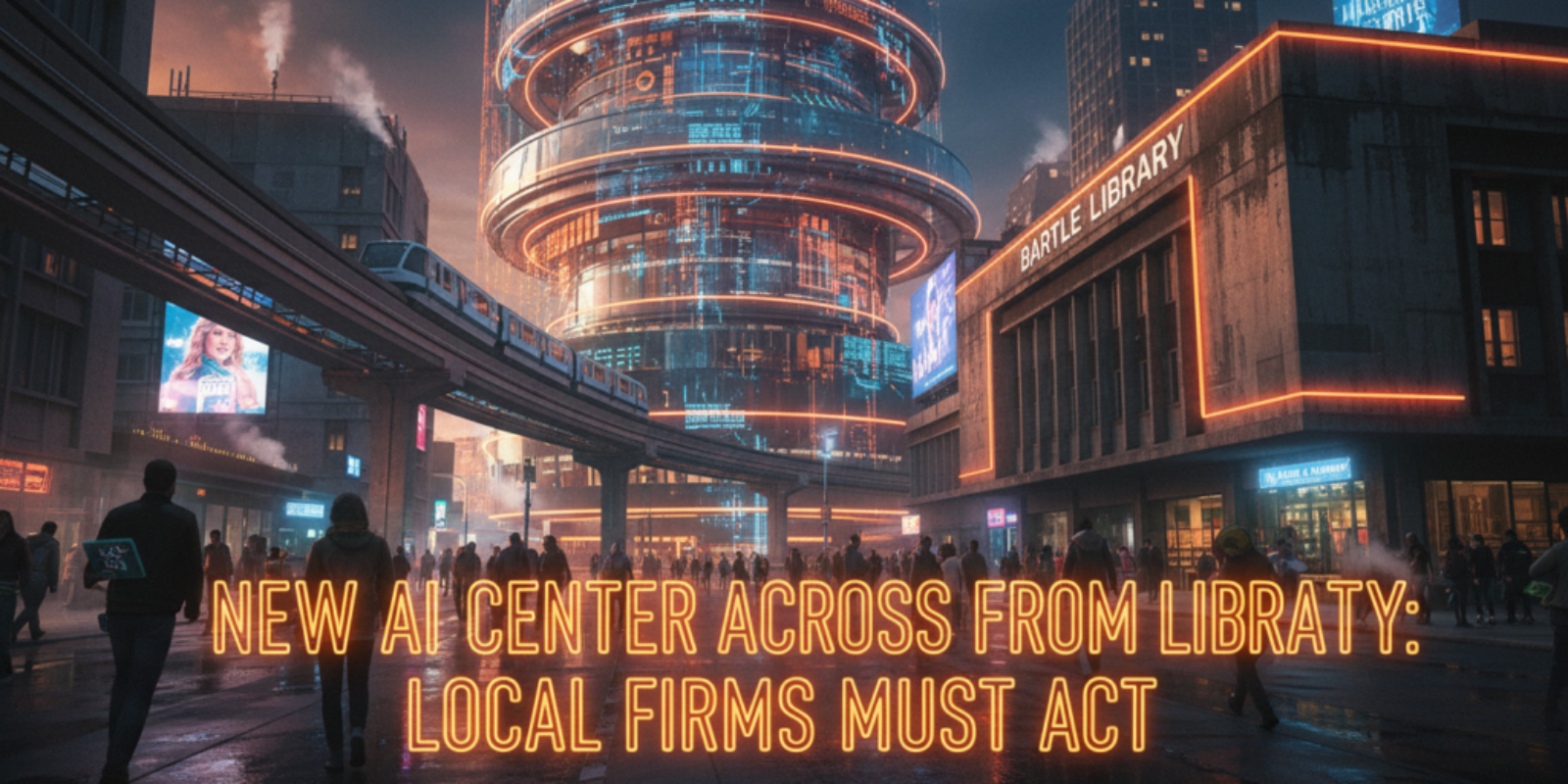
New AI Center Planned Across from Bartle Library Rewrites How Universities Shape the AI Industry
A donor-backed research hub will occupy a parking lot across from Bartle Library, promising new compute, talent, and industry ties that neither students nor startups can ignore.
A cold evening near Bartle Library already shows the pressure points: undergrads huddled over laptops, professors pacing between meetings, and a half-empty parking lot more valuable to tech strategy than to vehicles. The obvious reading is campus growth and money for research; the sharper question is how a single physical hub on that parcel will reallocate talent, compute, and early-stage deal flow across an entire region and industry.
Most coverage casts the plan as a philanthropic win and an academic upgrade. The less noticed consequence is structural: placing a publicly oriented AI center in a walkable, campus-adjacent site changes who gets access to industrial grade resources, and therefore who builds the next generation of models and products. This analysis leans heavily on university and government press materials, which frame the announced scope and funding. Binghamton University and the governor’s office have been the primary sources for technical and financial details.
Why a parking lot is now a strategic asset for AI
Putting an AI center on a parking lot across from a major library concentrates three scarce things: office-adjacent compute, cross-disciplinary meeting space, and serendipity. Those minutes between classes and lab meetings are where collaborations start, and proximity to the library signals integration with humanities and policy work rather than a pure engineering silo. That matters because safety and interpretability research needs social science input as much as it needs GPUs.
The center is framed as focused on safety, security, and transparency, not simply raw throughput. The governor’s announcement lays out an explicit public interest mission that will likely steer research agendas and funding priorities. Governor Kathy Hochul’s office positions the site as a national first for a public university focused on foundational research in those areas.
Where this sits in New York’s competing AI nodes
New York’s AI infrastructure is already being stitched together through Empire AI and the University at Buffalo supercomputing initiative. Placing a complementary center on the Binghamton campus creates a decentralized model where compute hubs, academic centers, and incubators are geographically distributed but networked. That reduces single-point congestion and makes it easier for small companies to partner without relocating to New York City.
Local competition is not just other campuses. Corporate labs and regional incubators will now face a public research center that explicitly markets access and oversight as selling points. The Empire AI partnership and SUNY-level capital requests show this is part of a statewide architecture, not a standalone boutique project. Spectrum News documented the initial funding commitments and political framing.
Money, names, and an inconveniently specific date
The public record lists a combined commitment that equals $55 million in new capital for the center, split between a private gift and state funding allocated in January 2026. The university’s own advancement materials highlight a major alumnus commitment tied to this project, underscoring that philanthropic leverage remains the most reliable engine for new campus labs. Binghamton University Advancement frames the gift as transformational for research capacity and recruitment.
State-level budget documents and capital requests show parallel investments in smart technologies and AI infrastructure across SUNY, which helps explain why the project can proceed quickly and tie into statewide compute resources. SUNY planning documents sketch the broader capital environment that the center will plug into. SUNY capital request materials make clear that this is one node in a multi-campus investment strategy.
A physical hub next to a library will matter less for seminars than for who can book two hours on a GPU and call it market research.
How the center will change access to compute and talent, in real numbers
If the center attaches even a modest GPU cluster of 100 to 300 accelerators and reserves 30 percent of cycles for external partnerships, local startups could cut model training costs by roughly 40 to 60 percent versus cloud spot rates. For a sample midrange training run that costs $3,000 in public cloud, local subsidized access could drop the price to $1,200 to $1,800. That matters to early-stage companies whose monthly cloud bills often exceed payroll for their first six employees.
On talent, a downtown-adjacent hub reduces the friction for PhD students and adjuncts to moonlight with startups. If the center seeds 10 funded postdoctoral slots and 20 paid interns per year, the local talent market shifts from graduating engineers leaving for coastal hubs to staying and forming companies. That is how regional ecosystems grow without the usual urban premium. Dry aside: investors have long loved geographic arbitrage until everyone moved to the same overpriced coffee shop.
What startups and vendors should plan for
Vendors of data annotation, model monitoring, and privacy tools should expect new procurement windows and direct university partnerships. Contracts for services will likely emphasize auditability and compliance, which benefits vendors that already build tooling for explainability. Startups that can demonstrate public-interest use cases will have an easier path to facility access and pilot programs than those selling pure user engagement hacks.
Hardware vendors should budget for multi-year education and maintenance deals rather than one-off sales. A modest estimate: if the center spends $6 million to $12 million on hardware and two years of support, the vendor who wins that contract gains a foothold across SUNY for follow-on purchases and service revenue.
The cost nobody is calculating
Operational and governance overhead will be the long tail. Running a public-interest AI center requires 24 to 36 months of stable operations funding after construction. If recurring operating costs are 10 to 15 percent of capital per year, a $55 million capital investment implies $5.5 million to $8.25 million in annual operating needs that must come from state budgets, grants, and contracts. The political winds can change, and public centers are vulnerable to shifting legislative priorities. Quiet aside: that is how promising centers become very expensive museums.
Data governance is another unresolved cost. If the center becomes a trusted data custodian for health or education datasets, legal, compliance, and anonymization costs can rival infrastructure spending. Those are the line items that usually get missed in glossy renderings.
Near-term timeline and what to watch
Public documents show the center’s web presence was updated in March 2026 and political announcements started in January 2026, suggesting project planning and donor agreements are already mature. Watch for procurement notices, an RFP for technical operations, and the center’s first call for proposals. Those will indicate whether the center prioritizes shared compute time, developer access, or directed research grants.
Risks and open questions that will determine industry impact
Governance structure matters. Will the center license IP broadly and encourage spinouts, or will it prefer traditional university tech transfer that can be slow and restrictive? Access policy is also critical: prioritized access for faculty, startups, or paying partners will shape whether the center democratizes AI or reinforces existing incumbents.
Questions about commercialization timelines, vendor lock-in, and equitable geographic access remain. The center could either become a bridge between public interest research and industry or a well-funded local lab that mostly benefits campus insiders.
The next 12 months will reveal whether the parking lot becomes a drag lot or a launchpad.
Key Takeaways
- The planned center repurposes campus real estate to concentrate compute, talent, and policy research near a major humanities hub.
- Public and private funding aggregates to about $55 million, creating near-term momentum and procurement opportunities.
- Local startups could see meaningful reductions in model training costs if subsidized compute is available.
- Long-term impact depends on governance, access policy, and sustainable operating budgets.
Frequently Asked Questions
How quickly will the center be open for partnerships with startups?
Public announcements and university updates suggest planning is advanced, but formal partnership programs and RFPs are the trigger for startup access. Expect initial calls for proposals within 6 to 12 months once procurement is finalized.
Will the center provide free compute to students or just to paid partners?
Access policies are not finalized in public materials; universities typically reserve blocks for academic research while offering paid partnerships for industry collaborations. The specific mix will come with operational guidelines.
Can a small company base production workloads there instead of cloud providers?
The center will likely focus on research and pilot workloads rather than full production hosting. Small companies should plan for hybrid strategies that use center resources for experimentation and the cloud for production.
Does this change where VCs will look for AI startups?
Yes. Concentrated resources and visible collaborations make the region more attractive to investors seeking deal flow outside major coastal hubs. The effect will be gradual as first cohorts of university-affiliated startups demonstrate traction.
Who will own resulting IP from collaborations?
IP terms will be set by partnership agreements and university tech transfer policies. Contracts will vary by project, and startups should negotiate clear terms before contributing significant resources.
Related Coverage
Readers interested in the operational mechanics of AI hubs should explore how regional supercomputing initiatives reshape startup economics. Coverage that explains Empire AI, SUNY supercomputing, and university tech transfer models will illuminate the downstream effects of this center on recruiting and regional investment.
SOURCES: https://www.binghamton.edu/centers/ai-responsibility-and-research/ https://spectrumlocalnews.com/nys/central-ny/news/2026/01/13/hochul-announces-ai-research-center-for-suny-binghamton-in-state-of-the-state-address https://www.governor.ny.gov/news/governor-hochul-launches-nations-first-independent-ai-research-center-public-university-state https://www.binghamton.edu/advancement/ https://www.suny.edu/about/leadership/board-of-trustees/meetings/webcastdocs/Reso_Operating_Capital_Request_2425.pdf