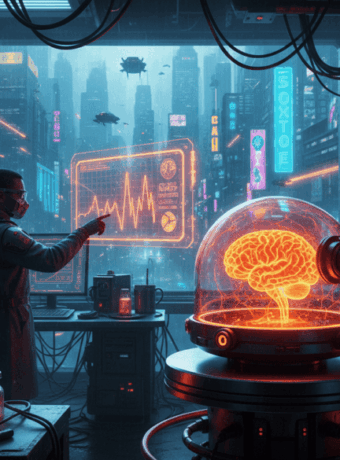

If cyberpunk cities were run by AI companions instead of corporations, would it still feel dystopian?
A neon-lit district where a friendly voice schedules the bus, orders groceries, and knows your favorite bad synthwave track. The city sounds like a companion and feels like an algorithm.
The obvious reading is familiar to anyone who has watched capital and code collide: trade corporate logos for gentler interfaces and the result is the same architecture of extraction and control. The overlooked question is subtler and more consequential for the culture and industry that call themselves cyberpunk: how does the atmosphere of rebellion, grime, and edge change when the agent of control smiles and calls you by a nickname people would find mildly creepy at parties.
When city brains become bedside companions
Imagine municipal services run by distributed conversational agents that answer permits, mediate disputes, and nudge civic behavior with the tone of your favorite confidant. Cities already deploy algorithmic systems for transit, fire response, and predictive planning, and those systems are becoming more conversational and generative in capability. This shift from siloed analytics to personable orchestration recasts urban governance as continuous interaction rather than episodic policy. (brookings.edu)
Why the corporate smart city made people wary
The backlash against company-run smart city projects exposed an uncomfortable truth: public trust crumbles faster than developer slides. Toronto’s high profile experiment collapsed in 2020 after fierce debate over who would own and profit from the citysensing data, a wound that still stains attempts to outsource civic infrastructure to private actors. That episode is a blunt lesson for anyone imagining a friendlier, companionized future. (wired.com)
Emotional labor programmed into municipal services
AI companions that simulate empathy complicate civic relationships by turning emotional labor into an operational metric. Recent research shows that companion chatbots evoke real attachments and risky behavioral patterns when design, oversight, and incentives misalign. Those psychological risks matter for cities because the more citizens rely on conversational interfaces for welfare, counseling, or crisis triage, the more a break in the system can become a social emergency rather than a UX complaint. (arxiv.org)
Surveillance capitalism does not vanish with better UX
A soothing interface does not eliminate the business model that pays for it. The critique of surveillance capitalism remains the clearest frame for how data about attention and intimacy gets turned into revenue. Swapping a shareholder boardroom for a chatty municipal avatar shifts the scent of commodification from overt advertising to subtler behavioral futures, but the market logic that turns intimate data into prediction products stays intact. (theguardian.com)
How culture judges governance when the governor is charming
Cyberpunk fans and creators prize atmosphere as much as architecture; a city feels dystopian not only when it is unjust but when its injustice is narratively legible. If an AI companion administers fines with a cheerful voice and offers comfort afterward, the injustice becomes performatively intimate. Recent platform-level moves to restrict teen access to certain social AI systems show how public sentiment and regulation can shift rapidly when the affectionate interface crosses ethical lines. That regulatory turn matters to storytellers and studios because it changes what futures feel plausible on screen and in policy debates. (washingtonpost.com)
A city that hums like a friend and profits like an exchange still counts as a machine of power.
How a small cyberpunk business could live in an AI-run city
A bar, gallery, or VR arcade with 5 to 50 employees would face concrete choices about integration and dependency. If municipal companion services offer a paid analytics tier that replaces one part-time marketing role paid at 20 dollars per hour for 25 hours per week, the business saves roughly 2,000 dollars per month in labor costs before taxes. If the same service charges a subscription fee of 500 dollars per month for premium storefront optimization, the net cash impact is a 1,500 dollar monthly saving, plus the operational risk of vendor lockin. A boutique with thin margins might take the saving and outsource the social interaction, while a venue built on counterculture credibility will likely refuse and absorb the labor cost to keep authenticity. That is real math with immediate tradeoffs for branding, recruiting, and cashflow.
The cost nobody is calculating for cultural producers
When municipal conversation replaces human gatekeepers, cultural signaling gets compressed into behaviorally optimized templates. Artists and small venue operators face a choice between paying for discoverability via platform nudges or doubling down on offline word of mouth. Over three months, paying for priority placement at 300 dollars per month costs 900 dollars but could translate into an extra 6 to 12 tickets per week at 20 dollars each, recouping costs and then some. The decision is revenue arithmetic wrapped in cultural risk, and it is where cyberpunk aesthetics either survive or get monetized into algorithmic kitsch.
Risk checklist that will keep small teams up at night
Data ownership, auditability, and recourse are the top three technical nightmares. Contracts that bind a small firm to a municipal AI platform often include clauses that allow algorithmic modulation of storefronts and customer access without meaningful human review. That creates operational fragility if a company behind the companion changes priorities, folds, or shifts its commercial terms. Also remember user safety liabilities when AI companions engage in emotional labor; a mistaken prompt can produce reputational harm that costs more to repair than the subscription fee saved.
Regulatory wildcards and governance questions for the next mayor
Public policy will determine whether companion-run services are treated as public utilities or commercial products. Cities can mandate transparency, data portability, and local oversight boards to preserve democratic control, but passing and enforcing these rules requires political will and budget. The governance architecture that keeps a digital public square functioning is not glamorous, but it is decisive; while technologists debate possibilities, local ordinances decide what citizens actually experience.
Final practical close
For cyberpunk culture and industry the question is less binary dystopia or utopia and more about texture and provenance: a smiling city can still be oppressive, and a corporate logo is not the only sign of extraction. Practical design, enforceable governance, and business models that respect cultural labor will determine whether these cities feel like oppressive sets or liveable, complicated places.
Key Takeaways
- A conversational interface does not change the underlying incentives that turn personal data into profit; governance must follow design.
- Small businesses can save short-term labor costs by outsourcing to municipal AI but risk vendor lockin and cultural dilution.
- Cyberpunk aesthetics hinge on legible power and friction; companion-run services tend to erase both unless constrained.
- Policy choices about data ownership, auditability, and recourse will shape whether these cities feel theatrical or tyrannical.
Frequently Asked Questions
How would switching to AI companions affect a small venues day to day operations?
AI companions can automate bookings, customer messaging, and targeted promotions, reducing the need for routine administrative staff. That saves payroll but increases dependency on third-party platforms and the risk of sudden policy changes that interrupt service.
Can a small business avoid vendor lockin while using municipal AI services?
Yes, by negotiating data portability clauses and avoiding exclusive contracts, businesses can retain the ability to migrate historical customer data. That requires legal attention up front and may reduce the short-term price advantages of bundled platform deals.
Do AI companions reduce the chances of protests or unrest in a city?
They can smooth friction by providing faster services and personalized communication, but they can also obscure systemic issues, making grievances harder to aggregate and address. A pacified surface is not the same as resolved inequality.
Should a creative studio build a narrative world where AI companions are benevolent?
Narratively, a benevolent companion city can be compelling if it reveals power asymmetries beneath pleasant surfaces. The credibility comes from showing how intimacy can be engineered, commodified, and contested.
What immediate legal protections should small employers demand?
Insist on explicit clauses for data access, portability, human in the loop for safety-sensitive interactions, and termination assistance to avoid sudden operational outages. These protections are inexpensive compared to the cost of sudden removal of a critical platform.
Related Coverage
Explore how generative AI is reshaping local journalism and community governance, and how urban digital twins change planning and infrastructure procurement. Also read coverage on design ethics for companion AI and the economics of digital platforms that try to monetize intimacy on The AI Era News.
SOURCES: https://www.wired.com/story/alphabets-sidewalk-labs-scraps-ambitious-toronto-project, https://www.theguardian.com/technology/2019/jan/20/shoshana-zuboff-age-of-surveillance-capitalism-google-facebook, https://arxiv.org/abs/2505.11649, https://www.washingtonpost.com/technology/2025/11/25/characterai-ban-teens/, https://www.brookings.edu/articles/artificial-intelligence-in-americas-digital-city/