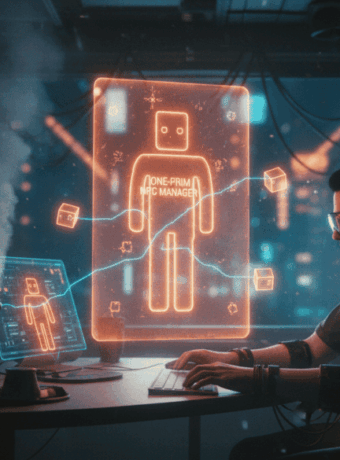
Taking Yourself Into the Metaverse
How bringing your actual presence into virtual worlds is reshaping small teams, platform power and the economics of being “there”
A creative director lifts a headset, sees a room that looks nothing like the office and walks toward a client avatar who is both themselves and not. The room smells of nothing; the handshake is a network packet; the conversation still decides the budget. This is the human moment that keeps boardrooms simultaneously excited and quietly terrified.
Most coverage frames the trend as a hardware race or a consumer social fad, a contest of headsets and hype. The overlooked business story is deeper: the practical mechanics of making a person portable, persistent and persuasive across multiple virtual platforms, and why that capability will determine who wins revenue from training, sales and immersive services.
This reporting leans on company announcements and developer briefings to map current capabilities and timelines, because the tools being described are still shipping features faster than independent reviewers can test them. (microsoft.com)
Why realistic avatars suddenly matter to revenue and trust
The move from cartoon to near-photoreal avatars changes what clients expect from remote interactions. When faces can convey microexpressions and eye contact, a virtual pitch or therapy session stops feeling like a slide deck and starts feeling like presence. Epic Games has pushed this ability with its MetaHuman tools, designed to let studios and agencies create lifelike digital humans quickly and at scale. (epicgames.com)
The platform battleground: where identity and commerce collide
Platform owners want bodies that lock users in, and marketplaces that sell outfits and accessories become recurring revenue engines. Meta has treated avatars as a cross-platform identity play for years, expanding body types, clothing and a commerce layer to normalize digital fashion. That marketization is less glamour and more strategic: sell a persona, sell the persistence of customer identity inside the platform. (techcrunch.com)
When the headset is not the limiting factor
Hardware mattered first, but software and interoperability are catching up. Microsoft’s push to make spatial presence a native part of Teams via Mesh signals that enterprise collaboration expects avatars to be useful rather than optional. For many businesses, the question is less which headset to buy and more how to make an employee’s virtual self useful across sales demos, onboarding and client support. (microsoft.com)
The middleware that turns characters into colleagues
Behind the scenes, real-time animation, cloud rendering and physics-driven digital twins are doing the heavy lift. NVIDIA’s Omniverse work shows how simulation and rendering can move from isolated demos to workflows useful for product design and training, meaning a single avatar or virtual twin can participate in design review, logistics rehearsal and customer interaction with the same fidelity. That reduces rebuild costs and speeds reuse. (nvidianews.nvidia.com)
The question is no longer can we put people inside virtual spaces but whether their virtual selves can close business without a plane ticket.
A concrete plan for a 5 to 50 person company
Start small with one concrete revenue or cost objective and measure change over three months. For a 10 person design agency, reserve two days to build a single ProtoPersona: one designer creates an avatar from a single webcam capture, one developer connects it to a shared Unreal or Unity scene, and the rest rehearse one client pitch in that environment. If staff time averages $50 per hour, a 40 hour setup equals $2,000; factor in two midrange headsets for testing at $500 each and a cloud staging budget of $200 a month and the first quarter investment sits near $3,700. If a single converted client project from the virtual pitch nets $10,000, payback occurs inside months, not years. This math is intentionally conservative and assumes incremental efficiencies in travel time and demo polish.
Deploy only after scripting repeatable use cases: a 15 minute immersive demo, a 20 minute walk-through of a deliverable, and a five minute after-action debrief that captures feedback directly onto the project board. If any of that sounds slightly dystopian, congratulations, it also sounds efficient.
The cost nobody is calculating
Licensing, data pipelines and avatar maintenance are the compounding costs people miss. Creating one believable avatar may be cheap in studio time, but keeping it consistent across updates, platforms and legal ownership requires ongoing infrastructure and contractual work. Expect before-and-after work in asset versioning, identity permissions and a small retained engineering cost to keep avatars compliant and synchronized across Web, mobile and native spatial apps.
Risks and hard limits that deserve more attention
Deepfakes, consent and identity theft are not edge cases. A photoreal avatar that convincingly mimics a salesperson could be weaponized to spoof contracts or mislead customers. Interoperability promises are also fragile: cross-engine licensing and differing animation rigs mean a persona might work perfectly in one room but break in another. Privacy statutes and platform terms can change overnight, unraveling a carefully built customer experience. Technology alone does not fix those governance gaps, and governance is expensive.
What small teams should watch in the next 12 to 24 months
Track three things: platform licensing for avatars, tools that reduce capture to one webcam, and standards for identity portability between engines. If a tool lets a small team capture realistic performance with consumer hardware and deploy it to multiple marketplaces, that company will be on the hook for new client expectations. Yes, this sounds like a standards problem; no, standards are not sexy, but they pay invoices. A colleague once described standards meetings as modern art for people who enjoy pain, which summarizes the incentive problem nicely.
Forward-looking close
Putting a person into the metaverse is now a toolbox choice rather than a science fiction gamble; the strategic question is which parts of a team’s workflow actually gain value from being persistent and transferable across virtual places, and whether the business is ready to pay for the engineering, legal and creative work that ensures those digital selves perform reliably.
Key Takeaways
- Realistic avatars change the quality of remote interactions and can turn demos into decisive sales tools when used with clear playbooks.
- Platform control of identity and marketplaces is the primary commercial lever, not just headset sales.
- Small teams can pilot with modest budgets and rapid payback if they select one revenue or cost objective to measure.
- Governance, licensing and ongoing maintenance are the costly invisible layers that decide long term success.
Frequently Asked Questions
How much will it cost to get a usable avatar and deploy it for client demos?
A usable avatar prototype can be built with one developer and one designer in a few days, with initial outlay dominated by staff time and modest cloud or rendering fees. Expect an initial project budget in the low thousands and ongoing costs for updates and hosting.
Can avatars replace in person sales for small professional services firms?
Avatars can replicate much of the ritual and presence of in person meetings, and for certain pitches they reduce friction and increase demo fidelity, but they do not remove the need for high trust relationships in every case. Use them to augment top of funnel and routine client work while keeping face to face for high stakes negotiations.
Do small teams need to build to Unreal Engine or Unity to participate?
No single engine is mandatory, but choosing an engine affects licensing, asset pipelines and talent hiring. Cross engine tools and marketplaces are emerging that reduce lock in, so prioritize workflow compatibility and developer familiarity over chasing the newest feature.
What are the biggest legal pitfalls for companies making avatars for customers?
Consent for likeness, copyrights for scanned assets, and data retention obligations are the primary legal risks. Contracts should explicitly state ownership, permitted use cases and procedures for takedown or modification.
How long before avatars are truly interoperable across platforms?
Interoperability will likely improve incrementally over several years as marketplaces and engines adopt shared standards; expect meaningful improvements in the next two to four years rather than overnight miracles.
Related Coverage
Readers who want to go deeper should look for reporting on avatar marketplaces and digital fashion, the economics of spatial collaboration tools, and technical primers on real-time animation pipelines. Those topics explain where revenue pools form, how teams organize to capture them, and what skills hiring managers should prioritize next.
SOURCES: https://www.epicgames.com/site/en-US/news/metahuman-creator-is-now-available-in-early-access https://nvidianews.nvidia.com/news/nvidia-announces-omniverse-real-time-physics-digital-twins-with-industry-software-leaders https://www.microsoft.com/en-us/microsoft-365/blog/2024/01/24/bring-virtual-connections-to-life-with-microsoft-mesh-now-generally-available-in-microsoft-teams/?msockid=3738f656f78b685d1ff6e0c5f6b469bf https://techcrunch.com/2023/04/27/meta-updates-its-avatars-with-new-body-shops-hair-and-clothing/ https://www.theverge.com/news/678403/epic-games-metahumans-unreal-engine