Night Sounds in the Sprawl: How After-Hours Audio Is Rewriting Cyberpunk Culture and Business
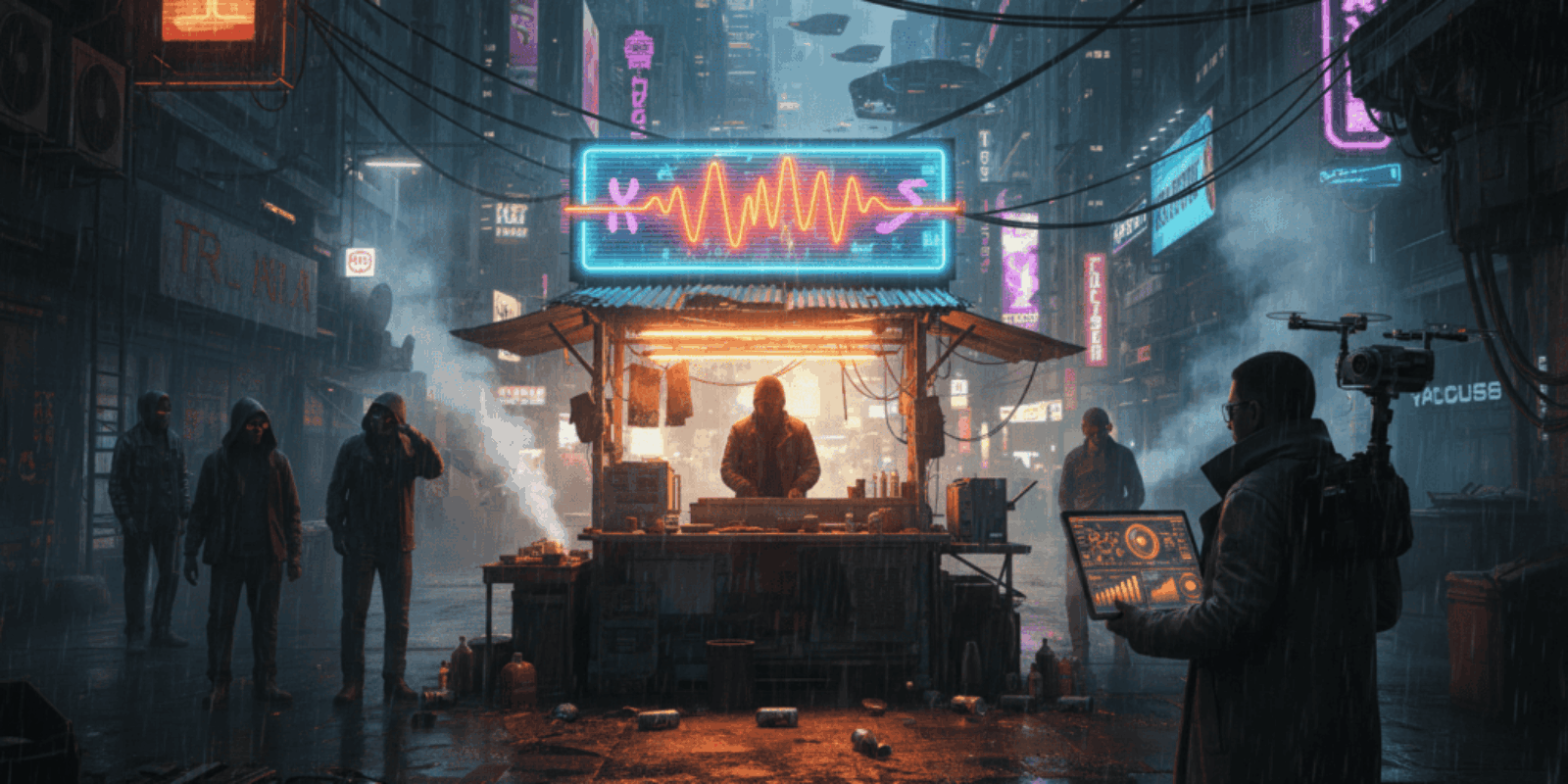
The neon fizz collapses into alley hiss and an underlayer of distant freight horns. A courier pauses under a flickering holo-billboard and notices that the city has a grammar of its own after dark.
Most observers treat the sprawl’s night sounds as atmosphere: a sensory seasoning for films, games, and playlists. The overlooked truth for studios, indie labels, game houses, and physical venues is that nocturnal soundscapes are becoming a product and a platform, with measurable audience engagement, new revenue vectors, and hard engineering requirements that shift budgets and talent pipelines.
Why the night is where cyberpunk audio actually earns money
Post-dusk listening habits drive longer sessions in games, VR experiences, and streaming ambient mixes where users pay for uninterrupted, spatialized immersion. That shift is not just aesthetic; a growing set of tools and middleware explicitly target immersive nighttime ambiences to increase session time and microtransaction conversion. Audiokinetic’s writing on the subject shows how adaptive audio systems are being repurposed to render layered urban ambiences as gameplay mechanics rather than passive background. (audiokinetic.com)
The competitors shaping the sound of the sprawl
Major game studios, boutique sound design houses, and audio middleware vendors are competing for authenticity at scale. CD Projekt Red and its contractors set a high bar with Night City audio, while middleware firms and headset makers race to deliver spatial audio features that make alleyway rain and overhead drones feel directional and consequential. The market is fragmenting into creators who license authentic field recordings, those who synthesize atmospheres algorithmically, and vendors who sell both to developers and to municipal projects aiming to shape public aural identity.
From Blade Runner to algorithmic rain: a lineage of influence
Film soundtracks established the idea that a city’s audio can be a character, not just scenery. Scholarship on Ridley Scott’s Blade Runner demonstrates how integrated score and sound design created a template cyberpunk sound that designers still reference when composing nocturnal ambiences. (mdpi.com) Modern developers borrow that blueprint and extend it with dynamic audio engines that respond to traffic flow, AI actors, and player noise.
The core story with dates, names, and product moves that matter
The push for night-first audio accelerated in the 2010s as VR and spatial audio matured, culminating in recent commercial efforts to package Night City style soundscapes for consumer headsets. In 2024 and 2025 several spatial audio products and gamepacks launched that promised personalized overhead and surround layers for popular open-world titles; one such release documents how studios are monetizing immersive ambiences with curated driver packs and headset software. (evr-product-releases.s3.amazonaws.com) Meanwhile, technical breakdowns of Cyberpunk 2077’s sound design detail large teams and months of field recording and synthesis work, signaling that high-fidelity nocturnal worlds are resource intensive and therefore strategic investments for major studios. (asoundeffect.com)
How designers build believable nightscapes
Designers combine three techniques in most modern builds: field recordings captured at scale, procedural layering driven by traffic and crowd models, and synthesized textures tuned to the property’s tonal identity. The synthesis often borrows retro synth timbres while the fieldwork supplies local specificity, like a food cart’s kettle in Kowloon-esque districts or the specific echo of a subway grate in a rainstorm. That mix is where the sprawl’s authenticity is paid for.
Night sounds in the sprawl are not background; they are a product feature that keeps players walking, listening, and spending.
What small teams should watch closely and how to budget for it
A studio of 5 to 50 employees should treat a night-first audio plan as a line item with three buckets: capture, integration, and distribution. Expect to spend 5 to 10 percent of a mid-sized game’s audio budget on field recording and licensing, another 10 to 15 percent on middleware integration and QA, and a final 2 to 5 percent on marketing ambiences for trailers and playlists. For example, a 20-person indie with a total audio budget of 50,000 dollars could allocate roughly 2,500 to 5,000 dollars to location recording sessions, 5,000 to 7,500 dollars to adaptive audio scripting, and 1,000 to 2,500 dollars to mastering and distribution on streaming platforms. If that indie opts for spatial audio, headset compatibility testing typically adds 1,500 to 3,000 dollars in engineering time, which might be the difference between a convincing alleyway and a flat loop that gets muted in user reviews. Small teams can buy curated ambience packs to reduce initial costs, but that choice trades uniqueness for speed.
A modestly dry aside about indie economics: pretending to be a major studio works until someone asks for the field recorder invoice.
The cost nobody is calculating: ongoing maintenance
Nightscapes age—city sounds change with policy, construction, and vehicle fleets—so assets need versioning. A one-off build will sound dated in 2 to 4 years unless teams plan for recurring recording or algorithmic updates. This matters for subscription-driven titles where freshness drives retention; the math is simple: a 1 percent increase in retention from rolling ambience updates can pay for a recording trip within 6 to 12 months on average for a live service game.
Risks, ethics, and open questions that stress-test the claim
There are safety and privacy concerns when field recording at night, especially in vulnerable neighborhoods where microphones can capture identifiable speech. There is also a cultural authenticity trap: commodifying the specific sounds of real neighborhoods without credit or revenue sharing risks backlash. From a technical angle, spatial audio that is poorly implemented can cause user discomfort, leading to negative reviews and returns. Finally, algorithmic generation raises copyright questions about trained data sources and the legal standing of synthesized “street noises.”
Practical implications for venues, bands, and memory economies
Clubs, ambient music labels, and mixed-reality arcades can sell “after-dark sound experiences” as tickets or DLC, bundling location-specific ambiences with live acts. A small venue hosting five themed nights per month might charge an extra 5 to 10 dollars for a marketed Night Sounds session and recoup the cost of a local field recording within 4 to 8 events. Licensing recorded nightscapes to game mods or virtual galleries creates a secondary revenue stream that scales with exposure without requiring additional staff hours.
Where standards and interoperability are headed
Expect more formalized formats for procedural ambience metadata so engines can stitch local soundmarks into global mixes. The academic literature on soundscapes provides a framework for measuring perceptual impact and suggests best practices for blending natural, mechanical, and musical layers; those metrics are turning from research into product specs for experiential designers. (pmc.ncbi.nlm.nih.gov)
What technologists should prototype now
Prototypes that sync city scale telemetry with audio layers, test low-latency spatial cues on consumer headsets, and offer lightweight authoring tools for nontechnical designers will win early business customers. Middleware vendors who simplify adaptive nightscapes into reusable modules will shortcut development time, a trend already noted by audio middleware practitioners writing about cyberpunk world building. (audiokinetic.com)
Final practical insight for business leaders
Treat nocturnal soundscapes as ongoing content assets that influence retention, authenticity, and monetization; plan for capture budgets, legal counsel, and platform testing rather than hoping ambience will “happen” during late-stage polish.
Key Takeaways
- Nighttime urban soundscapes are now a monetizable product and retention tool for games, venues, and VR experiences.
- Small teams should budget 5 to 15 percent of audio spend for capture and integration to avoid sounding generic.
- Spatial audio and recurring ambience updates can increase retention enough to justify modest recording trips.
- Ethical and legal considerations around field recordings require clear policies and potential community revenue sharing.
Frequently Asked Questions
How much does a professional nightscape recording session cost?
A professional location recording session typically ranges from 500 to 2,000 dollars per day depending on crew, permits, and travel. Postprocessing and licensing can add another 500 to 3,000 dollars depending on exclusivity and format needs.
Can small games use stock ambience and still feel authentic?
Stock ambience reduces cost and time to market but often lacks the location-specific artifacts that convey lived-in urbanity. For early builds stock is fine, but bespoke elements are important before launch to avoid reviews calling the world “empty.”
Do spatial audio features actually increase user engagement?
Spatial audio has been linked to longer sessions in immersive titles when implemented well; the impact depends on fidelity and integration with gameplay cues rather than novelty alone. Hardware support and QA are critical to realize engagement gains.
What legal steps protect creators who record city sounds?
Obtain location permits, avoid capturing identifiable private conversations, and use clear licensing terms if selling recordings. For recordings in public with incidental speech, consult counsel about local privacy and publicity laws.
Should venues share revenue with neighborhoods whose sounds they sample?
There is no legal requirement in most jurisdictions, but revenue or recognition sharing avoids reputational risk and can form part of ethical partnership strategies that strengthen local ties.
Related Coverage
Explore stories on audio middleware economics, the rise of spatial audio headsets in consumer markets, and field recording ethics for creative technologists. Those topics reveal the downstream deals and policy shifts that will determine whether night sounds remain an aesthetic flourish or become strategic assets.
SOURCES: https://www.audiokinetic.com/en/shaping-the-soundscape-of-the-cyberpunk-world-part-1/, https://www.asoundeffect.com/cyberpunk-2077-sound/, https://pmc.ncbi.nlm.nih.gov/articles/PMC7993416/, https://www.mdpi.com/2076-0752/13/5/154, https://evr-product-releases.s3.amazonaws.com/cyberpunk/immerse-windows-driver/latest/Immerse%20Gamepack%20Cyberpunk%202077%20Release%20Notes.pdf