Identity – Cyberpunk Wars: has anyone seen this obscure movie before?
A man wakes in a hospital with a chip in his head and a daughter he barely remembers. The credits roll in some markets, and the internet shrugs.
The obvious interpretation is that this is another low-budget cyberpunk actioner surfacing from outside Hollywood, useful only as background noise for late-night streaming. The overlooked angle worth paying attention to is that films like this act as cultural testbeds for cyberpunk aesthetics, tooling, and international IP flows that influence games, VFX vendors, and niche streaming markets in measurable ways.
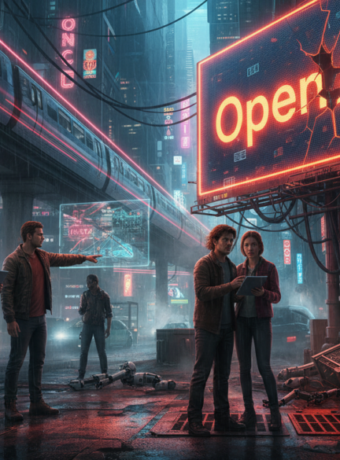
A damp, neon-lit opening scene that feels familiar and oddly strategic
The film stages a common cyberpunk tableau: memory loss, corporate predators, and a biochip that converts a grieving father into a walking exploit. That setup reads as formula but functions as a simple distribution vehicle for a handful of visual effects and worldbuilding choices that can be licensed, copied, or mocked across media.
According to a streaming description, the protagonist Leon was implanted with a biochip that lets him connect to computers while he fights to save a terminally ill daughter. (primevideo.com)
Who actually made this and when it landed in festivals
Identity originates from Russia with the original title Identifikatsiya and a festival screening in March of 2024, followed by later market releases in 2024 to 2025. That production timeline matters because it shows the film was completed and circulated during a period when AI-style visual tools and remote postproduction were becoming cheaper and more available. (imdb.com)
Why small VFX houses and indie game studios should be watching
Low-budget cinema has become a training ground for emerging pipelines and asset reuse. A single 84 minute film can produce dozens of usable assets such as urban skyline passes, UI HUD designs, and motion cycles that can be repurposed for games or advertising. The math is straightforward: if a studio spends 30 to 50 thousand dollars to create a set of reusable city plates and then licenses that pack to five small game teams at 2 to 5 thousand dollars each, the studio recoups costs and builds a micro-economy around a single title.
That kind of secondary licensing is less glamorous than a box office record but more reliable for sustaining boutique teams, and yes, it smells faintly of capitalism in pixel form. It also means the aesthetics seen in that hospital scene can become a shorthand across unrelated properties within months.
How the film is being distributed and who can actually see it
The title has begun to surface on German and pan-European streaming catalogs and digital stores as a buy or rent item, rather than a wide theatrical release. That pattern indicates a direct-to-digital strategy aimed at niche sci fi audiences rather than mass-market promotion. (justwatch.com)
Smaller streaming windows and pay per view offers make it easier for nontraditional distributors to test regional demand without big upfront spending. That distribution model accelerates the feedback loop for which visual motifs catch on.
The critical reception and platform ratings that shape discovery
Audience scores on several aggregator sites skew modest, with user ratings clustered in the lower midrange. Those middling ratings keep discovery limited to algorithmic pockets where cyberpunk fans already congregate, which paradoxically preserves the film as an obscure cult asset rather than a mainstream hit. (kinocheck.de)
A low average rating also reduces the marketing budget required for a platform to promote the film, effectively making it a cheap bet in a content catalog that needs breadth as much as hits. The result is more titles like this entering the market, each a small laboratory for cyberpunk motifs and IP experiments.
The talent roster and the production footprint
The movie credits list Serik Beyseu as director and a cast that includes Anton Pampushnyy and Viktoriya Agalakova, names familiar in regional markets but invisible in Hollywood trade pages. The production companies and producers listed suggest a modest budget and a strategy built around international digital licensing rather than domestic theatrical domination. (tvtoday.de)
That kind of talent mix often means crews who build their effects in-house or via small vendors, which in turn grows the capability base in markets outside the usual VFX hubs.
A dozen small films like this can rewrite the visual grammar of cyberpunk without anyone noticing until a game trailer borrows the exact HUD and everyone assumes it was original.
Practical implications for businesses with 5 to 50 employees
A boutique studio of 5 to 50 people can leverage films like this in three concrete ways. First, buy or license low cost plates and UI assets for rapid prototyping rather than commissioning bespoke work, saving roughly 40 to 70 percent on concept art and city plates. Second, partner with regional postproduction houses that worked on the film to co-develop middleware tools; a revenue split on middleware licensing can convert one project into recurring income. Third, use the film as a test case for community marketing: allocate 1 percent of annual revenue to buy targeted advertising around the film title on platform catalogs and measure conversion into a mailing list. Those numbers are small enough to be feasible and large enough to teach whether a given aesthetic actually converts for the studio.
Smaller teams looking to launch a cyberpunk game can prototype six weeks faster by reusing prebuilt assets, which translates into saved payroll that can be redeployed to marketing or QA.
Risks and questions that stress-test the significance
The biggest risk is mistaking surface style for strategic value. A neon palette and an implant plot do not guarantee cultural influence; the downstream spread depends on reuse, licensing clarity, and whether assets are released in practical formats. There is also legal risk: cross-border licensing and unclear chain of title can create downstream exposure for small studios that reuse assets without enforceable rights.
Another open question is whether audiences will consolidate around a few large franchises or remain fragmented. If the former happens, obscurities stay obscure; if the latter happens, every small title becomes a potential seedbed for a viral idea.
What the cyberpunk industry might actually learn from this
Small, regional productions accelerate experimentation with practical effects, affordable VFX, and UI design that larger studios are reluctant to trial. That experimentation feeds into games, live events, and themed hospitality projects looking for authentic, production-tested visuals rather than corporate-safe approximations. Expect more cross-pollination and fewer high-budget, risk-averse attempts to define the genre singlehandedly.
Looking ahead with a clear operational insight
If the goal is cultural influence rather than an Oscar, then funding small, distributed productions and cultivating licensing relationships is the most efficient path forward.
Key Takeaways
- Identity shows how low budget films become visual laboratories that influence games and niche brands.
- Digital-first distribution lets regional titles find paying microaudiences without big marketing spends.
- Small studios can save time and money by licensing assets from these films rather than building from scratch.
- Legal clarity on asset ownership is the single most important operational control for reuse.
Frequently Asked Questions
What is Identity – Cyberpunk Wars and where can I watch it?
Identity is a Russian science fiction action film released in festival circuits in March of 2024 and later distributed digitally in several markets. It appears on regional streaming and rental platforms rather than on major global subscription feeds. (imdb.com)
Can a small game studio legally reuse assets from an obscure film?
Reusing assets requires a license or explicit permission from the rights holder; buying the film on a storefront does not confer reuse rights. Contact the distributor or listed production company to negotiate a proper license before repurposing any asset.
Does this movie indicate a shift in cyberpunk aesthetics for mainstream media?
It is one of many small inputs that collectively shape the visual language; a single title rarely causes a sweeping change but several similar productions released in the same period can create a detectable trend.
How much can a studio expect to pay to license assets from a film like this?
Prices vary widely but small asset packs or plates can cost from a few hundred to a few thousand dollars depending on exclusivity and file formats. Negotiate per-use and test licensing on a single asset before scaling.
Should a boutique VFX vendor invest time pitching to films like this?
Yes, these productions are where vendors can build credits, test tooling, and create reusable asset packs that turn into multiple small licensing deals over time.
Related Coverage
Readers interested in this thread should explore reporting on how indie VFX vendors scale up through micro licensing deals, the economics of direct-to-digital regional releases, and the role of UI and HUD design in crossmedia franchises. Those topics show how small creative plays can become durable industry building blocks.
SOURCES: https://www.primevideo.com/detail/Identity—Cyberpunk-Wars/0TKO2M4CS8AFVG7RQOT8AR9SNG https://www.justwatch.com/de/Film/Identity https://www.imdb.com/title/tt7106728/releaseinfo/ https://kinocheck.de/film/8pc/identity-2025 https://www.tvtoday.de/filme/identity-cyberpunk-wars_12781488.html