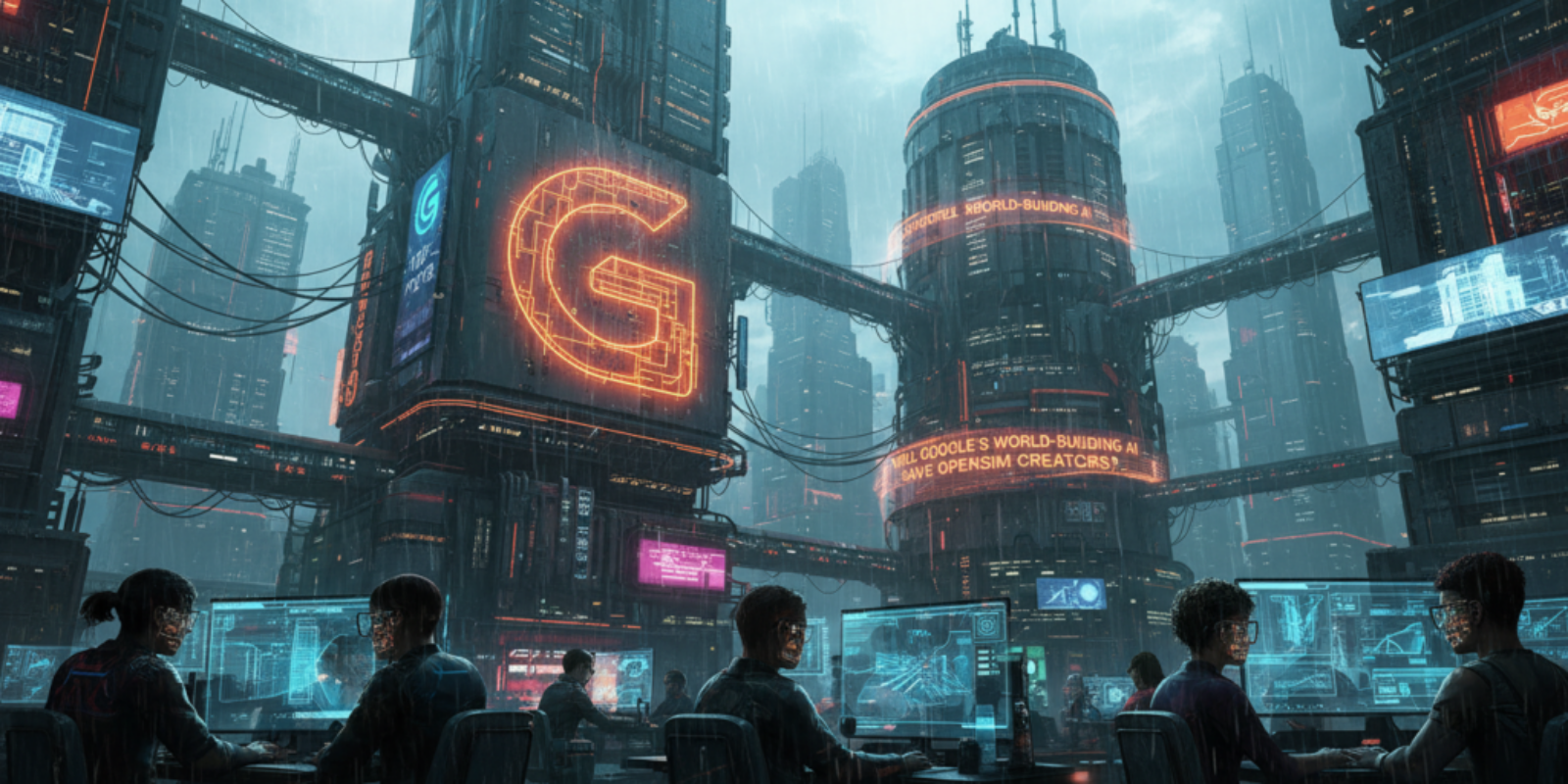
Google’s world building AI points to exciting future for OpenSim creators (or their doom!)
Project Genie and Genie 3 may hand OpenSim a toolset for rapid world creation while rewriting who gets paid to build the metaverse.
A small OpenSim grid admin watches a text prompt turn into a walkable plaza in less than five minutes, then thinks about rent for next month. The scene is not a movie pitch but a live demo of Google’s Project Genie that turns short prompts and images into explorable 3D environments in real time. Early access is rolling out to paid Google AI subscribers, and that rollout already reframes what small virtual world operators can expect. According to Google’s announcement, Project Genie is available to Google AI Ultra subscribers in the United States as an experimental research prototype. (blog.google)
The obvious reading is headline friendly: Google builds a faster way to prototype levels and train robots, and game studios rush to adopt it. The less obvious and more consequential angle is that this capability compresses the cost and time of world building into a service model that could either empower independent OpenSim creators to scale quickly or tilt the market toward platforms that control the generative pipeline. Early coverage leans heavily on Google press materials and DeepMind research notes, which is important context for evaluating claims. (deepmind.google)
Why the timing matters for the metaverse industry
Genie 3 arrives as the industry struggles to lower creation costs and onboard mainstream users. Established players from Epic Games to Nvidia are layering AI into content pipelines, and the promise of text to world generation accelerates that trend. Financial Times coverage frames world models as a potential near term disruptor for the broader games ecosystem, which signals where investment and talent may flow next. (ft.com)
A concise translation of the tech to practical effects
DeepMind’s Genie 3 generates navigable environments at roughly 24 frames per second and maintains several minutes of consistent world memory, which lets simulated physics and object placement remain coherent as a user explores. That coherence is the technical leap that turns novelty demos into tools for testing workflows and agent training. (deepmind.google)
Competitors and the arms race in world models
While Google DeepMind is the name grabbing headlines, a number of research teams and startups are racing to produce similar systems for creators and studios. TechCrunch’s reporting links Genie 3 to prior video and simulation breakthroughs and highlights the competitive pressure to move from static assets to interactive, generative environments. The competitive landscape will shape APIs, licensing, and which platforms get exclusive features. (techcrunch.com)
What this could mean for OpenSim creators today
For OpenSim grid owners and content creators, the short term is about operational gains. Generative worlds can produce base terrains, lighting conditions, and navigable architecture that a small team would otherwise sculpt by hand. That can speed event setup, proof of concept builds, and educational simulations, freeing human creators to focus on curation and scripting rather than rote geometry. Hypergrid Business has already encouraged OpenSim operators to experiment with generative AI on noncritical assets and to treat it as an augmentation rather than a replacement. (hypergridbusiness.com)
The danger is not that AI will uglify the metaverse; the danger is that it will make everything equally commodified, which is worse for creators than being ignored.
Practical scenarios for small teams with real math
A team of 10 people running a revenue generating OpenSim grid spends about 40 hours per region to design, texture, and script a themed zone. If Project Genie or similar tooling can cut that time to 4 hours, the team frees up 360 designer-hours per month. At an internal billing rate of 40 dollars per hour, that is a labor cost reduction of about 14,400 dollars per month that can be reallocated to marketing or community building. Even if the AI reduces only the first pass work, the savings on iteration time make seasonal activations feasible for teams that previously could not afford them.
A 5 person content studio that sells themed regions for 500 dollars each could increase throughput from 4 to 40 regions per month if generation time falls by 90 percent. That would change monthly revenue from 2,000 dollars to 20,000 dollars, assuming demand scales. Of course, these scenarios assume clients accept AI generated baselines and are willing to pay for human polish on top. If the market expects raw AI worlds, prices will compress accordingly, which is a different business problem.
The cost nobody is calculating
There is a hidden ledger here: homogenization, loss of unique artistic signatures, and licensing friction around training data. If many OpenSim creators rely on the same generator and datasets, grids start to look similar and the value of bespoke content falls. That reduces downstream income for independent artists and may concentrate purchasing power in platform owners who control premium-generation features. This is a cultural cost disguised as technical efficiency, and it will show up in churn rates for communities that prize uniqueness. Hypergrid Business raised similar concerns about homogenization and bias when advising OpenSim operators to use AI judiciously. (hypergridbusiness.com)
Dry aside: the good news is anyone can spin up a photoreal plaza; the bad news is the plaza may come with default benches and a suspiciously cheerful eucalyptus tree.
Risks, trust, and open questions that stress-test the claims
Generative world models still struggle with long duration consistency, legible text in scenes, and multi agent interactions. There are also intellectual property questions about whether generated objects mirror copyrighted designs and what that means for resale in open grids. Safety and moderation matter too because procedurally created spaces could include copyrighted, offensive, or unsafe content at scale. All of these are unsolved governance problems that require platform rules, developer tooling, and possibly new community standards. (deepmind.google)
Dry aside: more tools, more governance, more paperwork; metaverse bureaucracy is on trend for 2026.
A playbook for a 5 to 50 person metaverse business
Start with triage: automate low value tasks such as background scenery and filler NPC paths while reserving bespoke character design and narrative beats for humans. Budget for a modest subscription to a world generator, then set aside 20 percent of saved labor hours for quality assurance and anti plagiarism checks. Test one live event using AI generated regions and compare engagement metrics across two months to validate whether community participation improves enough to justify the subscription.
Forward looking close
Project Genie and Genie 3 crystallize a reality where world building becomes a mix of prompt engineering, human curation, and new licensing models; OpenSim creators who plan for that shift can use the tools to scale while protecting the cultural capital that distinguishes independent grids.
Key Takeaways
- Generative world models can slash initial build time for OpenSim regions while shifting value to curation and scripting.
- Google’s Project Genie rollout is an experimental, subscriber limited debut built on Genie 3 research that emphasizes real time navigable worlds. (blog.google)
- Small teams can convert labor hours into more frequent activations, but must budget to preserve uniqueness and manage licensing risk.
- Industry momentum favors platforms that combine good tooling with clear governance and creator revenue routes. (ft.com)
Frequently Asked Questions
How quickly can a small OpenSim team adopt Project Genie style tools?
Adoption can be immediate for noncritical assets since Project Genie is available to Google AI Ultra subscribers in the U.S. Testing integration with existing export formats and pipelines will take an additional few weeks to months depending on scripting complexity. (blog.google)
Will AI generated regions reduce my sales as a content seller?
Possibly, if buyers prefer low cost AI baselines. However, many clients still pay premiums for unique design, bespoke interactions, and support, which human teams can offer as add on services. Market segmentation will matter more than a simple price drop.
Are there legal risks from using AI generated content on OpenSim grids?
Yes. Questions about training data provenance and inadvertent resemblance to copyrighted works are unresolved in many jurisdictions, so maintain provenance records and consider licensing safeguards. (deepmind.google)
Can AI world models train in world AI agents for customer experiences?
That is one of the core promises. Genie 3 and similar systems are explicitly designed to train embodied agents in simulated tasks, which could accelerate automated moderation, NPC behavior, and bot driven experiences. (deepmind.google)
Should small grids be worried about being outcompeted by larger platforms?
Competition will intensify because large platforms can bundle generative features with distribution. Niche grids that double down on unique experiences, community governance, and creator revenue shares will remain viable if they adapt tools wisely. (ft.com)
Related Coverage
Readers interested in how AI is changing creation economics should explore reporting on automated animation pipelines, AI moderation systems, and the evolving licensing debate around training datasets. Coverage of tools that turn text prompts into playable game levels and of startups building creator marketplaces will be particularly relevant for OpenSim operators monitoring monetization options.