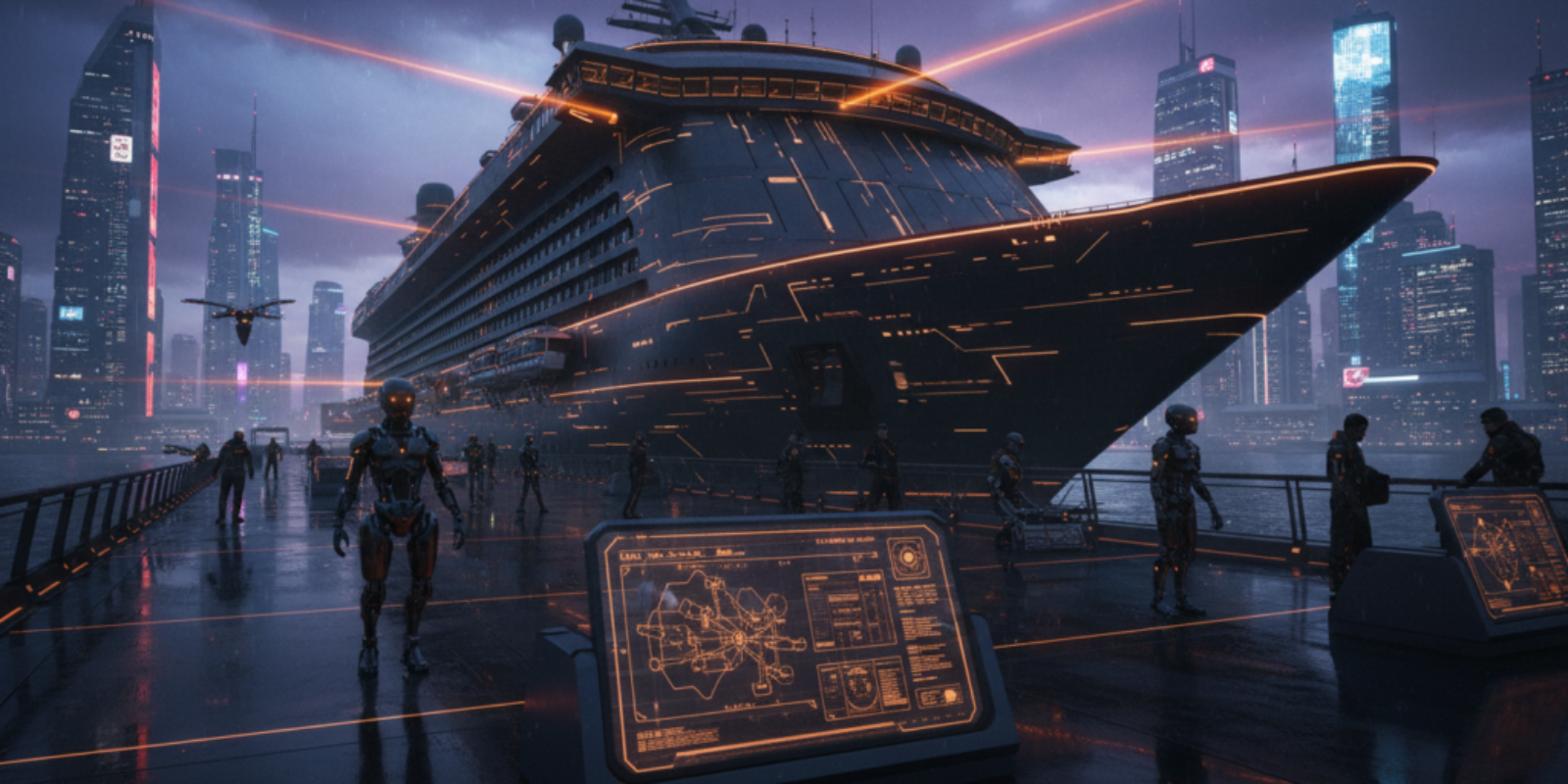
Passengers Will Be Welcomed by AI Robots on a Huge New Cruise Ship for AI Enthusiasts and Professionals
A gleaming gangway, an expectant crowd, and a line of humanoid kiosks nodding like polite greeters at a tech convention. This is not a film set — it is the hospitality industry learning to speak machine.
Arriving passengers will be scanned by a kiosk, guided by an AI concierge and handed a program for talks and labs before their luggage is gently pushed away by a delivery robot. The obvious reading is that this is a novelty experience for wealthy hobbyists who like workshops on their vacation. The overlooked business story is how a purpose-built, large-scale ship that embeds robotics, digital twins and AI services at every touchpoint could become a commercial proving ground for industrial AI deployments that scale beyond tourism.
Near the top: much of the public detail about robots on ships comes from vendor and cruise-line materials, which shape the narrative about capability and use cases. That said, the technical and market signals behind the idea are broader and actionable for industry leaders.
Why the cruise format matters more than the gimmicks
A cruise ship is a tightly controlled, high-density environment with predictable routes, repeatable operations and concentrated customer flows. That makes it ideal for iterating on robotics and AI stacks, because sensors, networks and operational processes can be standardized across decks and sailings. Companies can test multi-robot coordination, local inference for safety-critical tasks and human-robot service handoffs with a fraction of the deployment complexity found in a city.
Real-world examples already exist: robotic bartenders have been a commercial attraction at sea for years. Royal Caribbean’s Bionic Bar demonstrated throughput and customer interaction patterns that robotics firms study as service design data. According to the Royal Caribbean Press Center, those installations run continuous mixes and map guest-order behaviors to UI tweaks and maintenance schedules. This is not just theater; it is telemetry. Royal Caribbean Press Center
From robot bartenders to welcoming humanoids
Hospitality robots have been deployed on land for a decade, with mixed commercial results. Hotels such as Japan’s Henn-na showed that robots can welcome and guide guests while revealing the hard limits of novelty when routine reliability is required. Practical lessons include designing graceful fallbacks to human staff, managing expectations, and instrumenting every interaction for retraining. The industry learned that guests appreciate robots that solve problems, not robots that seek applause. Engadget covered the early Henn-na rollout and what the experiments taught operators.
Who the competitors are and why now
Vendors of service robotics, cloud AI stacks and industrial digital twins are converging on environments that require both scale and safety. Companies such as Makr Shakr built specialized robotic arms for high-throughput, repeatable hospitality tasks and have partnered with large cruise lines to install systems that collect mission-critical usage data. Their deployments on multiple ships created a template for integrating robotic subsystems with guest apps and payments. Makr Shakr’s media materials chronicle that journey from prototype to production deployment.
At the platform level, industrial incumbents are racing to provide the orchestration layer. Siemens and NVIDIA announced an expanded partnership to build an Industrial AI Operating System designed to turn passive digital twins into active control planes that can run robotics simulations, safety checks and model updates before code touches metal. Translating the same stack from shipyard to ship floor shortens deployment cycles for companies that want to test AI in constrained physical systems at scale. Siemens’ press materials from CES detail this initiative and the relevance to complex industries including shipbuilding.
Hard numbers that matter to investors and CTOs
The service robotics market is already large and growing rapidly, with industry reports projecting double-digit growth as hospitality, logistics and healthcare adopt robot workforces. Market research firms estimate the global service robotics market at tens of billions of dollars with forecasts that make a cruise-ship testbed a plausible commercial bet for vendors seeking repeatable revenue and data advantages. Those projections frame why investors would underwrite an expensive floating lab rather than a land-based pilot. MarketsandMarkets provides one of the market sizing baselines often cited by strategic teams.
A ship that runs fully instrumented robotics trials is not a vacation with gadgets; it is a continuous integration pipeline for the physical world.
Practical implications for businesses: real math, real scenarios
A mid-size cruise with 3,000 passengers running a robot concierge network that cuts average check-in time by 60 percent could free 20 human staff from repetitive duties. If average onboard labor cost is 30 dollars per hour and the ship sails 300 days per year, that is roughly 4.3 million dollars in annual wage-equivalent exposure shifted into capital, maintenance and software subscriptions. Add data monetization from aggregated anonymized behavioral feeds and the ROI timeline can compress to 18 to 36 months for vendors that sell Robot-as-a-Service plus analytics.
For AI companies, the ship provides closed-loop feedback for perception models, low-latency edge compute validation and curated datasets for simulation-to-reality transfer. A single ship yielding continuous labeled interactions across seasons offers more valuable model training data than short urban pilots.
The cost nobody is calculating up front
Capital expenditures, redundancy engineering for safety, maritime regulatory compliance and bandwidth provisioning are significant line items. Shipping companies will pay for reliable edge hardware, but AI firms must budget for rigorous certification cycles and a team that can operate at sea logistics. Underestimating the integration cost between physical robot fleets and existing hotel management systems is the fastest route to an expensive proof-of-concept that never scales.
Risks and open questions that stress-test the claims
Operational risk includes hardware failures in corrosive marine environments, adversarial inputs to perception systems and privacy concerns around biometric check-ins in international waters. Regulatory risk is nontrivial: maritime jurisdictions vary on data retention, surveillance and liability, and the ship must be architected to respect the strictest applicable rules. Finally, the human factor matters; guest acceptance curves differ across demographics and will determine whether robots augment or displace crew in practice.
What small teams should watch closely
Startups building perception stacks, teleoperation tools and Robot-as-a-Service business models should prioritize interoperability and modularity. Ships force scale and edge-first design in ways city pilots do not, so learnings translate to airports, hospitals and factories. If the ship proves a profitable staging ground, expect a wave of enterprise players buying services rather than hardware.
Where this moves the AI industry next
A floating testbed that proves reliable, repeatable outcomes will accelerate confidence in deploying AI systems for complex physical workflows. The result could be faster industrial AI adoption in logistics and manufacturing, because the same software that manages a cruise robot fleet can manage an automated warehouse or a production line.
Looking forward
The next 24 months will show whether the cruise-as-laboratory becomes a blueprint or a footnote. If the ships deliver operational savings and data quality on schedule, expect more vertical-specific AI platforms to emerge, selling subscription control planes rather than one-off robots.
Key Takeaways
- Cruise ships act as high-control environments that accelerate robotic systems validation and model training for the AI industry.
- Existing deployments like robotic bartenders supply real operational telemetry that informs scaling decisions.
- Industrial AI stacks and digital twins from Siemens and partners make shipboard orchestration technically feasible.
- Market forecasts for service robotics justify investment in large, instrumented testbeds if integration costs are managed.
Frequently Asked Questions
How will robots on a cruise ship improve operational efficiency for a travel brand?
Robots reduce repetitive human tasks such as check-in and room service, freeing staff for higher-value guest interactions. Savings come from reduced labor hours and improved throughput, though capital and maintenance costs must be included in ROI models.
Can the data collected on a ship be reused for other industries like manufacturing?
Yes. Dense, labeled interaction data from coordinated robots and sensors accelerates transfer learning for logistics and manufacturing, because simulation fidelity and edge orchestration patterns are similar across complex physical environments.
Will passengers lose jobs to robots on these ships?
Some roles focused on repetitive tasks may be reduced, but new roles emerge for robot supervisors, data engineers and service designers. The more likely near-term outcome is role rebalancing rather than wholesale displacement.
What are the privacy and legal concerns for AI systems operating at sea?
Maritime data governance spans flag state, port state and passenger nationalities, so systems must be designed for strict consent, anonymization and cross-border data controls to avoid regulatory conflicts.
Is investing in a cruise testbed wiser than an urban pilot?
It depends on the product. For multi-robot coordination, repeatable guest flows and controlled conditions, a cruise testbed can compress validation cycles. For broader population studies and variability, urban pilots may be superior.
Related Coverage
Readers interested in the operational demands of the Industrial AI transition should explore reporting on digital twin adoption in heavy industry and the economics of Robot-as-a-Service models. Coverage of hospitality automation and airport AI rollouts will also illuminate how public-facing deployments evolve from novelty to utility.
SOURCES: https://www.royalcaribbeanpresscenter.com/video/491/quantum-of-the-seas-bionic-bar-b-roll/, https://www.makrshakr.com/media-room/makr-shakr-is-first-robotic-bartending-system, https://www.engadget.com/2015/07/15/japans-first-robot-staffed-hotel/, https://press.siemens.com/global/en/pressrelease/siemens-and-nvidia-expand-partnership-build-industrial-ai-operating-system, https://www.marketsandmarkets.com/Market-Reports/service-robotics-market-681.html