And I Thought Drones Sounded Scary
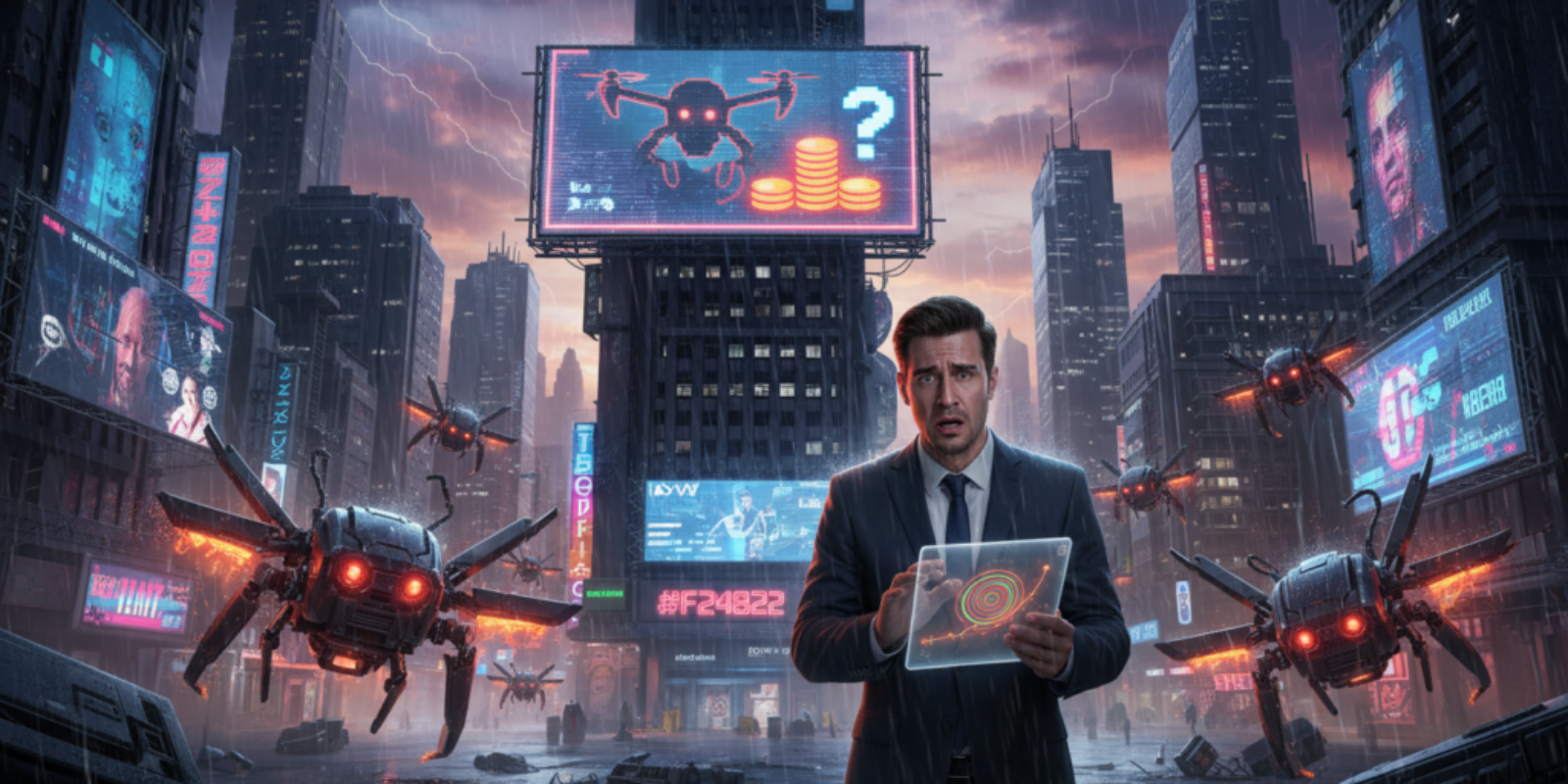
When the sky sounds like a thousand angry insects, the future stops being aesthetic and starts being policy.
A backyard at dusk. A neighbor’s kid playing, a dog panting, then a thin, rising whine that does not belong to any natural season. It hangs in the air until someone on the porch says the single sentence people now say to one another and then forget to mean: watch out. That small, mechanical terror has become a sonic shorthand for modern vulnerability, equal parts toy, tool, and terror.
Most coverage treats these noises as a wartime novelty or a consumer nuisance. The more consequential story is quieter: the buzz is rewriting how cyberpunk creators, small firms, and local planners imagine danger, trust, and public space—and that change has immediate business consequences for product designers and hospitality owners. This piece leans on recent press reporting and think tank analysis while adding cultural and commercial implications for the cyberpunk industry and small teams.
Why the buzz no longer belongs only to genre fiction
Drones graduated from spectacle to strategy when cheap, fast drones proved useful on real battlefields. The US and China are racing to field coordinated drone systems as a way to overwhelm defenses and project force at lower cost and higher scale than traditional tools. That strategic competition has pushed major defense budgets and startups into a new arms layer. (apnews.com)
When defense contractors read like superhero origin stories
Silicon Valley defense startups, long obsessed with software-first platforms, reframed aerial autonomy as a commercial product for war. The Pentagon’s multi-billion dollar interest in collaborative combat drones and expendable fleets accelerated companies that treat hundreds of flying machines as a single software problem rather than 100 radios and batteries. The result is a rapid move from choreographed light shows to systems designed to improvise on the battlefield. (wired.com)
How military developments leak into city streets and studio soundtracks
Swarm tactics, and the public recordings of them, supply the raw material for cyberpunk aesthetics. The soundtrack of a foggy alley in a game or a neon-lit chase in a film no longer needs a composer to fake dread; real life supplies a high-pitched, invasive timbre that audiences already understand. Creators are borrowing the language of surveillance and asymmetric attack to sell authenticity, and corporate sound designers are packaging that authenticity as an asset for immersive experiences.
The data that shifted how writers and CTOs sleep
Frontline reporting shows these systems are not hypothetical. In multiple conflicts, small explosive or loitering drones produced intense psychological effects on civilians and soldiers alike, with footage and audio circulating online and shaping public perception. At the same time, military and commercial players are investing in rapid fielding and countermeasures, creating a feedback loop between deployment, public panic, and product responses. (ft.com)
The drone’s whine is now a narrative tool and a risk vector, audible proof that the future of conflict is no longer distant.
The sound design feedback loop: real war feeds fiction and then products
Film and game sound designers harvest battlefield audio to heighten realism, which then trains audiences to react emotionally to specific frequencies. That training changes consumer tolerance for ambient tech noise and raises expectations for authenticity in cyberpunk IP. Meanwhile, startups selling defensive gear and detection software market their products using the very audio cues that studios monetize. There is an uncanny corporate symmetry here, plus the occasional deadpan truth: people used to complain about pigeons; now they invoice for them.
Practical implications for businesses with 5 to 50 employees
A neighborhood restaurant, a 20-person architecture firm, or a boutique studio must treat drone risk as operational, not cinematic. Consider a 15-person café with annual revenue of $600,000. A mid-tier detection setup often runs between $10,000 to $30,000 as a one-time capital cost plus 10 to 15 percent annually for licensing and maintenance. For this café the upfront spend equals 2 to 5 percent of annual revenue; amortized over 3 years it adds about $280 to $840 per month to operating costs. If insurance premiums rise by just 5 percent because of heightened local risk, that is another $25 to $100 per month, depending on current coverage. These numbers are not glamorous but they are precise: risk management has become a line item many small firms ignored until last year.
A 40-person creative studio with $3 million in revenue that spends $50,000 on detection and resilience is investing 1.7 percent of revenue to preserve client trust and avoid the far larger cost of a PR hit or physical disruption. The math is plain: prevention is small compared with the cost of lost contracts, reputational damage, and interrupted workflows.
Legal, reputational, and operational risks every small owner should weigh
Mitigation is not always legal. Active jamming often violates national communications law and can attract regulatory fines. Detection and reporting, integration with local law enforcement, and simple physical resilience planning are safer first steps. Businesses must also plan for the reputational angle: customers and neighbors interpret drone incidents through social media before official statements arrive, and that gap is where brands lose trust. The ethical debate over autonomous weaponry and the proliferation of low-cost swarms amplifies this moral hazard. (csmonitor.com)
The cost nobody is calculating: cultural liability
IP owners and event producers must reckon with a new kind of cultural liability: when fiction normalizes a frightening sound, audiences may weaponize the image and the noise for protest, stunt marketing, or worse. That dynamic forces brands to budget for crisis communications and to build quick-response operations, not just for tech fixes but for storytelling rereleases and community engagement. Think of it as insurance for your story.
Risks and open questions that stress-test confident claims
Proliferation remains the wild card. Cheap hardware, open-source coordination tools, and lessons from active theaters of conflict mean swarm capabilities could spread faster than regulators can react. Think tanks warn about a diffusion of swarm tactics to nonstate actors, with the potential for destabilizing regional security and enabling new forms of coercion. The time horizon for fully autonomous lethal swarms is debated, but the operational impact is here now in hybrid forms. (orfonline.org)
Where creators and small businesses should look next
Product teams should treat drone sound as both a design constraint and an opportunity: reduce uncontrolled noise, design for clear auditory UX, and consider partnerships with local security integrators. Cyberpunk storytellers should ask whether authentic audio helps narrative or simply traffics in trauma. Both industries will find that credibility now requires operational rigor as well as creative flair.
Key Takeaways
- The drone whine has become a cultural shorthand that directly influences cyberpunk media, sound design, and small business risk profiles.
- Geopolitical competition and startup defense strategies are accelerating real-world swarm capability and public exposure. (apnews.com)
- Small firms should budget modestly for detection and resilience because prevention costs far less than reputational or operational losses.
- Legal and ethical limits constrain active mitigation; detection, reporting, and insurance are the sensible first moves.
Frequently Asked Questions
How likely is it that a small business will be targeted by an armed drone?
Targeting tends to follow strategic or symbolic logic rather than randomness. Most small businesses face a low probability of being deliberately targeted, but collateral disruption and nuisance incidents are rising in conflict-adjacent areas.
Can a café legally jam or shoot down a drone over its property?
No. Jamming and kinetic interdiction are usually illegal and can create much larger liabilities. The safe route is detection, documentation, and coordination with local authorities and private security partners.
What’s a realistic budget for drone detection for a 10 to 50 person company?
A practical starting budget is $10,000 to $30,000 for detection and basic analytics, with ongoing fees of 10 to 15 percent annually. The precise figure should follow a site survey and a risk assessment.
Should creative studios change their sound design practices because of real-world harm?
Creative teams should be conscious of ethical implications and consider alternative cues or content warnings when using audio tied to traumatic real-world events. Audience empathy now shapes creative risk.
Are there industry partners that small businesses can hire for a fast response?
Yes. Security integrators, local private firms, and event risk vendors offer detection-as-a-service and incident response plans. Contracts can scale to match budgets and risk appetite.
Related Coverage
Readers who enjoyed this can explore how AI governance affects interactive entertainment and how spatial audio is reshaping user experience in urban AR. Also consider reporting on counter-UAS technology markets and the ethics of simulated battlefield audio in immersive experiences.
SOURCES: https://www.wired.com/story/anduril-is-building-out-the-pentagons-dream-of-deadly-drone-swarms/, https://apnews.com/article/us-china-drone-swarm-development-arms-race-e5808a715415d709f466da00cdeab10f, https://www.ft.com/content/1a19df67-3453-4a16-abf1-9fda36142f4b, https://www.csmonitor.com/USA/Military/2024/0826/pentagon-drone-swarms-ai-ethics-china-russia, https://www.orfonline.org/research/a-plague-on-the-horizon-concerns-on-the-proliferation-of-drone-swarms