How Refik Anadol’s Data-Driven, AI Sculptures Are Rewriting What Companies Expect from Creative Intelligence
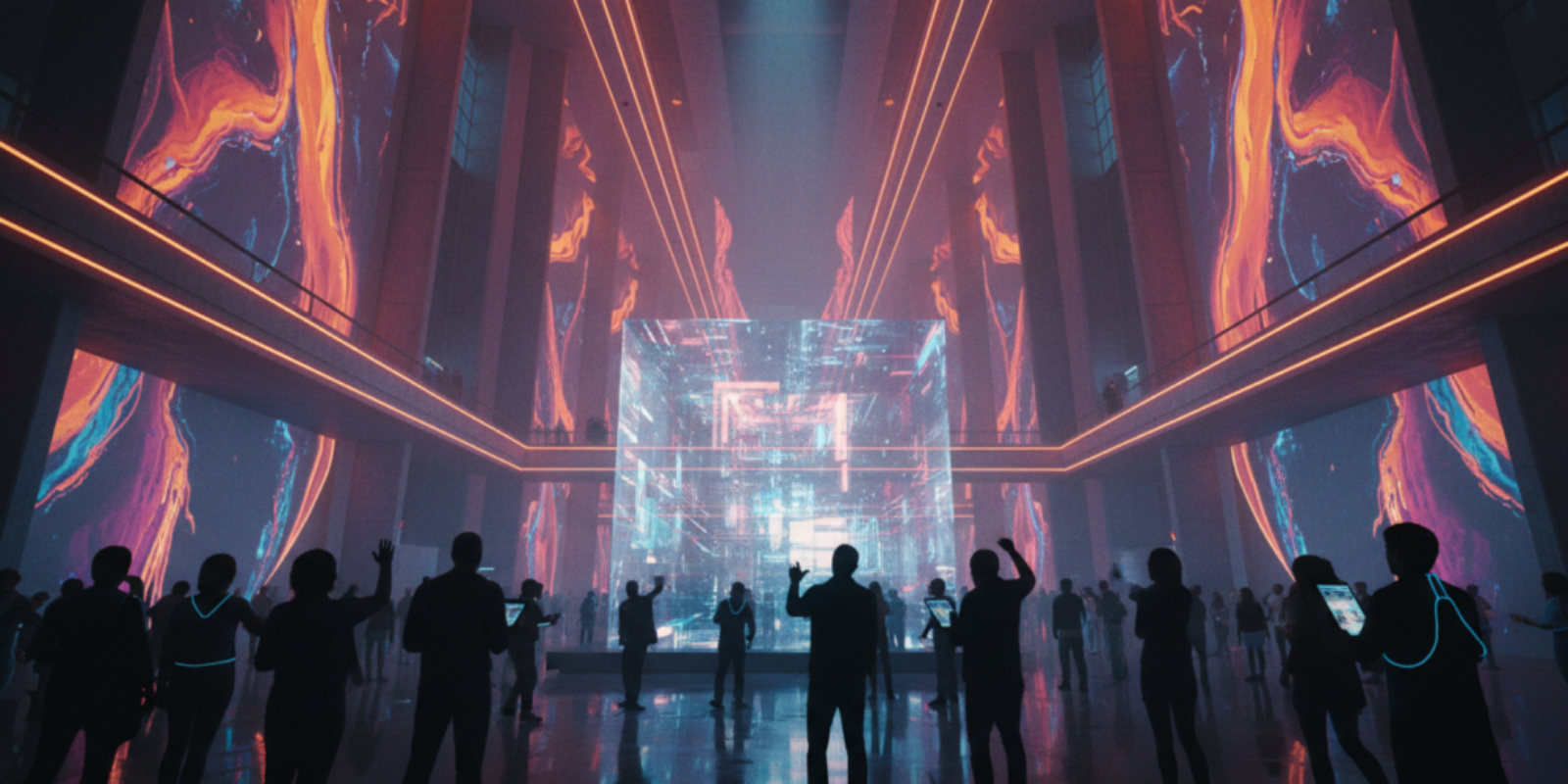
When a 24 foot media wall at MoMA stopped being a screen and started feeling like a thinking thing, the people in the lobby did not know whether to sit in silence or open their laptops and take notes.
A visitor leans forward as an image melts into another image and then another, each shift guided by algorithms that have been fed hundreds of millions of pictures. The obvious reaction is to call it spectacle, a clever use of big screens and brighter pixels to fill museum foot traffic and Instagram feeds. Much of the reporting and museum documentation comes from studio and institutional press materials, so this framing is the easy read; the sharper story for business leaders is how the underlying pattern of collecting massive proprietary or public datasets, training bespoke models, and treating AI outputs as continuously evolving assets changes cost structures and talent plans across industries. (refikanadol.com)
Why the public thinks this is just art and why that is becoming the least interesting angle
The mainstream line on Anadol’s work treats the machine as a tool that renders pretty abstractions for galleries. That view misses the operational playbook beneath the gallery floor. The studio’s process resembles how a product team might ingest domain data, iterate models, and ship continuous visual experiences, except here the output is authorized as cultural capital and sometimes tokenized. (refikanadolstudio.com)
How his projects actually look under the hood and why it matters to AI teams
Refik Anadol’s studio collects enormous, project specific corpora and engineers pipelines that convert visual archives into latent spaces for generative models. For Nature Dreams the studio reports training on a dataset of more than 300 million publicly available nature photographs, processed into a custom GAN pipeline to produce evolving, multisensory data sculptures. That scale is not a novelty but a design constraint: the choice to assemble huge, targeted datasets forces a different tooling and compute budget than off the shelf models. (refikanadol.com)
The compute and tooling that make a “living data sculpture” possible
Anadol’s installations run on accelerated GPU pipelines and bespoke rendering stacks that fuse fluid dynamics solvers with generative networks, a combination that benefits directly from high performance GPUs and parallelized data preprocessing. Industry partners are credited for providing those systems, and the dependence on specialized hardware converts an artistic brief into an engineering procurement exercise. Performance tuning, latency budgeting, and synchronization with physical architecture become product requirements. (nvidia.com)
What museums and venues learned when they hosted these works
When Unsupervised appeared at The Museum of Modern Art, the installation was described as a meditation on what a machine might dream after ingesting more than 200 years of the museum’s collection. The work incorporated environmental inputs such as light and sound to alter the model’s behavior in real time, demonstrating how live external signals can be used to personalize generative experiences at scale. MoMA extended the run because audiences engaged longer than typical gallery pieces, and the museum subsequently added the work to its permanent collection. (moma.org)
The small industry competitors and collaborators in the room
Anadol’s projects sit at the intersection of immersive studios, academic labs, and experiential venues. Organizations like Artechouse commission similar works that collapse public memory and generative models into site specific exhibitions, proving there is a market for production quality AI experiences beyond galleries. For companies thinking about branded environments or retail experiences this is more than decoration; it is a case study in the monetization of experience design. (artechouse.com)
The real product is not the image on the wall but the continuous model that keeps changing the image on the wall.
The core numbers every CTO and CMO should write down
Anadol’s studio cites datasets in the hundreds of millions of images for major projects and partnerships that include hardware vendors, research teams, and institutional donors. Expect multi month data collection phases followed by weeks to months of model tuning and render optimization for a single installation. Budgets for a major public installation commonly run into low seven figures when hardware, venue, staffing, and licensing are included; the value exchange for museums tends to be audience attention and cultural legitimacy rather than direct ticket revenue. (refikanadol.com)
Practical scenarios that show the math and the decision
If a retailer commissions an immersive storefront using a similar pipeline, assume an initial data and model development cost of 200,000 to 500,000 and a monthly operating bill of 5,000 to 20,000 for cloud GPUs, on site servers, and creative ops. If the installation lengthens average customer visit time by 10 percent and that converts to a 2 percent rise in spend, a 1 million revenue store could net 20,000 additional monthly, covering operating costs in short order. This is not fairy dust accounting; it is the same ROI calculus any digital product team uses, except the output is not a webpage but a continuously morphing public asset. The dry gray humor here is that art projects have always had pitch decks; now they have SLOs and SLAs as well.
The reputational and IP questions that executives will face
Tokenization and the use of public archive data raise thorny questions about ownership and provenance. Museums and studios have navigated this with donation and partnership agreements, and some works are minted as blockchain assets to memorialize editions or provenance. Those decisions shift liability and long term archival costs onto the collector or institution rather than the studio, but they also require legal teams to become fluent in data provenance. The blank stare from an arts lawyer encountering a 300 million image corpus is a modern classic. (refikanadol.com)
Risks, edge cases, and the ethics stress test
Training on massive public archives can embed biases and false associations at scale, and unsupervised generative workflows magnify obscure correlations into visible artifacts. Misattribution, unwanted recombination, and the weaponization of aesthetic trust are realistic failure modes. Operationally, continuous outputs mean continuous monitoring; without robust validation, a projection can drift into offensive or brand damaging content before anyone notices. The practical answer is not censorship but governance and realtime auditing. (nvidia.com)
One practical paragraph for teams deciding whether to experiment next quarter
If internal product teams want to prototype a similar pipeline, start with a 6 week pilot using a curated dataset of 50,000 images and a single medium sized GPU instance to validate the concept. If the pilot proves engagement lift, budget the second phase for dataset scaling, distributed training, and a production renderer. That two phase approach limits sunk cost and forces a measurable link between model behavior and business outcomes. A little humility helps; artists have been doing iterative prototyping for a long time and usually look less surprised than engineers at the end. (artechouse.com)
What to watch next as this pattern spreads beyond galleries
Expect more institutions to embed generative installations as part of customer experience programs and more vendors to offer turnkey solutions that bundle datasets, models, and render pipelines. Watch which cloud and GPU vendors standardize APIs for continuous generative assets, because standardization will reduce time to market and make these experiences as common as a branded video wall. Partnerships between creative studios and infrastructure providers will tilt commercial outcomes towards whoever controls both the cultural narrative and the compute stack. (nvidia.com)
Final practical insight for decision makers
Treat generative visual systems as living products with maintenance budgets, ethical guardrails, and measurable engagement metrics, not as one off campaigns. The organizational change is less about hiring a single artist and more about building a small multidisciplinary team that runs models like products.
Key Takeaways
- Large scale, project specific datasets change the cost and governance model for creative AI and require production grade compute and monitoring.
- Museums adopting generative works prove that continuous AI assets can be cultural and commercial properties at the same time.
- Prototype with a small curated corpus to validate engagement before committing to large scale dataset collection and render infrastructure.
- Legal and ethical reviews must be treated as part of the product roadmap because provenance and bias scale with data size.
Frequently Asked Questions
How much does a Refik Anadol scale installation cost to build and run for a year?
Costs vary widely but a major installation commonly includes low seven figure up front expenses for development and hardware plus five thousand to twenty thousand monthly operations for compute and staffing. Pricing depends on venue, scale, and whether the institution supplies infrastructure.
Can a retail brand reuse Anadol style pipelines for in store experiences without an artist?
Yes, but the output will require the same multidisciplinary team that handles data curation, model training, and creative direction; skipping the art practice risks shallow outcomes. Partnering with an experiential studio or acquiring similar tooling reduces the learning curve.
Are there off the shelf tools that replicate the same immersive quality?
Some vendors offer generative media stacks that handle model hosting and real time rendering, yet the distinctive quality often comes from bespoke datasets and hand tuned render pipelines rather than generic models. Expect trade offs between speed to deploy and uniqueness.
What are the main legal risks executives should prepare for?
Main risks include unclear visual provenance, licensing gaps in scraped datasets, and content drift that causes reputational harm; contracts, data audits, and continuous content moderation mitigate those risks. Legal teams should be involved before production begins.
Will this trend create new revenue lines for media owners?
Yes, museums and venues already monetize through ticketing, limited edition mementos, and licensing of tokenized assets; brands can monetize enhanced dwell time and commerce conversions tied to immersive experiences. The key is linking engagement metrics to commerce or subscription models.
Related Coverage
Readers looking to deepen understanding may want to explore how generative models are being commercialized for retail and hospitality environments and how cloud GPU pricing shapes experimental AI budgets. Investigations into data provenance and the role of museums in validating digital art are also timely, since institutions are increasingly acting like both curators and infrastructure partners.
SOURCES: https://refikanadol.com/works-old/machine-hallucinations-nature-dreams/ https://www.moma.org/calendar/exhibitions/5535 https://www.nvidia.com/en-us/research/ai-art-gallery/artists/refik-anadol/ https://www.artechouse.com/program/machine-hallucination-nyc/ https://www.euronews.com/culture/2022/11/17/refik-anadol-is-making-machines-hallucinate-for-his-moma-debut. (refikanadol.com)