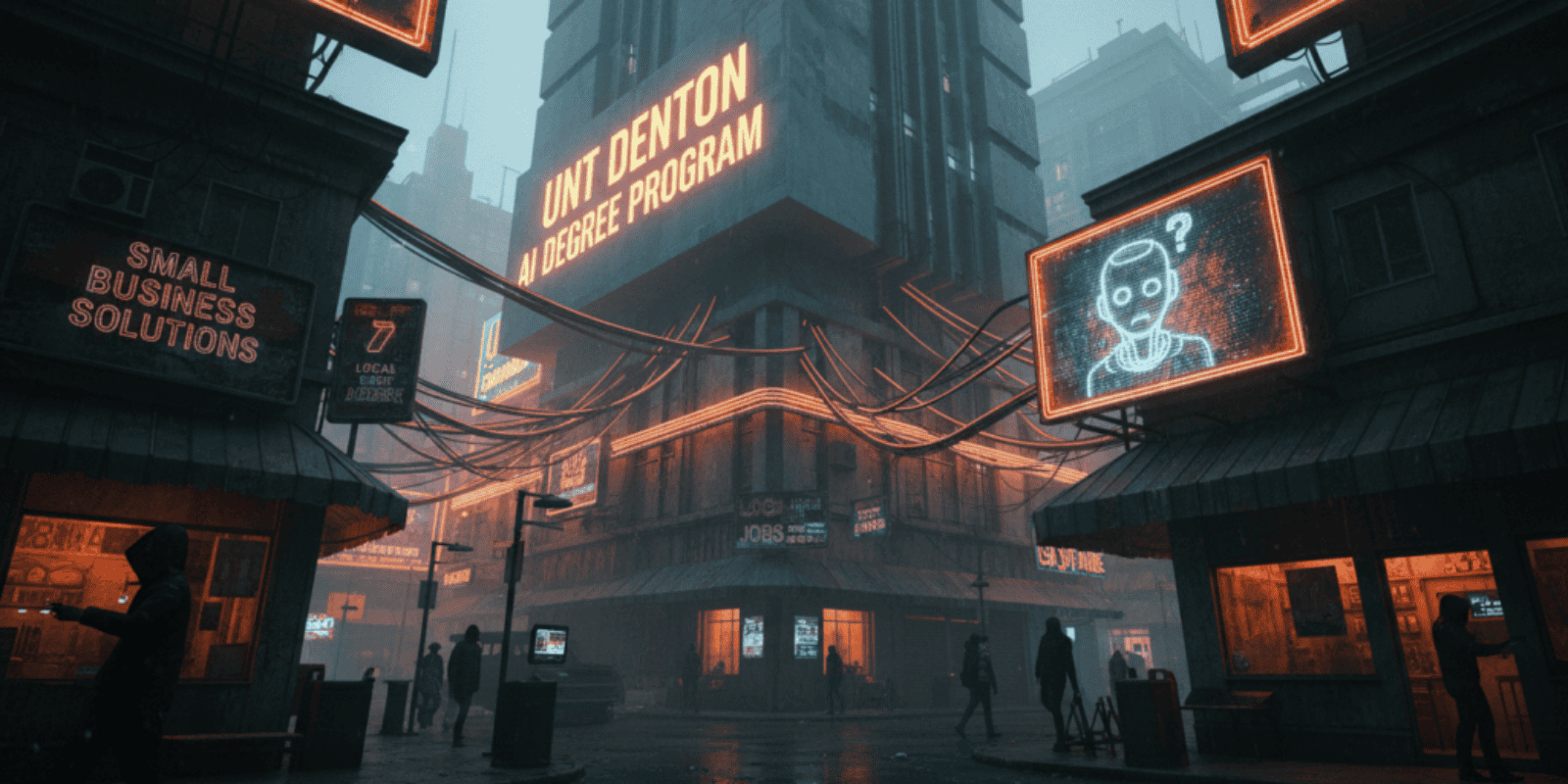
UNT in Denton Launches New Artificial Intelligence Degree for AI enthusiasts and professionals
A regional university’s curriculum pivot that asks a sharper question: can mid-tier public colleges become the talent pipeline that actually moves industry from pilots to production?
A midweek classroom at the University of North Texas looks ordinary until the server rack humming in the back begins answering student questions faster than the professor. The contrast between soldered hardware and streamed lectures frames an odd tension: students here will be trained to handhold production AI as much as they will be taught to invent it. The scene implies a familiar headline about more AI programs, but that headline misses what business leaders should be watching: the deliberate, funded pathway from introductory credentials to a market-ready master that UNT is baking into a single local ecosystem.
Most coverage will call this another university chasing buzzwords. The overlooked fact is that UNT is stacking certificate, graduate and departmental investments to create a ladder for working professionals and undergraduates to move into implementer roles at scale, which is the exact bottleneck companies are complaining about when pilots never graduate to production. This article relies heavily on university press materials and local reporting to document those moves and then tests what they mean for the AI industry. (online.unt.edu)
Why industry recruiters should stop scrolling and pay attention
UNT has launched an online Graduate Academic Certificate in Artificial Intelligence designed for professionals who need concrete skills they can apply in months instead of years. The certificate’s course list is built to plug straight into hands-on roles and to stack with further graduate study, which makes it a cheap experiment for employers to sponsor. UNT’s public materials show a clear pathway rather than a one-off course sale, and companies love pathways because they turn uncertain hiring bets into predictable pipelines. (online.unt.edu)
The obvious reading, and the sharper lens that actually matters
The obvious interpretation is this is a supply response to the hype around LLMs. The sharper lens is that UNT is trying to solve an implementation gap by funding research, creating a department and selling credentials that map to employer needs on day one. That is not glamorous, but it is what scales. If strategy meetings were a person, they would wear sensible shoes and carry three resumes. (research.unt.edu)
How UNT built the stack: certificates, a master and a department
UNT already advertises an M.S. in Artificial Intelligence with a 33 credit curriculum aimed at specialization in areas such as deep learning and autonomous systems. The program’s next start dates are published and priced with residency estimates, signaling readiness for both in-person and online cohorts. That makes the master a natural escalation from the shorter certificate, turning a six to nine month commitment into a two year finishing line for employers who want senior implementers. (online.unt.edu)
A department-level bet on data science
Separately, UNT launched a new Department of Data Science with multi-million dollar philanthropic backing to anchor long term research and faculty hires. Department-level investment is the institutional bet that keeps the credential pipeline honest and supplies the research projects that students can work on, rather than just theory that lives in slide decks. That linkage is the difference between a credential and a durable talent engine. (jpt.spe.org)
Where this sits against regional competition
Texas public universities are not waiting. Peer institutions are restructuring to put AI at the center of their offerings and to brand whole colleges around intelligence, cyber and data. That regional push matters because employers hiring in the Sunbelt will choose low-friction local talent pipelines before they open a national search. UNT’s approach is pragmatic and locally focused, which can be an advantage when the hiring manager needs people next quarter, not next year. (expressnews.com)
UNT is not trying to out-research Stanford overnight; it is trying to make sure the person who deploys your next AI flow has already tested it against a real dataset and a real deadline.
The numbers that make the plan credible
UNT received an NSF grant to enhance undergraduate AI education and hands-on research experiences, which points to targeted federal support for building workforce-ready skills. Grant funding accelerates curriculum redesign, lab creation and paid research positions that keep students working on applicable problems instead of reading about them. Those dollars buy enough time and instructor capacity for employers to find graduates who can carry production workloads rather than prototype glitter. (research.unt.edu)
Practical implications for businesses: the math of hiring versus upskilling
A mid-sized company hiring a machine learning engineer often faces a market rate of 120,000 to 150,000 dollars a year and six to nine months of onboarding. Sponsoring four employees through UNT’s certificate at institutional tuition rates can cost less than hiring one senior engineer and reduce time to value by roughly half, assuming employer-provided mentorship and real projects. If a company runs two internal projects simultaneously, the marginal cost of supporting a certificate cohort becomes a workforce multiplier rather than a line item expense. The arithmetic favors partnership when firms factor in reduced recruiting fees and faster deployment. No one enjoys the recruiting treadmill; UNT’s model offers a treadmill with an off switch. (online.unt.edu)
Risks, gaps and the questions that should keep executives awake
Academic programs do not automatically equal quality practitioners. Certification can be shallow unless curricula demand reproducible projects and industry-standard engineering practices. Faculty hiring velocity, internship pipelines and employer engagement are the three fragile levers here; if any stall, graduates will still know algorithms but not how to ship them. Public materials promise outcomes, but independent audits of alumni placement will matter more than glossy course pages. (jpt.spe.org)
What leaders should do now if they want to benefit
Recruiting partnerships and paid capstone projects are the fastest path to get value. Businesses should pilot a sponsored cohort of two to five employees, require production-grade deliverables, and commit a single engineering lead to mentor. That structure converts training into immediate capacity and gives HR a predictable metric to compare against external hiring costs. Consider it hiring by apprenticeship with a syllabus and less awkward small talk.
A compact, practical close
UNT’s layered approach is not an instant solution to the AI talent shortage, but it is a scalable one: combine short credentials, a market-facing master degree and funded research to produce practitioners who can move projects from pilot to production. Institutions that stitch those pieces together reliably will be the ones employers tap first when execution matters.
Key Takeaways
- UNT is creating a stacked credential pathway from certificate to M.S. to department-backed research that aims to produce deployment-ready AI practitioners.
- The university’s certificate is designed for fast employer-sponsored upskilling that can cost less than hiring a senior engineer.
- Federal and philanthropic funding at UNT is being used to scale faculty, labs and hands-on student research that employers can leverage.
- Regional competition across Texas means companies should secure local pipelines now rather than paying recruiting premiums later.
Frequently Asked Questions
How quickly can an employee finish UNT’s AI certificate and be useful on a production project?
Most professional certificates at public universities run three to nine months. With employer mentorship and a capstone tied to an internal dataset, employees can contribute meaningfully in two to three months after finishing structured coursework.
Can a small company afford a partnership with a university like UNT?
Yes. Small companies can sponsor a handful of employees for certificates or fund a capstone instead of paying recruiting fees. The total spend is often lower than a single senior hire when factoring onboarding and recruiting costs.
Is a university certificate better than online bootcamps for hiring needs?
A university certificate typically includes academic assessment, access to faculty and the chance to work with research labs, which can be more reliable than many bootcamps. Bootcamps may be faster, but university programs often provide credit-eligible stacks and stronger ties to research projects.
Will these graduates be able to handle LLM governance and safety issues?
That depends on curriculum depth. Programs that include ethics modules, reproducibility practices and governance frameworks produce better-prepared implementers. Employers should require capstones that include safety audits and explainability work to validate competency.
Should companies wait to see placement outcomes before partnering?
Companies can pilot small engagements immediately and evaluate placement outcomes as a secondary metric. Waiting cedes early access to graduates; piloting preserves optionality and gives real evidence to inform larger commitments.
Related Coverage
Read next about how regional research centers change talent flows in the Sunbelt and how industry consortia are creating shared apprenticeship programs that reduce hiring friction. Also explore coverage on deploying responsible AI in regulated industries and practical guides for structuring university capstones as vendor-neutral production projects.
SOURCES: https://online.unt.edu/news/unts-college-engineering-launches-online-graduate-academic-certificate-artificial-intelligence.html https://online.unt.edu/programs/graduate/artificial-intelligence-ms https://research.unt.edu/news/unt_enhancing_ai_education_and_research_efforts_with_2m_nsf_grant.html https://jpt.spe.org/twa/university-of-north-texas-launches-department-of-data-science https://www.expressnews.com/news/education/article/utsa-ai-cyber-college-19988214.php