
UK Minister Says Ukraine War Is Rewriting Warfare With AI, Drones, and Robots
How a frontline conflict is remapping the AI industry’s product roadmaps, talent markets, and ethical rule books
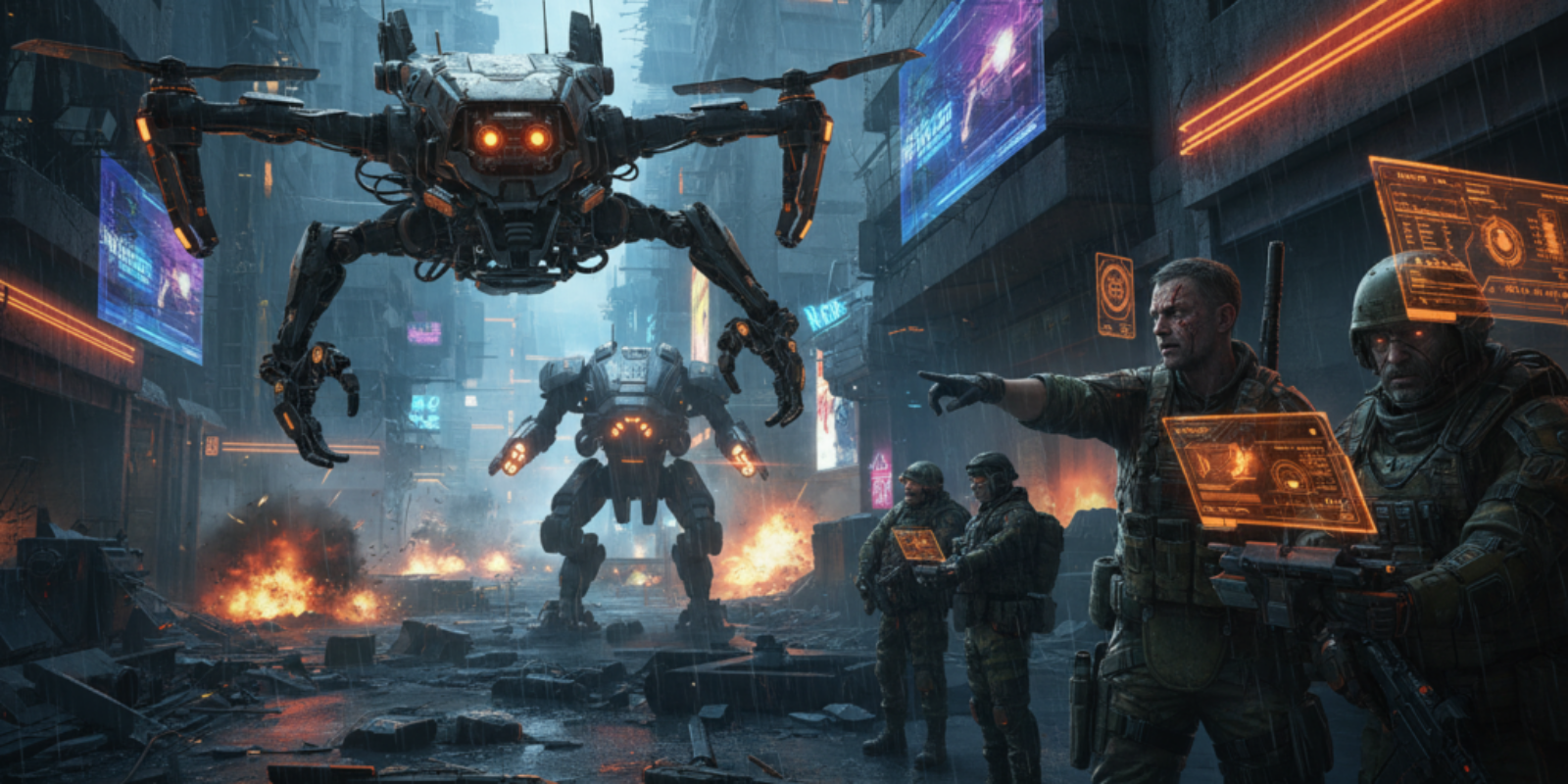
A phone screen lights up in a UK Ministry conference room with a live feed from the front. Operators point at a mosaic of drone tracks, an autonomous turret, and a data pipeline that turns blurry video into targetable coordinates in seconds. The scene is urgency and invention in equal measure, a wartime laboratory where software replaces soldiers at the margin and the rules written for peacetime struggle to keep up.
At first glance the headline is obvious: this is a military story about battlefield innovation and geopolitical urgency. The wider and less reported consequence is that the same systems being refined in close combat are being translated into product roadmaps, funding priorities, and regulatory headaches for the civilian AI sector. This account leans on a mix of press reporting and think tank work that tracks those exact crossovers. (united24media.com)
A ministerial warning that sent venture desks scrambling
At a NATO cyber defence forum, a senior UK minister argued that the conflict around Ukraine is fuelling a new AI arms race and that Western governments must accelerate lab capacity for AI security. That speech explicitly linked battlefield automation, cyberattacks, and rapid prototyping as a single security problem that demands national investment. The line moved markets because it signalled public money for labs and for supply chain hardening. (tbsnews.net)
Why product teams should treat conflict labs like accelerators
Ukraine’s battlefield has become a stress test no startup can buy. The insurgent innovation loops there compress development cycles from years to months, producing mature heuristics for low cost autonomy, distributed sensing, and resilient communications. Corporations that build mapping, object recognition, and autonomy stacks are suddenly competing with military-grade feedback loops, and a lot of commercial R and D now looks like a vendor relationship to a defence program.
What the fighting actually looks like in technical terms
Modern operations stitch together FPV drones, loitering munitions, and uncrewed ground vehicles with data fusion layers that ingest satellite, aerial, and human intelligence. RUSI’s field research shows a seven phase approach that integrates sensors, electronic warfare, and robotic effects to create a layered kill chain that shortens decision loops to hours or minutes. For AI engineers this means model evaluation must include adversarial signal interference, contested comms, and degraded sensors as baseline test cases. (rusi.org)
Robots on the ground and the software that runs them
Ukrainian officials and reporting describe an expansion from airborne swarms into ground robotics for logistics, surveillance, and direct fire roles. These systems are frequently software led, with cheaper commercial hardware and bespoke autonomy stacks glued together by cloud analytics and edge inference. The result is a market dynamic where nimble software firms can compete with traditional prime contractors, which is a pleasant surprise for small founders and a headache for procurement officers. (uk.news.yahoo.com)
How naval and maritime AI is changing trust assumptions
State reporting of expanded maritime drone capability shows an evolution from disposable one way drones to reusable, AI assisted maritime platforms that can conduct long range strikes or persistent surveillance. These platforms expose weaknesses in assumptions about secure comms and provenance of sensor data, pushing the industry to prioritize secure model update channels and provenance logs for sensor feeds. (apnews.com)
The Ukraine front is less a laboratory and more a user acceptance test for systems that will arrive in civilian life sooner than anyone planned.
The economics that are reconfiguring AI hiring and supply chains
Defence demand has created a bidding war for embedded ML engineers, perception researchers, and E W specialists, driving short term salary inflation and faster poaching cycles for startups and universities. Governments are offering funding that mixes procurement and R and D, which redirects talent away from consumer products into safety critical, latency sensitive work. For venture investors this means higher talent costs and a different risk calculus when underwriting hardware plus software plays.
The cost nobody is calculating for civilian markets
Running hardened models in contested networks costs more than standard cloud deployments. Realistic scenarios require multi availability zone redundancy, custom FPGA inference at the edge, and teams for secure over the air updates. A medium sized robotics fleet with modest autonomy requirements can see operating costs rise by 2 to 3 times when built to battlefield survivability standards, which eats margin on both enterprise and consumer business models.
Regulatory consequences and export control pressure
The battlefield provenance of components, especially when Chinese parts are involved, complicates commercial supply chains due to export controls and compliance with weapons statutes. Firms that previously treated hardware sourcing as a procurement problem now need export control counsel and compliance engineering. This raises the effective barrier to entry for startups that rely on global parts markets but do not have legal teams.
Ethics and governance that look like security engineering
The blurred line between surveillance, targeting, and analytics forces companies to standardize kill switch semantics, human in the loop policies, and model explainability under adversarial conditions. Practical governance now reads like system hardening: enumerated failure modes, denial of service protections, and audit trails for model decisions. Expect standards bodies to borrow heavily from safety critical systems rather than from social media content policy. Dry aside, which the legal team will appreciate: bureaucrats love checklists more than anyone pretends.
Risks that stress test the minister’s claims
Scaling battlefield-tested systems into civilian markets invites misuse, leakage, and rapid capability diffusion. If autonomy libraries are published without rigorous access control they can be forked for kinetic uses. Also, performance in a theatre of war does not guarantee reliability in a regulated urban environment with pedestrians and lawyers, which is to say the real world remains inconvenient. Another dry aside for caffeinated engineers: scaling always reveals that edge cases are actually entire continents.
What businesses should do this quarter
Security conscious vendors should add contested communications tests to their CI pipelines, budget for FPGA or TPU edge inference, and get serious about provenance and supply chain audits. Scenario math looks like this: for a fleet of 100 robots, add 30 to 50 percent to hardware costs for hardened comms and another 50 percent to software spend for secure orchestration and compliance, which can push total program cost up by roughly 70 percent compared to a non hardened build. Those numbers are credible enough to reshape product roadmaps.
Looking ahead with a practical bias
The immediate future will be a bifurcation between commodity autonomy for low risk use cases and hardened systems that are co engineered with governments and large integrators. The AI industry should prepare for both paths rather than pretend one will win outright.
Key Takeaways
- Ukraine is accelerating battlefield driven AI practices that will become commercial requirements, forcing firms to adopt contested environment testing.
- Governments are funding lab and procurement programs that redirect talent and capital into security focused AI R and D.
- Building resilient, compliant autonomy systems increases per unit cost substantially and changes startup economics.
- Standards and governance will follow engineering needs, not abstract ethics, so companies must invest in security engineering now.
Frequently Asked Questions
How does this conflict affect hiring for AI teams?
The market is tightening for embedded ML, perception engineers, and resilience experts as defence programs offer competitive packages. Expect longer hiring cycles and higher salary bands for candidates with robotics and E W experience.
Will battlefield algorithms end up in consumer products?
Some low risk techniques such as sensor fusion and energy efficient inference will migrate quickly into commercial stacks. High risk capabilities will be gated by regulation, but leakage and talent movement make some transfer probable.
Should startups partner with defence contractors?
Partnerships can offer scale and procurement routes but add compliance overhead and slower sales cycles. For many startups the better option is a hybrid approach that keeps core IP separate while delivering hardened instances under contract.
Does this raise new export control risks?
Yes, using global hardware sources can trigger complex export controls and end use restrictions, requiring legal review and potentially limiting market access for certain geographies.
What immediate investments should product leaders make?
Add contested comms and adversarial sensor tests to product validation, budget for secure OTA updates, and hire compliance expertise for supply chain and export policies.
Related Coverage
Readers interested in how defence procurement reshapes civilian AI regulation, the private market for counter drone systems, or the economics of dual use robotics should explore further reporting on interoperability standards, emerging export control regimes, and industrial scaling of autonomy. Those topics will clarify how battlefield innovation becomes commercial infrastructure over the next several years.
SOURCES: https://united24media.com/latest-news/drones-robots-and-a-7-phase-plan-how-ukraine-is-rewriting-the-rules-of-war-14047, https://www.reuters.com/world/europe/britain-nato-must-stay-ahead-new-ai-arms-race-says-uk-minister-2024-11-25/, https://uk.news.yahoo.com/ground-robots-may-next-game-202815601.html, https://apnews.com/article/0719211dd0314f2b9d15422e81ca66e3, https://www.rusi.org/explore-our-research/publications/insights-papers/emergent-approaches-combined-arms-manoeuvre-ukraine. (united24media.com)