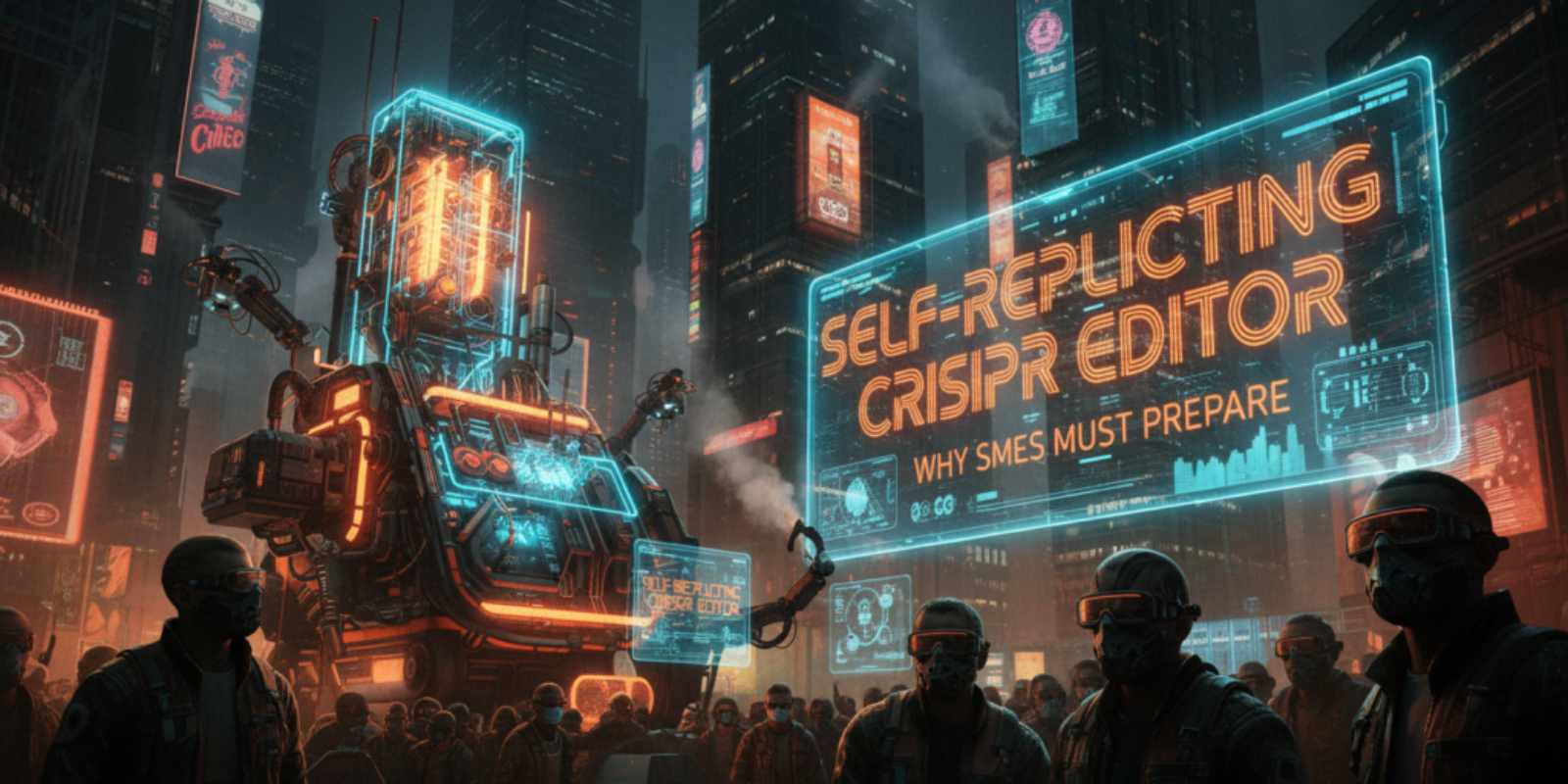
Souped-Up CRISPR Gene Editor Replicates and Spreads Like a Virus
How a new class of self-propagating CRISPR systems is reshaping the aesthetics, risks, and business calculus of cyberpunk culture and the biotech microeconomy.
A handheld sequencer hums on a table under strip lighting while a squad of coders and ex-bio majors argue about whether the modification should be reversible. Outside, a street-level clinic advertises rapid microbiome tuning in neon. The scene reads like a noir dream of tomorrow, but the technology making it plausible is arriving today with real-world lab data and public debate trailing behind.
Most coverage treats this as a public health or conservation story about mosquito control and ecological risk. The overlooked angle is economic and cultural: self-propagating CRISPR turns edits into a networked commodity, creating new market niches, new liability profiles for small labs, and a new aesthetic for cyberpunk firms that sell secrecy and upgrades. This article relies largely on press reporting and public statements to frame those commercial and cultural implications. (theguardian.com)
Why small teams should watch a technology that ‘spreads like a virus’
Gene drives are engineered systems that bias inheritance so a trait spreads through a population faster than normal genetics would allow. This converts a single release into a population-level distribution mechanism, a property that looks eerily viral and attractive to designers who think in networks rather than organisms. (nationalgeographic.com)
The first laboratory proof that CRISPR can be used to convert inheritance patterns came in a 2015 experiment that achieved conversion rates near 95 to 100 percent in fruit flies, showing the basic mechanics worked outside theory. That demonstration is the technical ancestor of many modern self-propagating designs. (sciencenews.org)
Who is building the pieces now and why the timing matters
Universities and consortia such as Target Malaria and laboratories at UC San Diego have been moving from concept to cage trials and modular systems that separate components to manage spreadability. The UC San Diego Ifegenia system published in 2023 engineered separate Cas9 and guide RNA lines to suppress female mosquitoes by inheritance, demonstrating practical pathways to population control while offering layers of containment. (sciencedaily.com)
Political pressure, funding cycles, and disease trends pushed this work forward in the early 2020s. That convergence matters for cyberpunk firms because it lowers the bar for practical deployment and increases incentives for both defensive services and shadow applications, making timing now not accidental but inevitable. (theguardian.com)
The core story with names, numbers, and dates
In 2015 Gantz and Bier showed that a CRISPR homing system could convert heterozygotes to homozygotes at rates above 95 percent in the lab. That proof of concept changed the way labs designed population-level edits and created a cottage industry of follow-on techniques aimed at either suppression or modification of species. By July 5, 2023 researchers at UC San Diego published Ifegenia in Science Advances, showing a two-component approach could kill female offspring and spread through populations while keeping the components separate until release. Regulatory and community engagement efforts accelerated in 2024 and 2025 as groups like Target Malaria moved planning toward possible field trials. (sciencenews.org)
This is not hypothetical theater. The architecture is modular, the math favors small seeding populations to achieve broad distribution, and press reports show funders and national partners lining up for trials on timelines measured in years, not decades. That timeline compresses the commercial window for providers of surveillance, containment, and ethical auditing services.
The edit that replicates is the edit that becomes a product, and products need custody and cost models.
How cyberpunk culture absorbs a self-spreading edit
Cyberpunk aesthetics always loved the idea of distributed change: aftermarket body mods, firmware updates, and black-market implants. Self-spreading CRISPR gives that visual a genetic literalness. Artists and underground labs will treat population editing as a medium: lab-made legends, rogue field art, and speculative fashion that mimics contagion. That cultural feedback loop will shape demand for privacy-preserving biotech services and for boutique firms offering authorized, reversible edits marketed as lifestyle upgrades. Expect a surge in brand identities that look like biosecurity consultancies but moonlight as modification boutiques, because nothing communicates dystopian chic like a liability waiver printed on glow paper.
Practical implications for businesses with 5 to 50 employees
A single small contract lab with 12 employees that currently runs routine plasmid work should budget for two immediate cost lines: detection and legal compliance. If weekly PCR surveillance costs roughly 50 per sample and each employee submits one sample per week, that is 600 per week, or about 31,200 per year. For infrastructure, a basic upgrade in containment, training, and incident response could run from 20,000 to 100,000 depending on existing systems and local regulations, so a conservative three-year compliance reserve should be 60,000 to 300,000. Those are cash flows that materially affect small teams and will shift hiring, pricing, and client risk allocation.
Service firms should model scenarios where a single public incident raises insurance premiums by 30 to 100 percent and forces contract clauses that require indemnity and higher test frequencies. For a 25-person startup with 12 months of runway, an unexpected 50,000 compliance bill is the kind of thing that turns an R and D sprint into a creditor negotiation. Small labs need vendor contracts that place monitoring and containment obligations on customers as well as themselves.
The cost nobody is calculating: liability for cultural supply chains
When edits propagate in the wild, attribution is messy. Who pays when a modification introduced for art or pest control crosses an ecological or geopolitical boundary? Insurers, already conservative about biotech risks, are likely to reprice small labs out of the market or demand strict audit trails. This creates an economic opportunity for audit-as-a-service firms but also a hazard: compliance vendors become single points of failure, which is comically bureaucratic and mildly terrifying in the way a corporate data center with human feelings would be.
Risks, misuse, and open scientific questions
Gene drive designs face resistance evolution, off-target edits, and ecological knock-on effects. Community consent and cross-border governance are unresolved. DIY biohacking presents proportional risk: while most home experiments are harmless, the combination of modular CRISPR parts and permissive sharing increases the chance that a poorly contained organism escapes labs or sewers. The press has already documented DIY culture and regulatory friction, which means policy debates will influence market access more than technical limits for the foreseeable future. (wired.com)
A quick practical checklist for a small biotech operator
Implement weekly staff surveillance and sample logging, procure modular containment upgrades, add indemnity clauses to client contracts, and build a 90-day cash buffer for regulatory surprises. Run tabletop exercises that include community relations and PR because reputational repair costs more than safety gear, and reputations do not come in sterile packaging.
Forward-looking close
Self-propagating CRISPR changes the unit economics of edits and makes containment an economic decision as much as a scientific one; small teams that invest in rigorous monitoring and clear legal frameworks will convert risk into a market advantage without needing to wear neon goggles.
Key Takeaways
- Self-propagating CRISPR systems convert single events into distributed products and shift liability onto operators.
- Lab upgrades and routine surveillance can cost small teams tens of thousands per year and should be budgeted now.
- Cultural demand for clandestine and boutique edits will create markets for privacy-first compliance and audit services.
- DIY and underregulated work increases systemic risk and accelerates regulatory attention.
Frequently Asked Questions
How soon could a field trial actually happen near me? Field trial timelines depend on regulatory approvals and community consent; some programs signaled planning in the mid 2020s and projected potential trials within a few years following approval, but exact schedules vary by country and project. Local approvals and public engagement are typically the gating factors.
Can a small community lab accidentally create a self-spreading edit? Creating a functional gene drive requires specific design choices and containment failures; however, a misconfigured release of engineered organisms could have consequences, so containment and training are essential even for small labs.
What should a 10-person biotech startup budget for compliance this year? Budget line items should include weekly or biweekly surveillance testing, containment upgrades, legal counsel for contracts, and an emergency reserve; conservative planning suggests tens of thousands of dollars annually depending on current facilities.
Are insurers covering gene editing incidents for small labs? Coverage is inconsistent; many insurers add exclusions or require enhanced safety protocols. Firms should negotiate terms and consider specialist biotech insurers.
Should cyberpunk brands hype self-spreading edits as lifestyle products? Marketing such products raises legal, ethical, and reputational risks; promoting reversible and well-audited services is safer and more likely to survive regulatory scrutiny.
Related Coverage
Explore reporting on genetic surveillance infrastructure and the economics of repair markets, and read profiles of biohacker communities and how regulators respond to decentralized innovation. Those topics explain the secondary markets and social dynamics that will decide whether this technology becomes boutique empowerment or bureaucratic hazard.