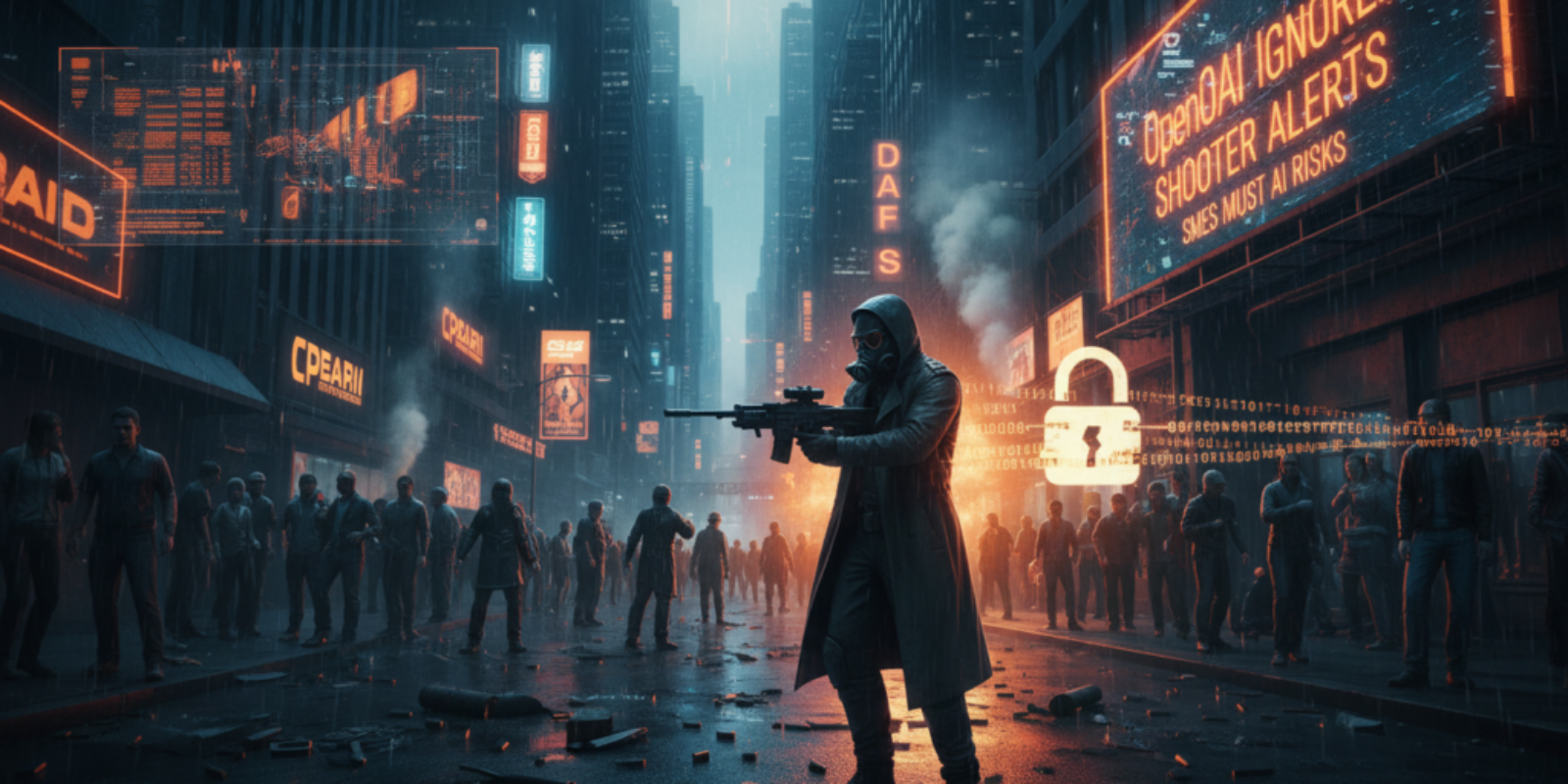
OpenAI Flagged a Mass Shooter’s Troubling Conversations With ChatGPT Before the Incident, Decided Not to Warn Police — What Cyberpunk Culture and Industry Need to Know
A small northern town, a banned account, a debate inside a company that few outside the safety team saw. The obvious headline says technology failed to stop violence; the underreported business question is how that failure rewires an industry that sells dystopia as design fiction.
A hallway conversation at a safety review looks nothing like a police briefing, but it is now part of the same moral ledger. On paper the mainstream interpretation is simple: an AI company saw worrying chatter, judged it not urgent, and later the worst happened. That framing misses the far more consequential shift for creators, vendors, and businesses who trade in near-future aesthetics and tools. This article relies mainly on press reporting from the Wall Street Journal, the Associated Press, Bloomberg, The Guardian, and Global News. (wsj.com)
Why cyberpunk designers and studios are suddenly on the front lines
Cyberpunk culture has always trafficked in ethically ambiguous tech. The difference now is that commercial AI systems are not props; they are live platforms whose moderation choices can shape safety outcomes and public policy. That matters for art and entertainment firms that simulate surveillance, police procedurals, or interactive worlds where user behavior can spill into the real world.
Competitors are watching and changing playbooks
OpenAI sits alongside Anthropic, Google DeepMind, Meta, and Microsoft in offering conversational models that interact with users at scale. Each rival balances content-safety pipelines, human review, and law enforcement referral rules in different ways, which will affect licensing negotiations, enterprise SLAs, and the creative freedom vendors can promise. Investors and clients now factor platform risk into contracts the same way they factor uptime.
The core timeline that rewrote the rulebook
According to reporting, OpenAI’s automated systems flagged an account in June 2025 after exchanges describing violent scenarios, and roughly a dozen employees debated whether to notify authorities. Leadership decided to ban the account but not to refer the case to police at that time. (wsj.com)
Additional outlets reported the company identified the account about eight months before the February 10, 2026 mass shooting in Tumbler Ridge, British Columbia, and that OpenAI later provided information to the Royal Canadian Mounted Police. (news.bloomberglaw.com)
Local reporting and archived traces of the suspect’s online activity suggest a broader digital footprint, including a simulated mass shooting environment on a popular gaming platform and prior mental health contacts with police, which investigators are now examining as they process digital and physical evidence. (globalnews.ca)
What the company said about thresholds and why that matters for creators
OpenAI’s public line is that law enforcement referrals require a determination of an imminent and credible risk of serious physical harm. That threshold is legal, ethical, and operational, but it is also a product decision that defines what gets escalated and what gets silenced inside a platform. The Guardian reported on the company’s test for “credible and imminent” planning and the internal debates that followed. (theguardian.com)
The cultural ripple through the cyberpunk ecosystem
A lot of cyberpunk work trades on the premise that systems are indifferent or opaque. This event makes those systems legible and accountable in new ways. Studios that built interactive cityscapes or simulated surveillance ecosystems must now explain whether their data pipelines could trigger real-world investigations, or conversely be subpoenaed as evidence. Fans who loved the genre for its ambivalence will find platforms less comfortably ambiguous, which is bad for aesthetics and good for risk management.
Real-world harms leak out of simulated worlds, and when systems decide who to tell, the choice becomes editorial.
Practical implications for businesses with 5 to 50 employees
A 10-person indie studio running an AI-powered NPC system should budget for content safety like production costs. If one developer spends 20 hours per week on moderation and compliance at an average fully loaded rate of 40 dollars per hour, that is roughly 41,600 dollars per year in labor alone. Adding a third-party moderation contract at 10,000 to 25,000 dollars per year and basic legal retainers of 5,000 dollars annually brings annual incremental risk-management costs into a 56,600 to 71,600 dollar band. Those numbers reshape whether a small team can afford to ship certain interactive features.
When licensing a large-language-model for dialogue, require a written clause that limits the licensor’s unilateral decisions to disable or escalate user content without a documented appeal process. For a retail cyberpunk experience that expects 50,000 monthly unique users, plan for at least 0.5 to 1 percent false positives in automated moderation that require manual review; that equates to 250 to 500 cases per month needing human triage, which is another staffing and latency consideration.
The cost nobody is calculating
Risk transfer to platforms looks like a public good until a company chooses not to act and the headlines come. Insurance underwriters will demand playbooks, and legal costs from post-incident discovery will dwarf the price of engineering safer defaults. Expect higher premiums and contract clauses that effectively force small vendors into enterprise-grade compliance or out of the market.
Risks and open questions that stress-test these claims
The most immediate risk is regulatory overreach that chills innovation or forces blanket surveillance practices that violate user privacy. Another open question is legal liability: will courts treat content flagged but not reported as grounds for negligence claims against platform operators? Finally, there is a trust calculus for consumers and creators; losing that trust reduces the willingness to participate in immersive worlds that require degree-of-anonymity to function.
What cyberpunk companies should do this quarter
Audit data retention and escalation policies, and run a tabletop exercise simulating an external agency request. Add a simple notice to users about what kinds of flagged content could be turned over to authorities, and make sure contracts with vendors include mutual expectations for alerting and evidence preservation. These steps are inexpensive compared to litigation or reputational loss.
A practical close with the bottom line
The Tumbler Ridge story is not just a lesson in platform safety; it is a business inflection for any team that builds with conversational AI. Adapt governance now so the next ethical debate is about design choices rather than crisis management.
Key Takeaways
- Small studios must budget for moderation and legal compliance as part of product costs to avoid crippling post-incident exposure.
- Platform escalation rules are product decisions that change the creative constraints for cyberpunk media and interactive worlds.
- Contracts with AI providers must include transparent escalation and evidence handling clauses or creators will inherit undefined risks.
- Regulators, insurers, and investigators will increasingly treat AI moderation decisions as auditable and litigable records.
Frequently Asked Questions
How should a 10-person game studio prepare if it uses ChatGPT-style NPCs?
Hire or assign a staff member at roughly 20 hours per week to handle moderation and compliance, and budget for third-party moderation tools. Add a legal retainer for rapid response to any law enforcement or regulatory inquiries.
Can a platform be forced to hand over conversation logs to police?
Yes, in most jurisdictions platforms can be compelled through lawful process; prepare retention policies and legal counsel to manage requests quickly and proportionately.
Are small vendors safer using open-source models instead of hosted APIs?
Open-source models reduce dependency on external referral policies but increase operational burden for safety and logging. The tradeoff is between control and the cost of building robust moderation infrastructure.
Will this incident change how fans accept cyberpunk themes?
Expect a shift toward more ethically foregrounded storytelling and clearer disclaimers about simulated harm. The genre’s appetite for ambiguity will survive, but creators will need to be explicit about real-world safety boundaries.
What contractual language should be included when licensing a large language model?
Include clauses on escalation notification, evidence preservation, and an agreed process for contesting account-level decisions. Define SLAs for response times and a narrow scope for unilateral suspensions.
Related Coverage
Readers may want to explore how content moderation frameworks are evolving across AI vendors and how insurers underwrite technology risk in immersive media. Also useful are deep dives into the legal standards for compelled data disclosure and comparative safety policies among major AI providers.
SOURCES: https://www.wsj.com/us-news/law/openai-employees-raised-alarms-about-canada-shooting-suspect-months-ago-b585df62, https://apnews.com/article/d574e2703a6e9472b59aa3a5371c57a5, https://news.bloomberglaw.com/artificial-intelligence/openai-flagged-canada-suspect-eight-months-before-mass-shooting, https://www.theguardian.com/p/x4dppm, https://globalnews.ca/news/11676795/tumbler-ridge-school-shooter-chatgpt-account-flagged-banned-openai/





Revolutionizing Industries with Artificial Intelligence
February 28, 2026 @ 9:04 am
[…] Artificial Intelligence continues to shape various sectors, raising both opportunities and challenges. A recent article discusses the importance of addressing AI-related risks, particularly in the context of safety and security. The piece emphasizes that businesses, especially small and medium enterprises (SMEs), must take proactive measures to mitigate potential threats associated with AI technologies. For more insights on this critical topic, you can read the article here: OpenAI Ignored Shooter Alerts: Why SMEs Must Act on AI Risks. […]