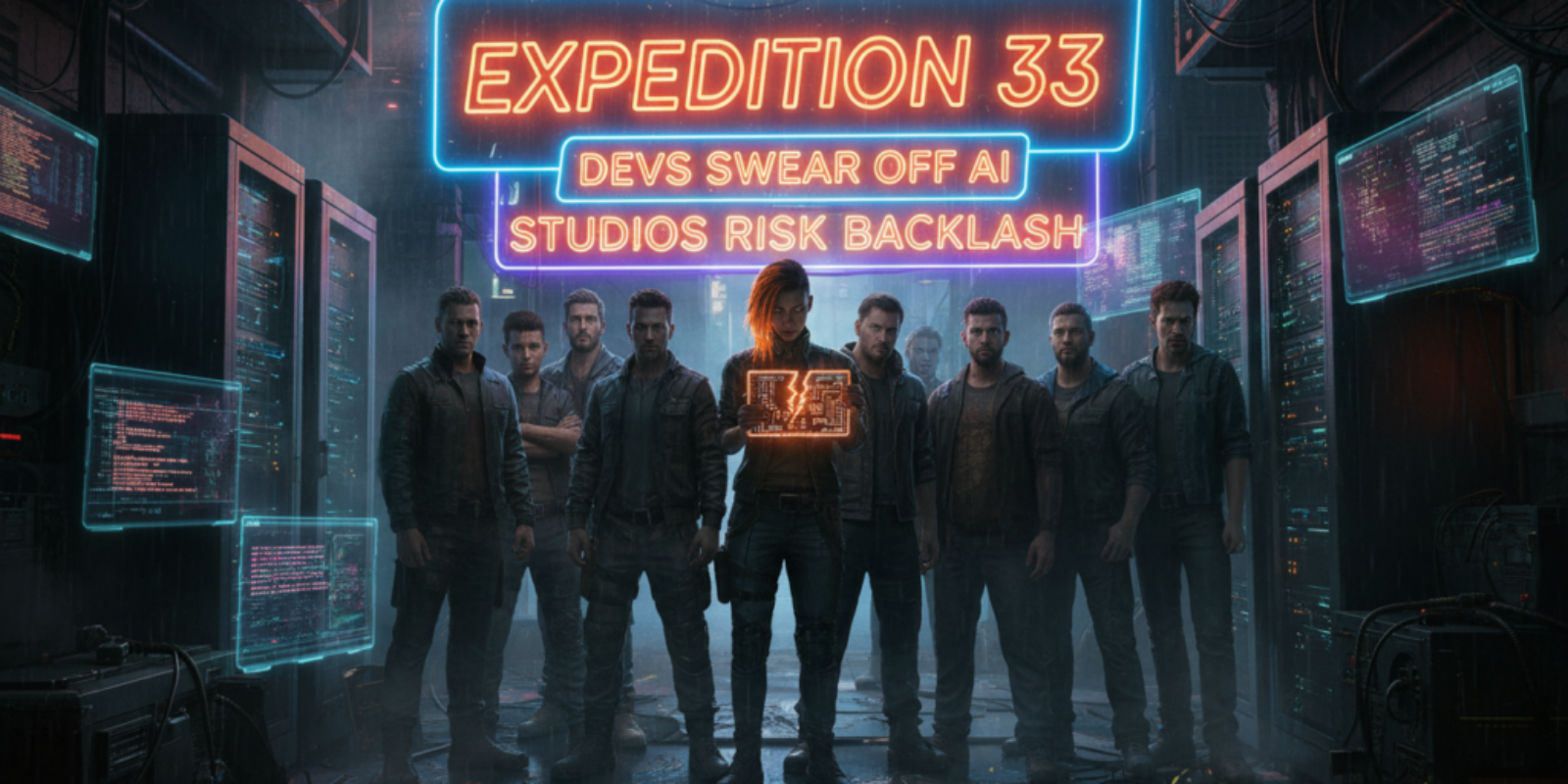
After the Game of the Year Pull, Expedition 33’s Devs Swear Off AI and the Industry Is Watching
When a small French studio loses a trophy over a few placeholder textures, the real question is not about guilt or innocence but about how policy, reputation, and tooling will reshape AI in creative work.
A crowded awards room went quiet when organizers announced they were retracting a Game of the Year prize. For fans it felt like a moral judgment; for the studio it was a reputational gut punch. The obvious reading is simple: a beloved RPG used generative AI and therefore broke a rule, so the award came off the shelf. That version of events misses the bigger point that companies and policy bodies are now setting standards that will alter how AI tools are bought, built, and governed across creative industries.
This reporting relies heavily on press materials and studio interviews released after the Indie Game Awards decision, which increasingly serve as the primary record of what happened in real time. According to The Verge, the Indie Game Awards rescinded Clair Obscur: Expedition 33’s Debut Game and Game of the Year awards after the developer acknowledged limited generative AI use during production. The Verge
Why now matters: genres, budgets, and expectations have changed. Triple A publishers and mid size studios are publicly embracing AI for animation, voice work, and procedural content, while a vocal indie community insists on human-crafted art as a brand promise. That split is not theoretical. Publishers such as Raw Fury and platforms like Steam are watching how consumers and juries react, and the VGC coverage of the incident shows how quickly awards and sales momentum can pivot after a disclosure. VGC
How the story unfolded in concrete terms is worth parsing. Sandfall Interactive’s Clair Obscur: Expedition 33 swept multiple awards in late 2025 but was disqualified by the Indie Game Awards on Dec 22, 2025 after a resurfaced interview indicated limited generative AI usage in early production. Developers say the AI-generated assets were placeholders removed within five days, and the studio publicly emphasized that the final game is human made. GameSpot summarized the IGA statement and the studio’s explanation in detail. GameSpot
The dev team’s public rejection of future AI tools is striking because it runs counter to how most technology teams respond to disruptive tooling. Director Guillaume Brioche told interviewers that the studio “tried” AI early on, found it uncomfortable, and will not use it moving forward. That pledge was reported in multiple outlets and repeated in developer Q and A sessions. GamesRadar
The immediate industry reaction will split into three commercial consequences. First, platform governance will harden because awards, storefronts, and festivals prefer clear eligibility rules to ambiguity. Second, studios that promise human-made craft may monetize that stance as a premium attribute, particularly among core players who see authenticity as scarce. Third, AI tool vendors face an existential marketing problem: promote efficiency and you risk alienating trust driven customers; promote art assistance and you get buried in nuance, which is not a great pitch at a trade show. A simple way to see the economics: if a small studio saves 10 percent of art production costs by using AI placeholders worth 20,000 dollars in total, losing a major award and press valuation spike might cost several hundred thousand dollars in sales and partnerships, wiping out the efficiency gain in a matter of days. That is not hypothetical math. The publicized sales boost and subsequent backlash for Expedition 33 illustrate how reputational risk can dwarf operational savings.
This is not about whether a texture was AI generated; it is about who gets to define the rules for creative legitimacy and what the cost of crossing that line will be.
For vendors and service providers the situation creates a market for certified workflows. Expect demand for audit trails, provenance metadata, and immutable logs that prove when and how an AI model was used. Studios will pay for that if a provenance package reduces the chance of a rescinded award or a lost publishing deal. Think of it as insurance for creative reputation, except the policy is a subscription and the claims adjuster is a jury of critics.
Small teams should watch this closely because the cost of compliance scales differently than the cost of tools. A five person indie team can spend 500 to 1,000 dollars a month on advanced generative models and integrate them quickly, but adding provenance, QA, and legal review could mean a one time compliance cost of 10,000 to 30,000 dollars. For some studios that number is a deal breaker; for others it is a price they will happily pay to avoid being the next cautionary headline. The conventional wisdom that AI lowers barriers to entry does not account for the new layer of governance that may raise the total cost of entry for reputationally sensitive projects.
There are real risks and open questions that stress test the studio’s pledge and the broader industry response. How are awards committees defining prohibited AI use in practice when so many production pipelines use procedural or algorithmic tools? Who audits the audits and which vendors are considered neutral? The Indie Game Awards rule is clear on paper, but edge cases will proliferate as companies use AI for localization, accessibility, and testing. Some of these uses reduce costs and improve quality, yet they are functionally indistinguishable from creative contributions unless provenance is tracked, which is not yet standard practice.
Another risk is regulatory fragmentation. If platforms and festivals adopt different definitions of acceptable AI use, studios will face a patchwork of compliance obligations, each with commercial consequences. That outcome favors larger publishers who can staff compliance teams, and it squeezes indie creativity. The irony is that a tool designed to democratize creation could accelerate consolidation because small teams cannot absorb the compliance overhead. Some will treat this as inevitable; others will double down on artisan branding. Nobody asked the awards to become an industry regulator, but that is where this is headed.
The longer term effect on the AI industry is subtle but material: vendors must bake transparency into products rather than bolt it on as an afterthought. Toolmakers who can provide clear exportable logs, model provenance, and usage fingerprints will win contracts with studios that want to use AI without risking public sanctions. That requires investment in tooling and partnerships with auditors, and it shifts the product roadmap away from raw capability and toward governance features.
In the next commercial cycle expect three visible trends: more explicit vendor SLAs about creative usage, an uptick in third party provenance startups, and an uptick in marketing that sells human-made authenticity as a premium. The commercial trade off is straightforward: efficiency for certainty or certainty for premium pricing. Both are valid business models.
The industry reaction to the Expedition 33 case will define practical norms for at least the next two to three years, and that matters for everyone building or buying AI tools.
Key Takeaways
- Awards and platform policies now shape commercial choices about AI more than technical capability.
- Studios promising human-made craft can monetize authenticity but face higher production costs.
- AI vendors that offer provenance and audit features will capture new enterprise budgets.
- Compliance overhead may accelerate consolidation toward larger publishers with legal teams.
How this affects small studios and publishers
Smaller teams face a binary decision when an awards body or platform defines a hard rule. Either invest 10,000 to 30,000 dollars for provenance and legal workflows or deliberately avoid AI tools and accept higher manpower costs. Publishers with deeper pockets will treat this as a compliance tax and will likely absorb it as a cost of doing business.
What tools and policies will change first
Vendors will prioritize immutable logs, exportable usage reports, and watermarks that survive production pipelines. Platforms will add explicit checkboxes at submission and storefront levels for model use. Expect auditors and consultants to emerge quickly; someone needs to sign the letter that says a game was compliant.
Frequently Asked Questions
Can a studio use AI for non creative tasks like testing and still be eligible for awards?
Yes, but it depends on the award body. Some festivals draw a bright line around any generative AI used in a build, while others allow AI for testing and QA if it did not produce final assets. Studios should check eligibility rules and preserve audit logs.
Will this make AI vendors less competitive on price?
Possibly. Vendors that include provenance and compliance features will charge more, but they will be attractive to clients who cannot tolerate reputational risk. Low cost, low transparency offerings will remain but serve a narrower market.
Does removing a few assets really justify rescinding an award?
Rescinding awards is about policy enforcement and precedent setting. For juries, transparency and adherence to submission terms are as important as the extent of use. It is punitive and symbolic, which is the point.
How should a creative director balance efficiency with authenticity?
Map use cases by impact and visibility. Use AI for background automation and testing, and keep player facing art under stricter provenance. If public trust is part of the brand, invest in traceable workflows.
Will regulators get involved and set legal standards?
That is likely down the road. For now industry groups, awards bodies, and platforms are creating de facto standards. Legal intervention typically follows once consumer harm or large commercial disputes appear.
Related Coverage
Readers may want to explore how major publishers are building in player facing generative features and what that means for production efficiency. Another useful thread covers the rise of provenance startups offering audit logs for AI usage and how they integrate with existing pipelines.
SOURCES: https://www.theverge.com/news/849144/indie-game-awards-game-of-the-year-expedition-33-generative-ai-chantey-modretro https://www.videogameschronicle.com/news/clair-obscur-expedition-33-game-of-the-year-award-pulled-after-admitting-to-generative-ai-use/ https://www.gamesradar.com/games/rpg/clair-obscur-expedition-33-director-admits-sandfall-tried-ai-during-the-jrpgs-development-but-didnt-like-it-and-everything-in-the-game-is-human-made/ https://www.gamespot.com/articles/clair-obscur-expedition-33-just-lost-its-indie-game-of-the-year-awards-over-ai-concerns/1100-6537129/ https://www.dexerto.com/gaming/clair-obscur-expedition-33-director-explains-why-theyll-never-use-ai-3297807/