Desigual embraces artificial intelligence to expand its creative universe and optimise its operations
How a famously maximalist Spanish brand is quietly reshaping AI workflows, supply chains, and creative tooling in ways the tech world should be paying attention to
The design studio smells of coffee and printed fabric swatches, while a laptop renders an impossible floral that no single human hand sketched. A junior designer nudges a prompt and watches variations arrive in seconds, then shrugs and picks the option that looks like summer in Barcelona, or at least Barcelona as interpreted by a very enthusiastic robot. The scene is civic theater for fashion fans and a small existential crisis for pattern cutters who remember ink on their fingers.
On the surface the move looks like another brand checking the generative AI box. That reading misses what actually matters: Desigual is not simply using AI to make pretty pictures. The company is wiring AI into product cycles, inventory logic, and startup partnerships in a way that forces engineers and model makers to reckon with real world retail constraints and business data. Much of the publicly available reporting leans on company materials and programme briefs, which is useful but not sufficient for understanding the industry impact. (premium.cat)
Why established fashion houses suddenly matter to the AI industry
Big tech tends to think of fashion as a playground for flashy demos and image benchmarks. The more impactful story is that consumer brands provide sustained, messy, real world feedback loops that models rarely see in lab conditions. Desigual operates across e commerce, wholesale and owned retail, and that complexity converts creative outputs into logistics problems, tagging needs and customer signals. Those signals are gold for model fine tuning if they can be captured ethically and at scale.
Competitors from fast fashion to luxury are also experimenting with automation and generative tools, but few combine on demand production experiments, startup acceleration and editorial AI campaigns in the same programmatic way. The result is a testbed that forces modelers to solve problems like size fitting, variant generation and artwork upscaling under production cost constraints rather than academic curiosity.
How the company moved from experiments to applied systems
Desigual has been iterating on on demand manufacturing for several seasons, using AI to generate patterns and limit stock exposure while testing customer appetite for bespoke pieces. That experiment entered public view with a spring line where AI-assisted designs were produced to order, limited to certain European markets and shipped on a longer timeline to accommodate production queues. The effort functioned as both a sustainability play and a live dataset generator for creative algorithms. (fashiongonerogue.com)
At the same time Desigual has expanded its internal innovation infrastructure. The Awesome Lab accelerator and a wider Create the Future initiative are structured to funnel startups and experiments into operational pilots focused on data management, automation and AI-assisted marketing. The company set an open call and scouting windows to bring external teams into production workflows and identify scalable tooling. That operational discipline is rare among labels that treat AI as episodic design theater rather than a cross functional lever. (fashionunited.in)
The Neural Fashion editorial and what it forces AI to solve
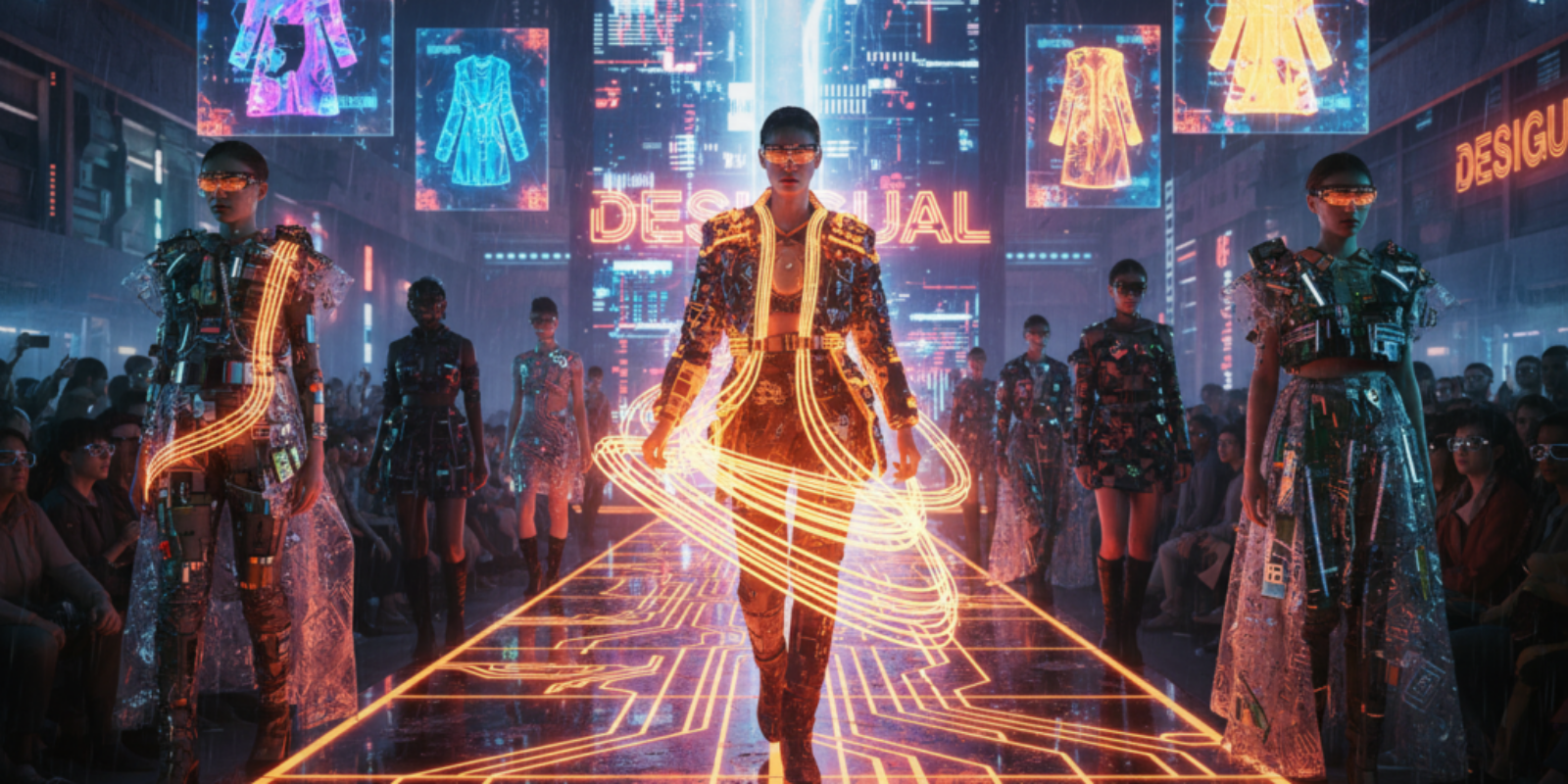
A recent editorial created in partnership with startups produced campaign imagery and garment assets that originated in generative models and then were upscaled and transformed into actual manufacturable designs. The partnership explicitly used tools across generative image stacks and model upscalers, and required engineers to translate pixel art into textile-ready files. That translation is a common blind spot in generative pipelines because it surfaces questions about seam allowance, repeatability and print resolution that standard image models do not answer. (fashionunited.com)
Generating an image is easy; generating a shirt that fits five sizes and survives the wash is where the real engineering begins.
The editorial shows that the AI industry will increasingly be judged not by novelty images but by how models integrate with CAD, PLM systems and factory constraints. Expect more engineering work around vectorization, color separation and prompt to production toolchains, and slightly cranky pattern makers who now have to supervise models. Someone will build a plugin to make production managers smile. It will probably be called something aggressively cheerful.
What this means for AI practitioners and startups
When a brand like Desigual runs open calls and pilots it creates distribution and a feedback loop startups need to move from POC to product. The brand’s approach creates opportunities for niche tooling companies that solve a very specific problem such as fabric repeat generation, print placement optimization or automated tech pack creation. For model builders, the demand shifts from generic image quality to domain constrained outputs with metadata, which means fine tuning datasets and building interfaces that convert creative intent into manufacturing spec.
A simple math example clarifies the business case. If an on demand program reduces deadstock by 20 percent on a capsule that would otherwise produce 10,000 units at 20 euros margin per unit, the program can free 40,000 euros while generating better training data for personalization models. Those are the numbers that justify investing engineering hours in custom loss functions and annotation pipelines, not just press coverage.
Risks and the questions that should keep engineers awake at night
Generative outputs trained on scraped imagery raise provenance and copyright issues, and when outputs become commercial products the legal exposure scales. There is also a real risk of overfit branding where AI amplifies signature motifs until everything looks like a more concentrated version of the same print. From an operations perspective, pushing AI into supply chains increases brittleness if the models are not audited against manufacturing tolerance ranges and vendor capabilities.
Another open question is consumer acceptance. Early testers may respond well to novel prints, but the majority of shoppers still buy on fit and price. If AI-generated garments cannot match those expectations, the experiment will be costly rather than transformative. The company’s strategy of slow market rollouts and pilot partnerships reduces exposure but does not eliminate long term brand risk. (trendhunter.com)
Why small engineering teams should watch this closely
Small teams building AI tooling should not assume only large luxury brands will buy their software. When a mid size label operationalizes AI it creates repeatable procurement patterns and integration requirements that scale horizontally. Winning a pilot at Desigual or similar groups can convert into a template that other brands reuse, which is how niche B2B AI vendors grow without pretending to be enterprise consultancy shops.
The cost nobody is calculating
The obvious costs are compute and licensing, but the hidden cost is human time spent curating model outputs into manufacturable assets. That work requires experienced pattern staff, colorists and production engineers who become prompt editors and model auditors. For many labels the people cost will dwarf cloud bills, and that is where the business case either stands up or falls apart.
What comes next for models and retail workflows
Expect more investment in domain specific model components that output not only images but metadata about seams, fabric grain and repeat ratios, and in tooling that lets designers work with models while preserving creative authorship. The AI industry will benefit because these constraints force better dataset labeling, stronger API contracts and predictable model behavior, which are the foundations of production grade AI.
Key Takeaways
- Desigual is using generative AI not as a stunt but as an operational lever that links design, production and marketing into a single experiment that produces usable product data.
- Pilot programs and open innovation create routes for startups to move from proof of concept to production, changing how AI tools are procured in fashion.
- The real engineering work is converting pixels into specifications that factories can follow, which shifts value to tooling that produces metadata with images.
- Legal exposure and human curation costs are the loud, predictable risks most projects underbudget.
Frequently Asked Questions
How can a small fashion brand start using AI without breaking the bank?
Start with a single constrained use case such as print generation or e commerce personalization and run it in a limited market. Use on demand production to cap inventory risk while collecting the data needed for iterative improvement.
Will AI replace designers and pattern makers?
AI is more likely to augment designers by accelerating iteration and expanding idea generation, while pattern makers will move toward supervisory roles that ensure manufacturability. The transition requires retraining and new human review steps rather than wholesale replacement.
What kinds of startups should AI product teams partner with in fashion?
Look for partners that solve narrowly defined problems like repeatable print generation, automated tech packs or fit prediction, because those provide measurable operational value. Integration capability with PLM systems is a practical buying signal.
Is it legal to sell garments generated by public generative models?
Legal exposure depends on the training data and how outputs are transformed into final products. Brands should use provenance controls and legal review before commercializing outputs, and consider working with partners that provide model licensing clarity.
How will this affect model evaluation metrics used by engineers?
Expect a shift from purely perceptual metrics to production oriented metrics that include manufacturability, repeatability and metadata accuracy. That requires new benchmark datasets and closer ties to downstream systems.
Related Coverage
Readers who want deeper technical detail should explore pieces on dataset governance for creative models and case studies of on demand manufacturing in apparel. Coverage of B2B tooling that bridges design and production will also be useful for product managers and engineers seeking commercial traction.
SOURCES: https://premium.cat/en/economy-business/fashion-and-the-artificial-intelligence-revolution-at-desigual/ https://www.fashiongonerogue.com/desigual-spring-2024-ai-on-demand/ https://fashionunited.in/news/business/desigual-llama-a-participar-de-la-cuarta-edicion-de-su-programa-de-aceleracion-de-startups/2025012148489 https://fashionunited.com/news/fashion/desigual-embraces-artificial-intelligence-to-expand-its-creative-universe-and-optimise-its-operations/2025071467120/ https://www.trendhunter.com/trends/desigual-x-neural-fashion