Comic-Con Bans AI Art After Artist Pushback: What the Move Really Means for the AI Industry
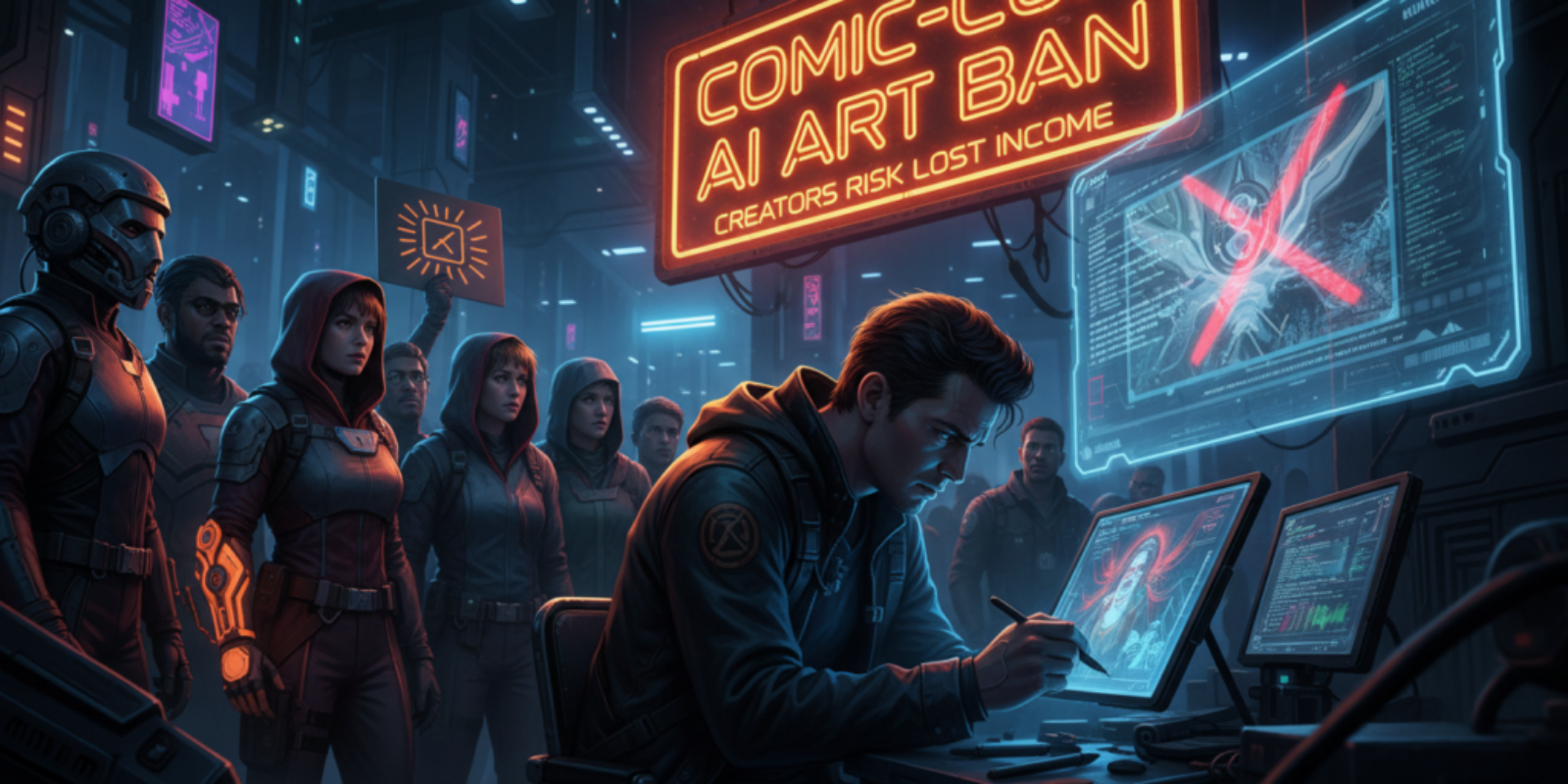
San Diego’s Artist Alley felt like a tribunal: a table of handmade prints facing a glowing tablet, and a crowd deciding which one deserved a future.
A vendor quietly folded a signed print while a line of buyers debated authenticity and value. The obvious headline is that conventions are reasserting space for human makers; the less obvious consequence is how those local policy choices pressure entire AI supply chains, from training data to platform economics.
A policy flashpoint that started on the floor and landed in boardrooms
San Diego Comic-Con announced a ban on AI-generated works in its 2026 Comic-Con Art Show after artists organized on social platforms and publicly protested the older, looser rules. (news.artnet.com) This was not an isolated gesture; the decision follows a wave of similar moves by regional shows and promoters. The story looks like artists winning a turf battle. Business owners should instead see it as a policy precedent that forces AI vendors to confront downstream distribution and reputational costs.
Why the timing worries model builders
Major fan conventions are concentrated markets for prints and commissions. When GalaxyCon publicly updated its exhibitor terms to forbid AI-generated products, organizers signaled a structural shift in how venues will police creative marketplaces. (prnewswire.com) For model makers that sell tools or license images, losing access to this distribution layer translates to fewer visible use cases and less feedback from paying customers. Private-sector product teams will notice reduced exposure to practical business use and next to no goodwill from the creator community, which is a tiny market with outsized cultural influence.
A quick history of convention pushback
Smaller shows moved first: FanX and several regional cons banned AI art from vendor floors after vendor complaints and a few public enforcement incidents. (axios.com) The trend accelerated when convention organizers started refunding exhibitors who had planned to sell AI-generated work. That reaction matters because enforcement now includes contract-level remedies, not just ad hoc requests to remove merchandise.
What happened at Artist Alley
Some conventions that previously allowed AI works under strict disclosure rules tightened those policies to an outright ban. Portsmouth Comic Con, for example, maintains a public policy that prohibits the sale, display, or promotion of AI-generated art at its event. (portsmouthcomiccon.com) Artists who made a public fight against permissive rules often cited process opacity from AI tools and the feeling of being undercut by products trained on unconsenting portfolio images. The net effect is that conventions are converting ethical outrage into enforceable commercial rules.
The cost nobody is calculating right now
If even 1 percent of convention sales shift from human-made prints to AI prints, organizers could see measurable revenue effects from exhibitor churn and guest satisfaction problems. A mid-sized convention with 1,000 artist tables that averages 200 dollars in daily sales per table would lose 200,000 dollars in on-floor commerce if AI displaces ten artists who then quit or are banned. That is money that funds venue rentals, guest travel, and programming. Whoever builds models that the community tolerates is not just building software; they are underwriting a fragile ecosystem of livelihoods and gatekeepers.
Enforcement is easier to announce than to implement
Conventions can ban AI art on paper, but identification and enforcement are murky. Detection tools produce false positives and false negatives when prompts use human collaborators or iterative edits, and legal definitions of “AI-generated” remain unsettled in many jurisdictions. The current reality is an arms race between simple policy declarations and the complex traces left by hybrid workflows. Organizers will either have to invest in forensic tools, which means new vendor budgets, or rely on tip lines and social policing, which scales poorly.
Creators will pay attention to contracts more than press releases because contracts have teeth.
What this means for AI companies and marketplaces
Model providers face three practical choices: accept tighter downstream restrictions and add features to provide provenance, lobby for legal clarity, or cede floor-level distribution to third-party marketplaces that certify provenance. Each choice has trade-offs. Building provenance tools costs engineering and slows product velocity; lobbying invites public scrutiny and potential regulatory heat; conceding distribution hands more control to gatekeepers who might ban certain model outputs outright.
Real scenarios companies should model today
A marketplace that integrates provenance could offer an optional metadata header that survives printing and resale. If a print sells for 50 dollars and the marketplace takes a 10 percent fee, adding a 2 dollar verification surcharge to fund artist relief programs still leaves the buyer paying 52 dollars. That small friction could preserve exhibitor goodwill while keeping volumes stable. On the other hand, if conventions collectively refuse vendor passes to sellers who use certain models, model providers risk losing a live testing ground and valuable direct revenue from microtransactions.
Legal pressure and the slow burn of lawsuits
Conventions are reacting to litigation and public complaints against AI tooling and training practices. Coverage of vendor bans often ties back to broader claims that models are trained on unlicensed work, which is driving plaintiff activity across the entertainment industry. (deseret.com) Legal outcomes could either codify a right for conventions to reject AI outputs or create new obligations for provenance and licensing. Either outcome will reshape commercial risk for AI vendors and marketplaces.
How small teams should watch this closely
Independent studios building creative models should plan for distribution constraints and build opt-in provenance layers early. A simple change to logging and export metadata can become a competitive advantage when conventions and retailers require traceable origin data. Think of it as compliance that doubles as marketing: provenance equals trust, and trust matters where buyers spend money, which is usually in physical-world spaces with strict rules.
Risks and open questions that stress-test the claims
Will bans hold against artists who hybridize workflows, or will enforcement lead to arbitration and messy precedent? How will international cons react, given divergent laws and cultural norms? What happens if enforcement disproportionately harms emerging artists who rely on cheap tools to bootstrap careers? These are unresolved variables that could push the industry toward formal certification schemes or fragmented local rules.
Where this is likely to go next
Expect more conventions to publish explicit AI policies in the 2026 convention season, and expect some regional organizers to test verification pilots with third-party vendors. Marketplaces that offer clear provenance and revenue-sharing for training data will have a stronger business case for long-term partnerships with venues and creators.
Key Takeaways
- Conventions are turning artistic outrage into enforceable policy, creating new distribution risk for AI tools.
- Bans shift economic pressure onto model providers to offer provenance features or lose access to live marketplaces.
- Enforcement will be inconsistent without better detection or contractual standards, which creates compliance opportunity for startups.
- Legal developments around training data and licensing could either harden or relax venue-level restrictions.
Frequently Asked Questions
How will this affect sales on convention floors?
Conventions that ban AI work will shrink the pool of sellers who rely on AI output and may temporarily reduce variety. Some buyers who prize originality will spend more, but overall foot traffic effects vary by event size and enforcement consistency.
Do bans mean AI art is illegal to sell everywhere?
No, bans are policy decisions by organizers and not blanket legal prohibitions. Local laws and platform terms create the regulatory patchwork that governs actual legality and liability.
Can AI companies fix this by adding provenance tools?
Yes, provenance can reduce friction with organizers by proving origin and giving buyers confidence. Implementing durable metadata and traceable licensing is a feasible technical path that requires industry coordination.
Will this change how models are trained?
Possibly. If venue-level bans and lawsuits make unconsented training feeds a commercial liability, model builders have a stronger incentive to license curated datasets and offer opt-out mechanisms.
Should event organizers invest in detection technologies?
Detection helps but will not be perfect. Organizers should combine clear contract language with random audits, verified provenance, and community reporting to manage risk while avoiding overreliance on brittle tools.
Related Coverage
Readers interested in the business mechanics should follow developments in dataset licensing and model transparency standards. Also explore how entertainment studios and publishers are litigating training data practices and how marketplaces are experimenting with certification for creator-friendly AI.
SOURCES: https://news.artnet.com/art-world/san-diego-comic-con-bans-ai-art-2739389 https://www.prnewswire.com/news-releases/galaxycon-llc-announces-sweeping-ai-art-ban-302545326.html https://portsmouthcomiccon.com/info/ai-policy/ https://www.axios.com/local/salt-lake-city/2025/09/25/fanx-utah-bans-ai-art-vendors https://www.deseret.com/utah/2025/09/09/fan-x-bans-ai-generated-art-merchandise/