
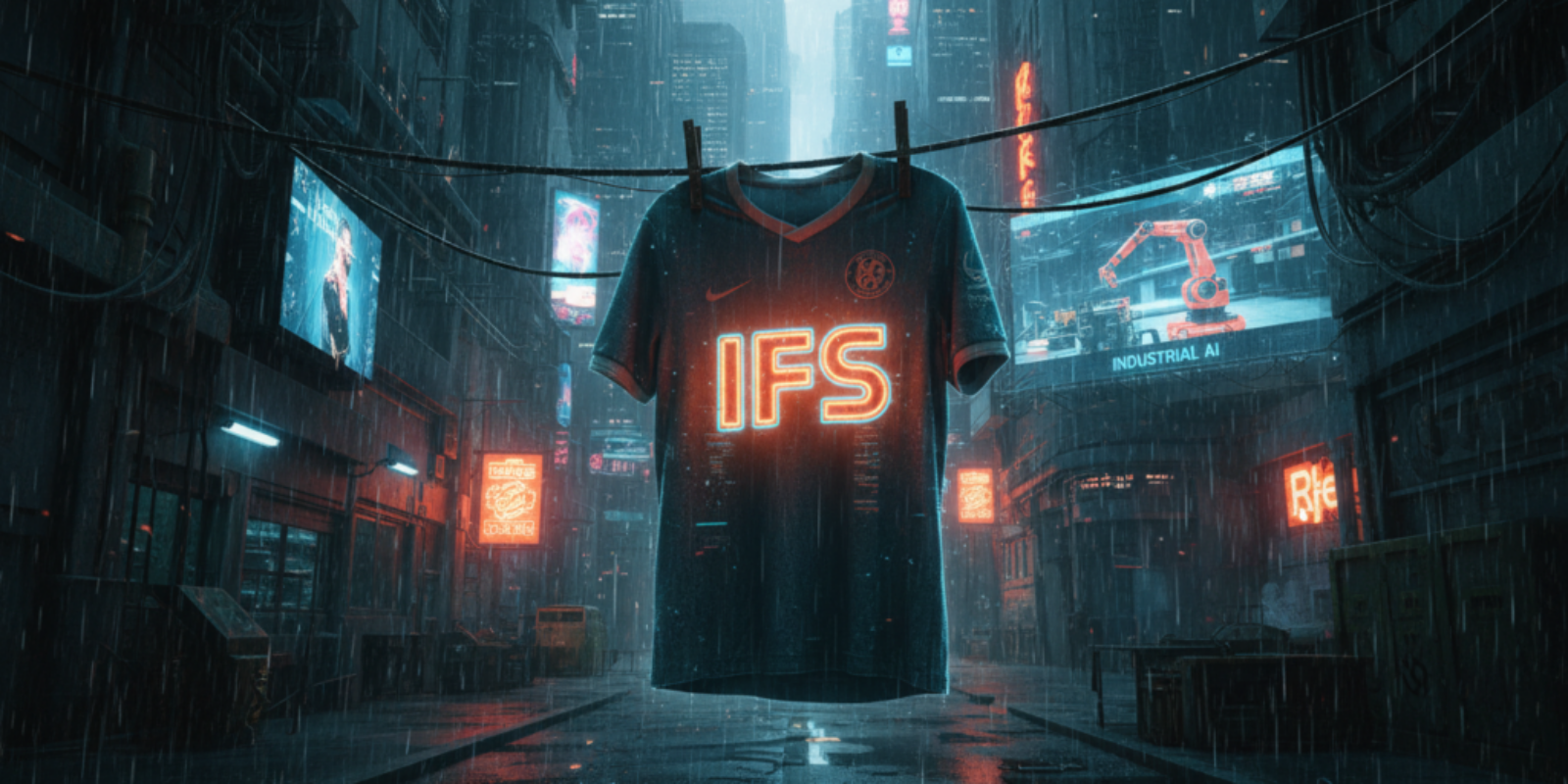
Chelsea’s kit deal with Industrial AI firm IFS is a quiet pivot that will rattle the AI market
What looks like a sponsorship is actually the early commercialization of Industrial AI on a global advertising stage.
A Stamford Bridge crowd notices a new logo and the stadium chat moves from injuries to algorithms. Behind the scenes, data analysts who once argued over video cutoffs are now in meetings where procurement and kit design collide, and the perfunctory moment of a logo reveal hides a bigger operational chess move. Fans will clap at kickoff, but commercial teams and AI buyers will be writing new procurement checklists that night.
On the surface this is the familiar playbook: a cash-poor club finds a naming partner and a tech vendor signs on for visibility. The less visible consequence is that a provider of industry-specific, operations-focused AI has bought prime global advertising real estate, and that shift matters more to corporates and AI professionals than it does to shirt sales. This is not just about brand awareness; it is about normalizing Industrial AI as a mainstream B2B product with consumer-facing marketing and the commercial expectations that follow.
Why a football shirt should make enterprise buyers uncomfortable
Premier League shirt real estate converts credibility into contracts quickly. The Chelsea announcement, published on the club’s official site, frames the deal as a multi-year global partnership that elevates IFS to Principal Partner and puts its logo on the front of the shirt for the remainder of the 2025 to 2026 season. (chelseafc.com)
That corporate seal of approval will register with procurement committees worldwide. The IFS narrative is not only promotional; the company positions its Industrial AI as directly applicable to real-world operations, the same claim it promotes on its own product pages. (ifs.com)
How this fits into the sports tech sponsorship arms race
Clubs have been testing tech partnerships for years, but few have placed an enterprise AI vendor on the front of the first team shirt. Sports outlets reported that IFS will appear immediately on shirts for matches against Burnley and Manchester United, reinforcing that this is a visibility play timed for high-profile fixtures. (espn.com)
The move follows a pattern of clubs monetizing technology stacks through sponsorship, but it also broadens the market for AI vendors. When a company that sells asset management and operational AI buys a global sports audience, it signals confidence that customers will map brand recognition to enterprise credibility. Goal reported the partnership as a multi-year commitment that places advanced AI at the center of club operations, a claim that will be dissected by buyers and competitors alike. (goal.com)
The financial numbers and the timeline that matter
Chelsea has been without a long-term front-of-shirt sponsor since 2023, and the club has prioritized extracting higher commercial value for that slot. Industry reports place Chelsea’s expectations for a permanent sponsor in the range of roughly 65 million pounds annually, a benchmark that frames how this interim agreement will be judged. (goal.com)
IFS and Chelsea say the partnership will run beyond the immediate season into 2028 in some form, and the IFS pitch centers on embedding its software and AI agents into performance, operations and fan engagement. The company’s public materials emphasize operational outcomes rather than generic model talk, which matters when chief operating officers demand ROI. (ifs.com)
What competitors should be watching closely
Other Industrial AI and enterprise software vendors now face a new standard of commercial validation, where brand presence in consumer contexts becomes part of winning deals. If procurement teams start treating this as a credibility signal, vendors from Siemens to Uptake-style challengers will consider sponsorship as a go-to-market lever, not merely an expensive billboard. Sports Illustrated covered the deal as an example of clubs experimenting with high-tech partners, showing how sports marketing budgets are being repurposed for tech credibility and global reach. (si.com)
This could produce a wave of similar sponsorships, which would be good for ad agencies and mildly terrifying for finance teams that suddenly compete with marketing for runway. Expect procurement to add a new checkbox called “consumer brand recognition in target markets,” and yes, someone will ask for a Stamford Bridge photo in the RFP.
This shirt is advertising a product that promises to run factories better while millions watch a football match, and that is the commercialization of trust in action.
Practical implications for businesses and the real math
A midmarket manufacturer evaluating Industrial AI might previously have benchmarked vendor performance on pilot outcomes and implementation cost. Now imagine the same vendor shows a Chelsea kit photo in its sales deck; the procurement committee updates its risk tolerance and shortlists differently. If a vendor spends 10 million dollars on sponsorship and that converts to three enterprise deals worth 25 million dollars each, the implied payback is immediate and hard to argue with.
For clubs, the calculus is similar. If Chelsea secured a multi-year partner that offsets 10 to 20 percent of the club’s shirt revenue expectations while delivering measurable operational improvements in logistics and stadium operations, the deal becomes not just commercial but strategic. Even conservative scenarios where IFS cuts matchday operating costs by a few percentage points would produce tangible savings over a multi-year contract.
The cost nobody is calculating yet
Brand credibility bought at scale changes procurement dynamics in subtle ways vendors and buyers will not quantify for months. Marketing-driven procurement inflates the value of logos at the expense of comparative technical evaluation, and that creates win rates that are not strictly linked to product merit. Someone will have to write the post-mortem when a high-profile vendor proves less capable in customer pilots than its sponsorship suggested, and that will be a very awkward board meeting for the buyer who signed based on brand presence.
Risks that stress-test the partnership’s claims
Embedding Industrial AI into a football club’s operations is nontrivial, and the outcomes are conditional on data quality, integration with legacy systems and governance. Clubs often lack the data maturity of industrial customers, which means some claims about performance gains could be aspirational until integration projects are completed. There is also reputational risk for both sides if fans perceive the partnership as a pay-to-play authenticity swap rather than a genuine innovation program.
Regulatory scrutiny is another unknown. As enterprise AI comes under more regulation globally, any high-profile deployment that fails on fairness, explainability or safety could attract attention that prizes neither club revenue nor vendor visibility. That would be a public relations problem that no kit deal budget covers.
A short, practical close for business leaders
This deal signals that Industrial AI vendors now compete on stage as much as in workshops; procurement teams should update vendor evaluation criteria to separate marketing from measurable deployment outcomes. Treat sponsorship as a signal worth noting and then insist on the same hard ROI metrics procurement always demanded.
Key Takeaways
- Sponsorship is now part of enterprise go-to-market for Industrial AI and will influence procurement psychology.
- Chelsea and IFS frame the deal as multi-year with immediate visibility and operational integration goals.
- Buyers should demand measurable pilots and baseline metrics regardless of brand signals on global platforms.
- The deal raises the reputational and regulatory stakes for visible AI deployments.
Frequently Asked Questions
How will a shirt sponsorship change how companies buy Industrial AI?
Procurement committees may put greater weight on brand signals when vetting vendors, but the underlying buying process will still require pilots, proof of concept and value metrics. Brand recognition accelerates conversations but does not replace technical due diligence.
Is this partnership mostly marketing or will IFS deliver operational value to Chelsea?
The announcement emphasizes both visibility and integration of IFS software into club operations, but actual value will depend on execution, data readiness and integration timelines. Expect staged pilots and measurable KPIs to determine real impact.
Should other Industrial AI vendors copy this sponsorship strategy?
Sponsorship is expensive and not a substitute for strong product-market fit; it can amplify momentum but magnifies failure if deployments do not deliver. Smaller vendors should consider partnerships that match their customer profile rather than chasing mass-audience visibility.
Does this change the regulatory landscape for Industrial AI?
High-profile deployments draw attention from regulators and civil society, increasing the need for governance, explainability and compliance documentation. That scrutiny is likely to grow as more enterprise AI goes public-facing.
Will this affect Chelsea’s on-field performance?
Any direct performance gains depend on the club’s ability to integrate AI into training, scouting and operations with reliable data and change management. Branding alone will not change results, but better operational decisions can shift marginal outcomes over time.
Related Coverage
Readers interested in the intersection of sport and enterprise AI should explore how Formula 1’s data-driven commercialization models have influenced other sports and how stadium operations are becoming testbeds for smart city technology. Also follow how procurement committees are rewriting RFP templates to include brand signals and post-deployment accountability.
SOURCES: https://www.chelseafc.com/en/news/article/chelsea-football-club-selects-ifs-as-principal-partner https://www.ifs.com/en/about/sponsorship/chelsea-fc https://www.espn.com/soccer/story/_/id/47988573/chelsea-announce-ai-company-ifs-shirt-sponsor-end-season https://www.goal.com/en-us/lists/chelsea-announce-new-ai-front-of-shirt-sponsor/bltbeadad3dbf8a6cc6/ https://www.si.com/onsi/soccer/chelsea/news/chelsea-confirm-new-front-of-shirt-sponsor-as-long-awaited-debut-vs-burnley-confirmed-01khy6t71rmv