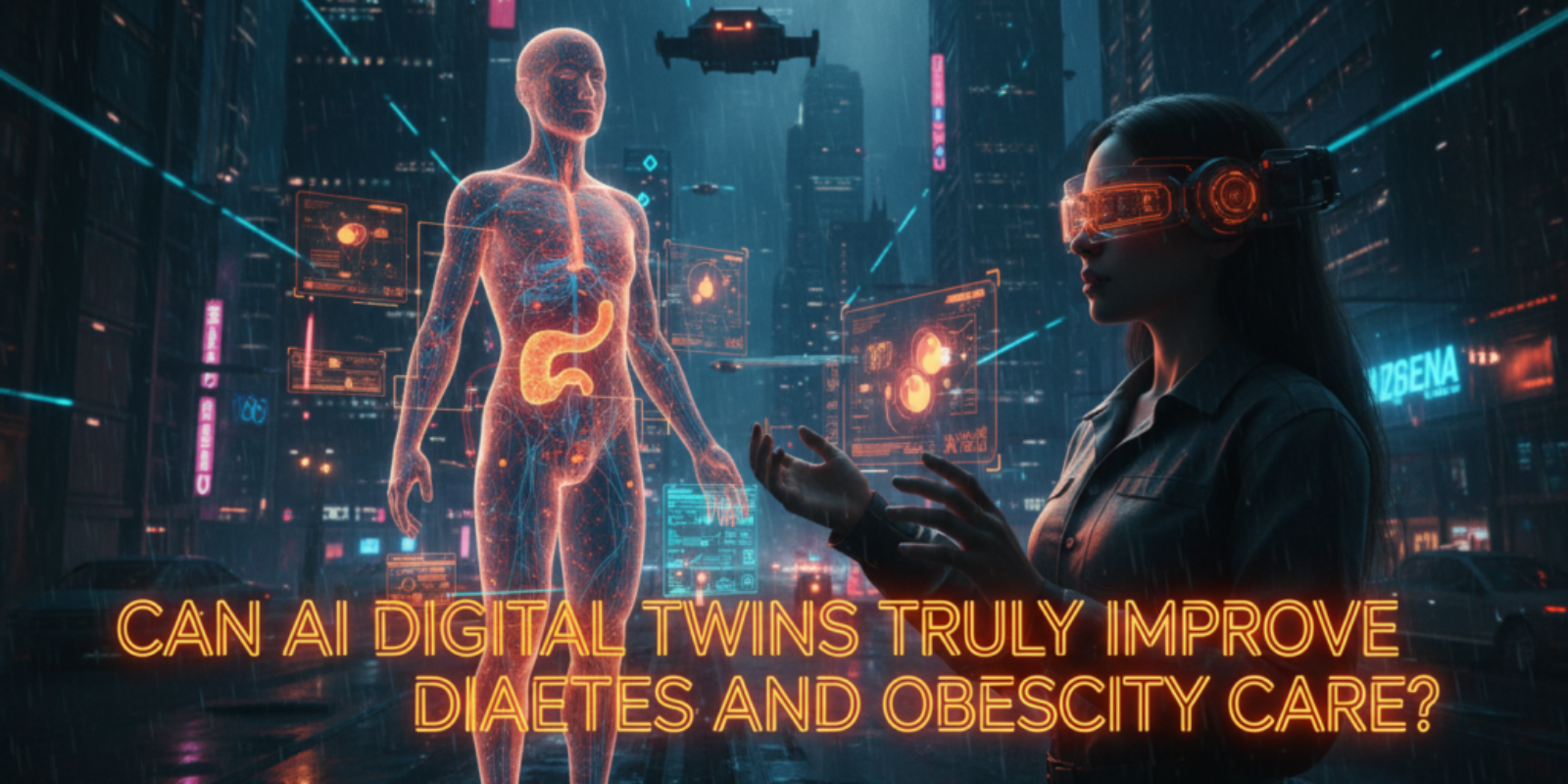
AI Digital Twins Are Helping People Manage Diabetes and Obesity
Why a virtual metabolism matters more to tech stacks and health insurers than to vanity metrics
A man straps on a continuous glucose monitor, steps on a smart scale, and gets a text: skip the pastry, walk 10 minutes now, and your blood sugar will thank you by bedtime. The advice is granular, evidence driven, and annoyingly effective; he loses weight, drops a medication, and his employer’s health plan reports lower costs. That scene is no longer a clinical vignette; it is becoming the playbook for a new class of AI systems.
Most stories frame these products as patient tools or as alternatives to expensive GLP-1 drugs. The overlooked angle is how digital twins are forcing the AI industry to solve problems that enterprises have been avoiding: tightly calibrated multimodal data ingestion, pay-for-outcome commercial models, and regulatory grade model validation. This matters to AI teams because it changes product road maps and revenue architectures in health tech fast enough to make procurement teams look like they enjoy spreadsheets for sport.
Why employers and payers are planting flags now
Rising medication costs have turned employers into de facto health policy wonks. When a GLP-1 can cost roughly 1,000 to 1,500 US dollars per month per person, alternative interventions that reduce medication dependence suddenly look like capital projects, not wellness perks. Wired’s reporting on employer adoption shows why benefits teams are piloting programs that promise cost reduction as a measurable outcome. The needle for CFOs is simple: can a digital twin drive enough clinical improvement to justify replacing recurring drug spend.
What an AI metabolic twin actually is
A digital twin in this context is a personalized, dynamic model of a person’s metabolism that ingests streams from continuous glucose monitors, wearables, scales, and self reported meals, then predicts physiological responses to food and activity. Academic frameworks describe these twins as layered systems combining mechanistic knowledge graphs with machine learning to personalize interventions at the individual level. These hybrids let engineers move beyond one-size-fits-most recommendation engines into highly individualized control systems.
Models, sensors, and the data plumbing
Constructing a twin means solving sensor alignment, timestamp quality, and label scarcity at scale. Recent papers map out architectures where metabolic flux models and clinical biomarkers are fused with behavior models to predict outcomes like A1c and weight change. Those design patterns are becoming the de facto reference for teams building production systems rather than research demos, which raises the bar for MLOps and clinical validation. Dry aside: teams that thought data engineering was boring are being forced to choose between spreadsheets and existential dread.
The numbers that make investors and benefit managers sit up
Peer reviewed and real-world studies are starting to deliver the load-bearing claims that payers ask for. A one-year real-world study reported meaningful reductions in A1c and medication use, with an average A1c decline of about 1.8 percent and most participants achieving clinically significant control. The presence of such results in Scientific Reports gives these interventions empirical heft that investors and employers can quantify. Twin-style programs also report randomized or quasi-randomized trial results with large differences in medication reduction and weight loss, which is why procurement conversations now mention “outcomes guarantees” in the same breath as SLAs.
Employers are buying outcomes, not apps, and digital twins make that commercial promise measurable.
Who the main players are and why competition is healthy
Startups and research groups are clustering around metabolic twins rather than a single winner emerging overnight. Academic groups published a framework toward twins for type 2 diabetes earlier this year, laying out a blueprint for combining knowledge graphs and machine learning. Established digital health companies are integrating twin concepts into existing chronic care platforms, while specialist vendors offer verticalized stacks that focus only on metabolic modeling. The competitive landscape is healthy because it forces interoperability and clinical validation to the forefront, rather than UX lipstick on a legacy product.
Practical implications for businesses with real math
A benefits team that spends 12,000 US dollars per year on a GLP-1 for an employee can model a scenario where a digital twin program charging 2,500 to 5,000 US dollars per participant per year and achieving a 50 percent reduction in drug use produces immediate savings. If 100 employees switch and half avoid a costly drug, payroll and drug spend math becomes favorable within the first year, even after paying for monitoring kits and coaching. For startups pitching B2B, this math requires providing transparent cohorts, baseline-risk adjustment, and an auditable path from inputs to outcomes; that is the engineering and compliance work that most AI teams underestimate.
The cost nobody is calculating
Setting up a twin requires more than model training. Costs include sensor procurement, secure data lakes, clinician oversight, and a validation pipeline for model drift. There is also the hidden expense of human workflows to act on model outputs; recommendations without human triage invite liability and disengagement. Investors who prize low marginal cost software are being reminded that health AI often trades off scale economics for regulatory and clinical infrastructure, and that is where margins evaporate if teams are not disciplined.
Risks and open questions that stress test the claims
Digital twins can amplify bias if training cohorts are skewed by socioeconomic status, race, or device access, producing recommendations that work well for early adopters but fail everyone else. Privacy and consent models are brittle when employers are the contracting party, and perverse incentives may arise if vendors are paid only on specific endpoints. Model drift is a practical worry; metabolic responses change with age, medications, and novel therapeutics, demanding continuous revalidation pipelines. Also, not every patient wants intensive tracking; uptake and sustained engagement remain uncertain variables.
Where regulation and standards come into play
Clinical acceptance will hinge on transparent validation and reproducible results, not glossy testimonials. Regulators and academic journals increasingly expect prospective trials or reproduction in independent cohorts, and pragmatic trials are becoming the minimum bar for enterprise adoption. That shift makes quality engineering and auditability as important as model architecture in procurement discussions, which is a mild tragedy for teams that hired solely for research chops. A little sarcasm: no, retraining a model once a quarter does not count as a medical audit.
A practical close for product and AI leaders
AI teams building twins must treat clinical outcomes as product features, instrument them as KPIs, and build the governance to prove causality. That discipline will determine whether metabolic twins are a niche clinical curiosity or a foundation for a new class of AI-driven, pay-for-performance health services.
Key Takeaways
- Digital twins translate continuous biometric streams into measurable clinical outcomes that employers can monetize as cost savings.
- Academic and real-world studies now provide data that make pay-for-outcome contracts feasible for metabolic care.
- Building a production twin demands clinical validation, relentless data engineering, and robust governance, which changes MLOps priorities.
- For payers, the core value is replaceable recurring drug spend with auditable, outcome-linked programs.
Frequently Asked Questions
How much can employers realistically save by using digital twin programs instead of GLP-1 drugs?
Savings depend on drug price, program cost, and effectiveness; a basic scenario sees a 50 percent reduction in drug spend generate net savings if program fees fall in the low thousands per person per year. Companies should model baseline prevalence and expected adherence to get accurate projections.
Are digital twins proven to reduce A1c and medication use?
Recent real-world and trial data show significant A1c reductions and lower medication reliance in users of digital twin programs, including results published in peer reviewed journals and clinical reports. Independent replication and prospective trials strengthen confidence in these findings.
What technical work is necessary to build a clinical-grade digital twin?
Teams must solve sensor integration, time series alignment, label scarcity, and continuous validation pipelines, plus build clinician workflows to act on model outputs. Strong MLOps, secure data infrastructure, and regulatory-compliant auditing are essential.
Do privacy laws prevent employers from using twin data?
Employers can contract programs that aggregate and anonymize outcomes, while clinicians retain identifiable data under protected health information rules where applicable. Legal designs vary by jurisdiction and require careful privacy engineering and legal review.
Will digital twins replace doctors or medications?
Digital twins augment clinical decision making and can reduce medication use for some patients, but they do not eliminate the need for clinicians or all pharmacotherapy. These systems are tools for personalization and monitoring rather than replacements for clinical judgment.
Related Coverage
Readers who follow this topic will want deeper reporting on algorithmic certification for clinical AI, the intersection of digital therapeutics and reimbursement policy, and the engineering practices behind continuous clinical validation. Those pieces explain the standards and procurement patterns that determine which health AI vendors survive and which become interesting footnotes.
SOURCES: https://www.wired.com/story/ai-digital-twins-are-helping-people-manage-diabetes-and-obesity/ https://www.nature.com/articles/s41598-024-76584-7 https://www.frontiersin.org/articles/10.3389/fdgth.2024.1336050/full https://usa.twinhealth.com/ourapproach https://www.nature.com/articles/s41746-024-01108-6