
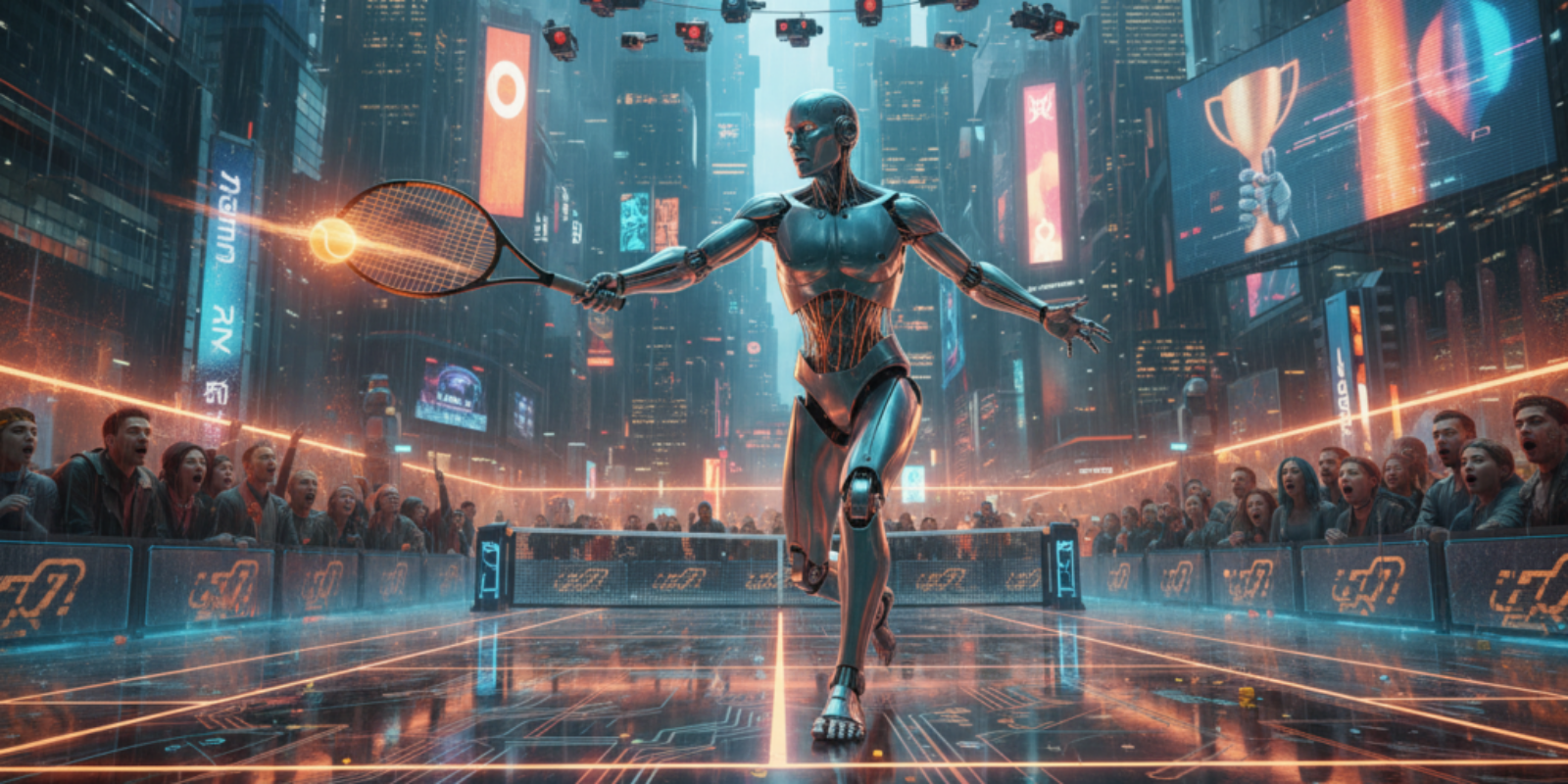
This Video of a Humanoid Robot Playing Perfect Tennis Is Extremely Impressive for Cyberpunk Enthusiasts and Professionals
A humanoid returns a smash so clean it makes the human player look like a conceptual art piece; the spectacle matters less than the industrial and cultural tremors it leaves behind.
A fluorescent gym, a small crowd, and a robot that tracks the ball with the calm focus of someone who has never been distracted by email. The clip looks like a late night cyberpunk vignette: synthetic limbs, a lacquered racket, and a machine doing something that, for decades, lived in film and fantasy. The immediate sensation is visceral awe, the kind that makes people rewatch slow motion and argue over whether the robot smiled.
The obvious headline is spectacle: robots can now emulate human athleticism. The underreported business story is different and sharper: achievements like this are not just marketing stunts, they are technical milestones that collapse long timelines for deploying humanoids in factory floors, hospitality, and experiential retail. This article leans on a primary research preprint and mainstream reporting around the demo, and it treats the viral clip as a data point in a broader industrial shift. (arxiv.org)
Why the Perfect Rally Is Not Just a Party Trick
At first glance the robot is performing a dynamic manipulation task that required sub-second perception and whole body control, skills roboticists have chased for years. The HITTER project demonstrates a hierarchical control stack that separates ball prediction from motion execution, allowing sustained, adaptable rallies. (arxiv.org)
The media angle framed the clip as viral curiosity; gaming and tech outlets amplified the visual. That coverage matters, but the deeper effect is how those images socialize products: investors see a timeline, designers see constraints, and customers start to expect humanoid fluency. (pcgamer.com)
Who Is Building These Machines and Why Now
A small set of players has pushed humanoid robotics from labs to live demos and early factory pilots. Boston Dynamics has moved Atlas into a product path, Hyundai is a visible industrial partner, and a clutch of startups are shipping narrower humanoid agents to warehouses. These demonstrations accelerate procurement conversations in manufacturing and logistics. (apnews.com)
The industry is no longer debating whether humanoids are possible, only where they make sense. That pivot dethrones the old argument that nonhumanoid robots are always cheaper and more effective, especially for tasks that require human form factor or social presence. Tech press and show floors are now the place where that calculus is publicly argued. (techradar.com)
The Tech Under the Skin
Two advances matter in the footage: high-frequency perception that removes motion blur and sample-efficient control that generalizes from human motion references to real-world interaction. Together they let a humanoid intercept a puck sized object at human reaction speeds. The research shows this approach can reach more than 100 consecutive returns in a human-robot rally. (arxiv.org)
Robotics is borrowing heavily from event-based vision, reinforcement learning, and model-predictive planners. The result reads like a cyberpunk toolbox: fast sensors, adaptive policies, and lightweight but powerful actuators. The surprise for practitioners is how those components are finally interoperable at scale.
What Cyberpunk Culture Loves and Fears
The video satisfies the aesthetic appetite of cyberpunk fans: human form, uncanny motion, and a sense that machines are becoming protagonists. That pleasure is political as well as visual; humanoids staged in public become symbols for debates about labor, surveillance, and urban design. Live Science and other outlets documented the eeriness and normalization that follow such demos, which is exactly the cultural electricity cyberpunk feeds on. (livescience.com)
Society oscillates between fetishizing elegant motion and fearing replacement. Both reactions accelerate product cycles: public acceptance lowers social friction, and fear pressures regulators to engage earlier. Either way, the genre influences procurement as much as it shapes sci fi fan art.
A robot that can keep a rally alive for 100 shots is not just a novelty, it is a mechanical proof that machines can close the loop on perception, planning, and social performance.
Practical SME Implications for Businesses with 5 to 50 Employees
Small manufacturers and experiential retailers should run simple math now, not later. Assume a repetitive packing role costs a business $25 per hour in wages and benefits, about $52,000 per year for a full time worker. If a commercial humanoid platform eventually costs $200,000 capital and is amortized over 5 years, that is $40,000 per year before maintenance and connectivity fees. Add $10,000 per year for maintenance and cloud services and the robot runs $50,000 per year. That becomes competitive for 1 to 2 roles where on-site availability, night shifts, or hazardous duty add hidden costs.
For a 20 person shop with 6 packing stations at $25 per hour, yearly labor is roughly $624,000. Swapping two stations for robots using the conservative estimate above would reduce recurring payroll by about $104,000 while adding $100,000 in amortized robot costs. The decision hinges on cash flow, financing terms, and the value of extended uptime. If a small business prefers leasing, capex hurdles disappear, but long term service contracts grow into vendor dependence. The numbers are blunt but demonstrative; the competitive edge is often operational uptime rather than headline cost savings.
The Cost Nobody Is Calculating
Most demos hide deployment integration, cybersecurity, and the human training overhead. A humanoid in a live environment demands safety validation, recalibration, and physical layout changes that can exceed initial capital. Staffing for monitoring, patch management, and human-robot cooperation design adds ongoing labor lines many leaders forget when dazzled by the demo.
Risks and Open Questions That Stress-Test the Claims
Autonomy over time remains unproven in diverse, unstructured environments. Supply chains for actuators and high-speed vision chips are geopolitical bottlenecks. Liability for collisions or misplacement is legally fuzzy and will likely require new insurance products. There is also a social acceptance risk: the same viral clip that drives investment can trigger local bans or restrictive labor rules if misread as a replacement rather than a tool.
Regulatory timing is uncertain and will vary by sector. The tech stacks must also prove secure against model and sensor spoofing before widespread deployment.
Where This Leaves Cyberpunk Professionals and Culture Makers
Design and narrative professionals should treat these demonstrations as new raw material. Practical worldbuilding is now constrained by real actuator limits and sensor timelines rather than pure imagination. Costume designers, set directors, and UX writers get a clearer template for plausible future cities.
A Short, Forward-Looking Close
Robots volleying tennis balls are entertaining and instructive: they reveal which technical problems are solved and which are now commercial questions rather than theoretical ones. Businesses that plan around those realities gain optionality; those that ignore the visual momentum risk being surprised on the factory floor and in public perception.
Key Takeaways
- The viral humanoid tennis demo is a technical milestone that signals readiness for limited industrial and service deployment within years, not decades.
- Small businesses should model robot replacement as amortized capital plus maintenance against full time equivalent labor to reveal realistic trade offs.
- Cultural normalization from viral demos lowers social friction but raises regulatory and liability questions that carry real costs.
- The real value for SMEs will often be extended uptime and access to hazardous or off-hours work rather than pure wage arbitrage.
Frequently Asked Questions
How soon could a small factory realistically buy a humanoid that does simple repetitive tasks?
Commercial pilots and factory-specific humanoids are being trialed now and productized versions are entering early industrial use within the next few years. Adoption depends on financing, integration costs, and task complexity.
Are these robots likely to replace human workers in a 10 person business?
Robots will replace specific roles that are repetitive, hazardous, or require 24 hour uptime, but most small businesses will find hybrid human plus robot teams more practical because robots require oversight and maintenance.
What are the immediate cybersecurity concerns for deploying humanoids?
Concerns include sensor spoofing, remote takeover, and data leakage from camera feeds; businesses should include network segmentation, encrypted telemetry, and strict patching regimes in procurement contracts.
Will public fascination with robot demos help or hurt my brand if I adopt them?
Public fascination can boost brand visibility and create a premium for novelty experiences, but it can also provoke backlash if perceived as job cutting; clear messaging about augmentation and worker redeployment mitigates risk.
How much should a 5 to 50 person business budget for integration beyond the purchase price?
Integration can run 10 to 50 percent of the capex in the first year for layout changes, safety systems, and staff training; budgeting for a higher initial integration cost is prudent.
Related Coverage
Explore how event-based vision and reinforcement learning are rewriting robotics research pipelines, and read practical pieces on retrofitting small factories for human-robot collaboration. Also consider coverage on regulatory frameworks for commercial humanoids and case studies of early warehouse deployments on The AI Era News.
SOURCES: https://arxiv.org/abs/2508.21043 https://www.pcgamer.com/hardware/this-humanoid-robot-is-playing-ping-pong-better-than-most-amateur-players-ive-seen/ https://apnews.com/article/ces-humanoid-robots-atlas-hyundai-boston-dynamics-8de7b2470c23f5f22441ad1ad7555136 https://www.techradar.com/ai-platforms-assistants/boston-dynamics-atlas-humanoid-robot-is-now-a-product-and-heading-to-factories-in-2028 https://www.livescience.com/technology/robotics/watch-eerie-video-of-army-of-humanoid-robots-marching-naturally-thanks-to-a-major-ai-upgrade