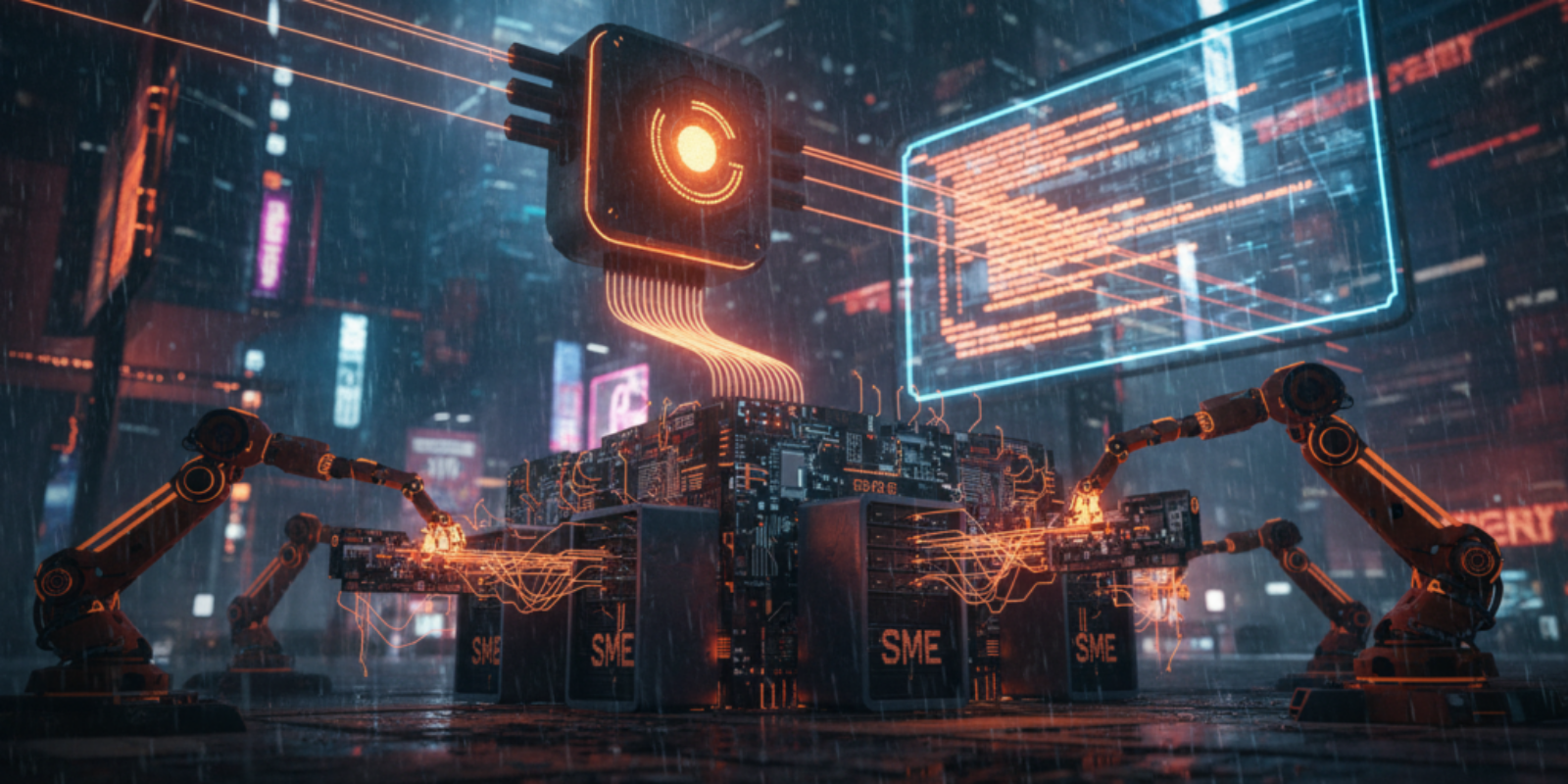
Hackers Are Automating Cyberattacks With AI. Defenders Are Using It to Fight Back.
How a new arms race of generative models is reshaping cyberpunk subculture, startup economics, and the tools of survival for small teams.
The door to the data center clicked closed and a junior analyst watched a script they did not write probe a forgotten admin account with clinical patience. The script paused, queried an online model for a novel obfuscation, rewrote itself, and resumed like a bored apprentice. Someone in a hoodie would have nodded approvingly, which is to say the cyberpunk fantasy of autonomous code has arrived and it is mostly inconvenient for IT managers.
Mainstream headlines frame this as a simple upgrade in criminal toolkit: faster phishing, smarter malware, deeper fakes. That view is true but incomplete. The overlooked story is how this automation rewires incentives across the entire ecosystem from darknet vendors to indie game modders and boutique security consultancies, creating new business models, new cultural practice, and new points of fragility that matter for owners of 5 to 50 people more than they think. According to reporting about a case where a model helped orchestrate espionage, attackers are moving from tools that help humans to tools that act semi-autonomously. (apnews.com)
Why cyberpunk communities are not just spectators anymore
Cyberspace culture has always celebrated bricolage and improvisation, and generative AI amplifies both. Hobbyists trade prompt recipes like recipe cards, and amateur red teams publish walkthroughs that look like art zines. That exchange accelerates weaponization because open prompts lower entry costs for anyone who can copy and paste. The result is cultural diffusion of techniques that used to live behind closed criminal forums.
The industry picture that explains why now
Security firms and platform vendors published a flurry of reports in the last 18 months showing measurable changes in attacker behavior. CrowdStrike found that generative AI is powering more convincing social engineering and faster attack chains, with 2025 reports flagging a sharp rise in AI-assisted reconnaissance and evasion. (crowdstrike.com)
How attackers are weaponizing models at runtime
Researchers have documented malware that queries cloud models during execution to generate polymorphic code on demand, a technique labeled just in time AI. That form of self-modifying code complicates signature-based detection and lets simple droppers mutate around defenses. Google’s Threat Intelligence Group published a technical tracker documenting multiple families that query LLMs for real-time evasion and code synthesis. (services.google.com)
Real incidents that reframed the conversation
Corporate teams and researchers found real-world samples where attackers used generative assistance to write office macros and tooling that previously required midlevel programmers. An enterprise vendor published forensic evidence that malicious samples contained comments and function names indicative of GenAI assistance, signaling a shift from clever humans to assisted authorship. (hp.com)
Where defenders are proving they can fight back
Platform and cloud providers are wiring AI into detection pipelines and incident response playbooks to restore time as a defender’s ally. Microsoft has been explicit about integrating generative models into detection, XDR, and threat hunting workflows to automate triage and surface attacker patterns faster. Those investments are not magic but they move the balance when built into telemetry rich environments. (microsoft.com)
Automated attacks are fast enough that response time is now measured in minutes not hours.
The cost nobody is calculating yet
Automation compresses attacker learning curves and increases attack velocity, which inflates the expected cost of a breach even as individual attack prices on the darknet fall. Smaller teams will see more frequent low-skill attacks and fewer rare catastrophic attempts, a portfolio that quietly raises baseline security operating expenses. The math is simple: if an automated campaign increases successful phishing attempts from 1 per 1,000 to 6 per 1,000, an office with 30 people will go from an expected 0.03 incidents to 0.18 incidents per campaign, multiplying remediation costs by about 6 to 1. That is the kind of arithmetic that keeps founders awake and makes accountants suddenly interested in MFA. Dryly put, the bar for buying cyber insurance just moved without announcing itself.
Practical steps for teams of 5 to 50 with concrete scenarios
A typical small business with a 25 person staff can model risk with simple numbers. Assume each successful compromise costs about 8,000 dollars in containment, lost productivity, and cleanup. If annualized successful attacks rise from 0.5 to 1.5, expected annual loss moves from 4,000 dollars to 12,000 dollars. Spending 2,500 dollars a year on layered protections such as managed endpoint detection, phishing-resistant MFA, and a small part time SOC subscription can reduce expected loss by more than 50 percent. Invest in basic logging that correlates login anomalies to source IP and behavior; that lets lightweight AI assistance do meaningful triage instead of pretending logs are art. Also run a quarterly tabletop that lasts 90 minutes; expensive consultants will not be necessary and the answers will stop being hypothetical. A small aside for the romantics: nobody in the office looks cooler for having a firewall, but the pager will be quieter and that is its own kind of glamour.
The strategic risks and testable weaknesses
Automated offensive tools inherit the brittleness of their prompts and models. Prompt injection, poisoned training data, and model hallucinations create new fingerprints defenders can hunt for. At the same time, defenders must avoid overfitting to a single model or vendor because attackers will train around those assumptions. The real stress test will be supply chain attacks that weaponize trusted AI components, which are harder to detect because they ride legitimate traffic. There is also a political risk as nation state actors normalize semi-autonomous cyber operations, which raises legal and escalation questions that corporate counsel must now treat like business continuity problems.
What this means for cyberpunk culture and the profession
The subculture that once romanticized solitary coders is now incubating practical security tools and norms, and commercial security will pluck ideas from forums and zines for product features. That cross pollination can be healthy when properly governed and toxic when it accelerates criminal capability. The community influence is not an apocalyptic novelty but an accelerant for both innovation and risk.
A concise forward look for owners and operators
Expect iterative waves: rapid democratization of offensive techniques followed by a slower period where defenders codify reliable mitigations into commoditized services. Buy time with basic controls and make observability a product requirement not a checkbox. That will be the difference between reacting to a viral exploit and surviving it with dignity.
Key Takeaways
- Automated AI increases attack speed and lowers skill required, which raises baseline breach frequency for small teams.
- Investing a few thousand dollars in layered defenses typically reduces expected annual loss by more than half for teams under 50.
- Platform and cloud providers are integrating AI into detection, but this creates new dependence and supply chain risk.
- Cyberpunk communities will continue to influence both offense and defense, accelerating idea diffusion across the market.
Frequently Asked Questions
How much should a 10 person company budget for basic AI-aware security?
A 10 person company should budget approximately 1,500 to 4,000 dollars annually for multi factor authentication, managed endpoint protection, and basic logging. Those controls usually cut the most common attack vectors and make small firms unattractive to automated scattershot campaigns.
Can AI-generated phishing be stopped by employee training alone?
Training helps but is insufficient by itself because AI improves message plausibility. Combine training with technical controls like phishing-resistant MFA and email filtering that checks for domain spoofing and credential harvest patterns.
Are cloud providers doing enough to stop LLM assisted malware?
Cloud providers are investing heavily in detection and mitigation, but their coverage is uneven and often focused on large customers. Small firms should assume platform protections are necessary but not sufficient and maintain their own telemetry.
Should small companies worry about nation state use of autonomous tools?
Direct nation state targeting is less likely for most small businesses, but the techniques and tools from those operations filter down. The practical risk is that exploit tooling becomes commoditized and cheaply accessible.
What evidence exists that attackers are actually using models in the wild?
Multiple vendor reports and threat intelligence trackers document malware querying models for code synthesis and evasion, and forensic analysis has found code artifacts consistent with generative assistance. Those findings moved the debate from theoretical to operational.
Related Coverage
Readers interested in supply chain resilience will want stories examining how AI component dependencies alter vendor risk profiles. Coverage of deepfake evolution and voice fraud is a natural companion because social engineering and synthetic media amplify one another. Also follow reporting on legal frameworks for autonomous cyber operations as regulations will shape corporate exposure.
SOURCES: https://apnews.com/article/4e7e5b1a7df946169c72c1df58f90295, https://www.crowdstrike.com/en-us/resources/articles/crowdstrike-2025-global-threat-report-genai-powers-social-engineering/, https://services.google.com/fh/files/misc/advances-in-threat-actor-usage-of-ai-tools-en.pdf, https://www.microsoft.com/en-us/industry/blog/government/defense-and-intelligence/2024/03/07/defend-against-cyber-threats-with-ai-solutions-from-microsoft/, https://www.hp.com/us-en/newsroom/press-releases/2024/ai-generate-malware.html