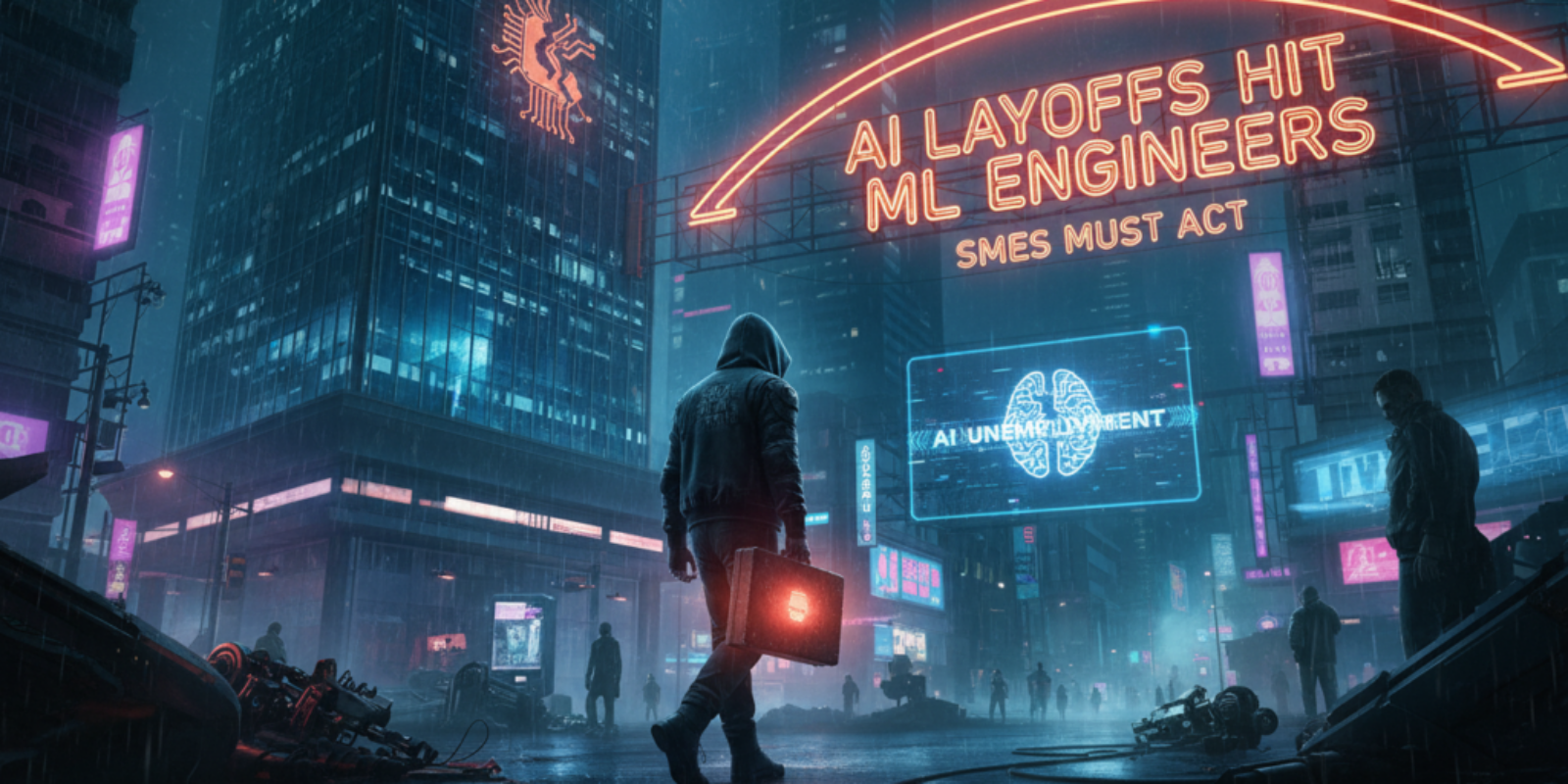
A Machine Learning Engineer Thought He Was Safe From AI Layoffs. Then He Got Some Depressing News
When the machine learned to code, he assumed his seat at the table was secure. The email that arrived on a Tuesday morning suggested otherwise.
He had been the person people called when a model failed in production, the one who stayed late to stitch pipelines back together and to explain probabilistic surprises to nontechnical executives. That confidence is the obvious reading of the moment: specialists build the systems, so specialists are safe. The underreported angle is more consequential for cyberpunk culture and industry: when companies swap narrative for optimization and minimalist teams run AI-native products, the aesthetic of cyberpunk moves from fiction to operational risk for small creative firms and studios.
Why this matters to cyberpunk enthusiasts is not sentimental. Cyberpunk has always been about relationships between humans and opaque systems, about who gets power when code scales. The practical business implication is that those who produce cyberpunk media, games, design elements, and immersive experiences often rely on small teams of ML practitioners and artists. When a single machine learning engineer who thought they were unassailable finds the opposite, it creates a supply shock for the cyberpunk economy that fuels both creativity and its myths.
How the headlines mapped a human story into a corporate justification
Major outlets have traced waves of job cuts back to companies framing efficiency gains as AI adoption. Forbes tracked large cuts across tech and media that companies described as shifts toward AI. (forbes.com)
At the same time, long reads and first person accounts have surfaced workers who were reassigned, sidelined, or let go after internal AI projects matured enough to perform tasks once considered specialist. The Guardian gathered multiple such accounts of people whose roles shrank as firms leaned on generative systems for routine decisions. (theguardian.com)
These two narratives together created a public story that a machine learning engineer could be both highly capable and suddenly redundant. That contradiction is the exact raw material cyberpunk writers and designers use, except now it is metastasizing into labor markets.
The ecosystem that makes a specialist suddenly dispensable
Large firms invested heavily in agentic systems and workflow automation in 2024 and 2025. The result was not only new products but new org charts that favor fewer, more senior maintainers over larger specialist teams. The Los Angeles Times described recent Silicon Valley rounds of layoffs and the resulting analytics of candidate glut versus available roles. (latimes.com)
Competitors in this space range from cloud providers that embed code-generation copilots into development pipelines to AI-native startups that sell full-stack agents that replicate entire job functions. This competition compresses the value of bespoke human judgment in repeatable domains and raises the bar for those who remain human overseers.
The core story: dates, names, and what actually changed
In mid 2024 to early 2025 several public companies signaled reorgs tied to AI investments and cut staff in HR, content moderation, and engineering teams. These moves accelerated in 2025 when some firms publicly linked headcount reductions to automation strategies. The Machine magazine reported detailed interviews with employees at companies that quietly redeployed investment toward agentic AI and then eliminated the human roles responsible for the workflows the agents absorbed. (machine.news)
One telling personal angle was covered in a candid essay about someone who spent years promoting AI and later found their own role diminished as the same tools they championed were operationalized at scale. That piece showed the ironic career loop that is now repeating across sectors. (thedailybeast.com)
The machines did not announce an uprising, they negotiated cost savings with an ROI model and an HR template.
Why cyberpunk culture feels this as both prophecy and practical headache
Cyberpunk fans have long celebrated dystopian futures where corporations automate life and commodify identity. The current wave of AI-driven reorganizations is a literal instantiation of those tropes for the creative economy that supports cyberpunk output. Studios that make narrative worlds, retrofuturist art, indie games, and immersive theater rely on small clusters of ML engineers and artists; losing a specialist is not an abstraction, it is a production delay with cascading creative costs.
Writers and designers also face a cultural hazard: authenticity. Cyberpunk authenticity historically depends on creators who have worked around messy systems. As more of that messy work gets outsourced to models, the texture that makes cyberpunk believable risks flattening into generative pastiche. One could say the future is getting polished; alas, polish is not the same as grit, and sometimes the audience notices grit went missing.
Practical implications for businesses with 5 to 50 employees
Small teams should model the math of substitution precisely. If hiring a midlevel ML engineer costs about one hundred fifty thousand dollars per year including overhead, and an AI service license plus cloud training costs forty thousand dollars per year, then the marginal financial case for replacing a single engineer looks compelling to cash-strapped founders. But the real cost includes time to production, debugging, and domain expertise that a model cannot replicate without curated datasets and human review.
A studio with a five person team that budgets one hundred thousand dollars for labor per person would have to decide whether to spend forty thousand on an AI platform plus twenty thousand on an external consultant annually, or hire a full-time engineer for one hundred fifty thousand. The consultant path saves cash in year one but raises rework risk that can double iteration time on a thirty thousand dollar project, erasing the nominal savings. These are the tradeoffs that move decisions from speculative to brutal accounting.
Small companies should track not only direct spend but failure-mode costs, such as a week of lost production when a generated artifact violates IP constraints or when a model hallucination requires rework. That time multiplies in creative pipelines and often undermines the supposed efficiency gains.
The cost nobody is calculating and the cultural supply shock
Replacing a single ML role with a vendor reduces headcount, but it also shrinks the pool of experts who know the peculiarities of niche creative processes. For cyberpunk industries that depend on craft knowledge about retro hardware, analog video aesthetics, and interactive narrative heuristics, this is a supply shock. The boutiques that remain will command premium rates, inflating budgets for indie projects and concentrating cultural production into better funded houses.
Also unpriced is trust erosion. Fans detect hollowing out. When a beloved studio leans too hard on AI for character dialogue and loses the tonal subtlety, the community responds. That social backlash can cost more than any license fee.
Risks and open questions that stress-test the claims
The causal link between AI and layoffs is rarely simple. Macro conditions, over-hiring, and investor pressures also drive cuts, meaning attribution risks overstating AI as the singular cause. Regulatory changes, remote labor arbitrage, and offshore hiring complicate the picture further.
Another open question is whether AI-induced churn creates long term gaps or a cyclical credentialing market where displaced specialists reskill into higher value governance roles. That outcome depends on public policy, educational funding, and whether firms invest in reskilling with real career pathways rather than PR-friendly workshops.
Practical next steps for cyberpunk studios and creators
Audit the parts of production that are repeatable and safe to automate, and protect the irreplaceable creative checkpoints with human oversight. Negotiate vendor contracts that include response SLAs and human-in-the-loop guarantees for critical assets. Budget contingency for rework equal to ten to twenty percent of project timelines when using generative tools, because models are fast and occasionally delightfully wrong.
A short forward-looking close
The story is not a morality play about machines versus humans; it is a coordination problem about which work gets commodified and which expertise remains scarce and valuable. Cyberpunk culture will adapt, but the industry must price in the human costs of that adaptation.
Key Takeaways
- Small creative teams face a real tradeoff between hiring specialists and buying AI services, and nominal savings can vanish when rework and domain loss are counted.
- Public narratives that frame layoffs as pure AI efficiency obscure the broader forces of cost cutting and organizational change.
- Cyberpunk production depends on niche expertise that is vulnerable to supply shocks when specialist roles are removed.
- Contracts, governance, and budgeting for failure modes are the most practical defenses for 5 to 50 person teams.
Frequently Asked Questions
How likely is it that AI will replace a machine learning engineer at my 10 person studio?
It depends on the tasks assigned. If the engineer runs repeatable training jobs and monitoring, an AI vendor plus a contractor might replicate that function. If the role involves bespoke model design and creative judgments, replacement is much less likely.
Should a small studio invest in AI tools or keep all work in-house?
A hybrid approach usually wins. Use AI for bulk tasks and keep human oversight for final creative decisions. Budget for extra review time and possible rework when using generative models.
What specific costs should a 5 person team include when adopting AI services?
Include subscription fees, cloud compute for fine-tuning, consultant time for integration, and an allowance of ten to twenty percent of project time for fixes due to model errors. Those add up quickly relative to headcount savings.
Can reskilling save displaced ML engineers in this sector?
Reskilling helps when companies provide genuine roles in model governance, safety, or data curation. Without concrete rehire commitments, reskilling risks becoming PR theatre.
How should indie creators preserve the ‘authentic’ cyberpunk aesthetic when using AI?
Keep core narrative and tonal editing human. Use AI for texture generation and iteration, but gate final voice and worldbuilding choices through small human panels that protect feel and continuity.
Related Coverage
Readers who work in creative tech may want to explore how agentic AI startups reshape org charts, how copyright and IP law is evolving around generative content, and how indie game studios are renegotiating production pipelines for a world where models are collaborators rather than replacements. These topics probe the business mechanics behind cultural change and offer practical playbooks.
SOURCES: https://www.forbes.com/sites/martineparis/2025/07/09/sweeping-layoffs-hit-tech-and-media-giants-citing-ai-take-over/, https://www.theguardian.com/technology/2025/may/31/the-workers-who-lost-their-jobs-to-ai-chatgpt, https://www.thedailybeast.com/i-promoted-ai-for-years-and-automated-myself-out-of-a-job/, https://www.machine.news/eliminated-what-its-like-to-lose-a-corporate-job-to-ai/, https://www.latimes.com/business/story/2026-03-06/tech-layoffs-pile-up-as-sllicon-valley-shakeout-continues-into-2026