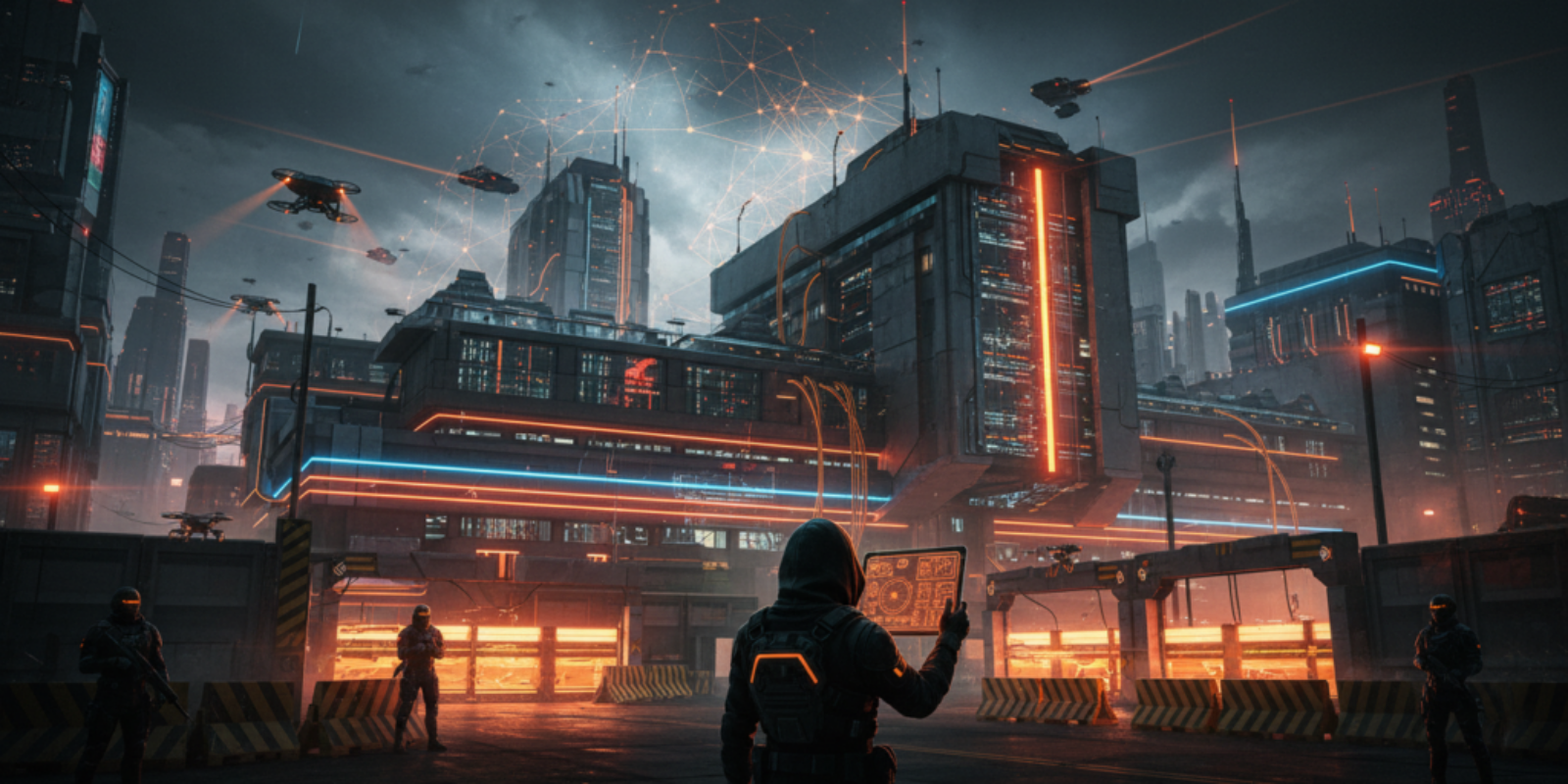
When the Cloud Gets Shot at: Why AI Data Centres Are the New Frontline in Modern Warfare
Physical attacks on cloud infrastructure are reshaping how AI is built, hosted, and defended — and the industry is only just waking up.
A maintenance engineer in Dubai watched smoke curl from the edge of a data hall while executives on three continents tried to reroute trillions of small transactions, model checkpoints, and overnight training jobs. The scene read like bad science fiction until a series of drone strikes in early March 2026 made it plain that the physical places powering today’s AI were now legitimate military targets. According to AP News, several Amazon Web Services facilities in the United Arab Emirates and Bahrain were struck, causing structural damage, disrupted power delivery, and wide ranging service outages. (apnews.com)
Most commentary reduced the story to service availability and outage postmortems. That is the obvious angle and a perfectly good headline for a cloud ops newsletter. What has been underreported is how physical vulnerability of concentrated compute maps directly to strategic leverage in conflict, and how that leverage changes the economics, architecture, and geopolitical calculus of training and deploying large AI models.
Why a few data halls now matter more than entire fleets of tanks
Hyperscale cloud regions host the GPUs and networking fabric that underpin foundation models. When those handfuls of facilities go offline, entire pipelines stall and intelligence flows dry up. Wired mapped the mechanics of physical damage versus cyber disruption, noting that hardware replacement, cooling system failure, and water damage from fire suppression produce multiweek recovery windows that software rollbacks cannot cure. (wired.me)
The consequence is concentration risk writ large. Most advanced model training runs are scheduled across a small set of regions to reduce latency and procurement complexity. That efficiency becomes fragility when a rival actor decides to weaponize drones or missiles against infrastructure. The Guardian reported that some governments now view AI data centres as strategic assets whose loss would hamper military decision making and commerce alike. (theguardian.com)
Why governments are suddenly offering land and power to cloud builders
Foreign and defense ministries face a paradox: the state needs domestic access to compute for intelligence and logistics, but hosting it on civilian hyperscalers creates single points of failure. The U.S. Air Force proposal to host private AI data centres on bases is one concrete policy response that highlights this tension. Defense One covered that plan, which asks industry to build on military land while raising concerns about land use, security, and the legal implications of colocating commercial systems on bases. (defenseone.com)
This is not just about bunkers and concrete. Energy policy matters too. Governments are racing to guarantee power and microgrids for compute, and the Biden administration previously signed orders to accelerate energy siting for AI data centres to reduce those choke points, turning the power grid into another contested domain. The Economist has documented rising exposure of data centres to hybrid warfare dynamics and the supply chain shocks that follow when regions become contested. (assets.ctfassets.net)
The core story for AI companies: where the compute lives determines who wins
Cloud providers AWS, Microsoft Azure, and Google Cloud compete to host the highest density of AI GPU racks near customers. That architecture is profitable because customers prefer low-latency, locality, and consistent SLAs. When a Gulf region availability zone was physically hit, customers lost more than an e commerce checkout or a messaging stream; critical model checkpoints and inference endpoints were unavailable, demonstrating how kinetic events cascade into model performance and business continuity. The industry now has to weigh redundancy costs against latency and regulatory demands, and that math is neither trivial nor cheap.
A single struck facility can pause a multiweek training run and turn a competitive lead into a painful reminder that compute is a vulnerability as much as an asset.
Practical implications with real math for AI teams and platform owners
For a mid sized AI developer renting 1,000 GPUs at market rates of 3 to 6 dollars per GPU hour, a week of downtime costs on the order of 50,000 to 100,000 dollars in compute alone, not counting wasted research time and delayed model releases. Replicating a training job across two regions to achieve basic redundancy roughly doubles the compute bill and adds 10 to 20 percent in cross region egress fees. That tradeoff is now part of product roadmap decisions: pay for resilience or accept a single region of failure and move faster.
Enterprises should model a simple scenario: a production model requiring 24 hours of fine tuning per release would lose 24 to 72 hours of availability if the primary region is hit and cross region failover has not been tested. For time sensitive applications such as battlefield analytics or emergency response, those hours are operationally catastrophic. Teams must budget for redundant checkpoints, regional replication, and cold spare capacity that can be spun up within hours.
The cost nobody is calculating
Security budgets usually focus on cyber controls, not kinetic hardening. Hardened perimeters, anti drone systems, and onsite firefighting redundancies add capital expenditures that do not appear in typical cloud TCO calculators. Small and medium AI shops cannot absorb those costs and are more likely to opt for multi cloud strategies that raise engineering complexity. Expect new insurance products and compliance regimes to emerge that treat compute footprint as a regulated national infrastructure item, which will push pricing and procurement toward larger, vertically integrated vendors.
Risks and open questions that will stress test current assumptions
Physical attacks on data centres raise legal and policy questions about neutrality, the status of commercial cloud assets in conflict, and the rules of proportionality when civilian infrastructure supports military decision making. Attribution remains messy and rapid retaliation is rarer than headlines suggest; those delays change incentives for state and non state actors. There is also the danger of overcentralizing “defense” data inside military compounds that lose the benefits of commercial innovation and rapid scaling.
Drone swarms, cyber plus kinetic combinations, and supply chain targeting each create different failure modes. If attackers learn to time strikes to coincide with model retraining windows, the impact is multiplied. Conversely, redundant architectures, air gapped back ups, and localized edge inference can blunt those risks, but they raise costs and engineering overhead — the industry’s version of paying for a submarine you hope never to use. That is a dry joke only slightly more useful than pretending a VPN is a shield.
What leaders should do next
Start by mapping where critical model training and inference workloads live, and run tabletop exercises that include physical damage and multi region recovery. Negotiate SLAs that include physical incident response commitments and build a budget for cross region replication, cold storage of checkpoints, and incident response retainers. Expect cloud contracts to change; the firms that can sell guaranteed, geographically dispersed compute with documented hardened facilities will win more government and defense work.
Looking ahead
The AI industry will graft new layers of resilience onto existing architectures, and market leaders will monetize the premium for hardened, geopolitically aware compute. That will be expensive, sometimes awkward, but ultimately necessary to keep AI systems operating when the maps stop being digital.
Key Takeaways
- AI workloads are now strategic assets, and strikes on data centres can pause model training and break inference pipelines in hours.
- Replicating workloads across regions roughly doubles compute costs but reduces the chance of catastrophic downtime for mission critical systems.
- Governments are offering access to military land and power to host AI compute, shifting the security burden onto cloud providers and clients.
- Expect new insurance, procurement, and compliance regimes that treat compute infrastructure as critical national infrastructure.
Frequently Asked Questions
How should a startup hosting models on a single cloud region react to recent attacks?
Startups should prioritize offsite checkpoint backups, test multi region failover, and quantify how many days of work are at risk if a region goes offline. Short term, negotiate stronger incident response clauses with providers and consider a staged replication plan to limit costs.
Can multi cloud eliminate the risk of physical strikes on my training jobs?
Multi cloud reduces single point failure risk but increases operational complexity and egress costs. For true resilience, combine multi cloud with geographically separated backups and automated orchestration that can resume training within hours.
Will cloud providers be forced to harden facilities or change where they build regions?
Market incentives and government pressure will push providers toward hardened designs and preferred locations with guaranteed power and security. Expect higher costs in contested regions and more public private partnerships around compute siting.
Is it safer to run inference at the edge rather than in centralized data centres?
Edge inference reduces latency and lowers dependency on a single facility, but it can be more expensive per prediction and harder to coordinate model updates. For critical operations, a hybrid approach that keeps lightweight inference local and heavy training centralized makes sense.
Do laws protect commercial cloud assets in wartime?
International humanitarian law draws lines around civilian infrastructure, but when assets support military intelligence they occupy a grey zone. Firms should plan for ambiguity and work with governments to clarify protections and obligations.
Related Coverage
Explore reporting on how chip supply chains and export controls affect access to high end GPUs for model builders, and read investigations into how cloud provider contracts are changing to include physical incident terms. Also look into stories about new insurance markets for cloud infrastructure and the evolution of edge compute for resilience.
SOURCES: https://apnews.com/article/71066b0a822c4cfd88b61e3fe79af917 https://www.theguardian.com/world/2026/mar/07/it-means-missile-defence-on-data-centres-drone-strikes-raises-doubts-over-gulf-as-ai-superpower https://www.wired.me/story/when-iranian-drones-hit-the-cloud-aws-data-centres-damaged-in-the-gulf https://www.defenseone.com/policy/2025/10/air-force-wants-put-private-ai-data-centers-its-bases-raising-security-land-use-fears/409046/ https://assets.ctfassets.net/9crgcb5vlu43/4HgM58L40j2AUG4YOCQwD2/1e81ef2905b49693609fe5f549ed4537/Economist_Impact_x_FM_Foundations_at_Risk_Infographic.pdf