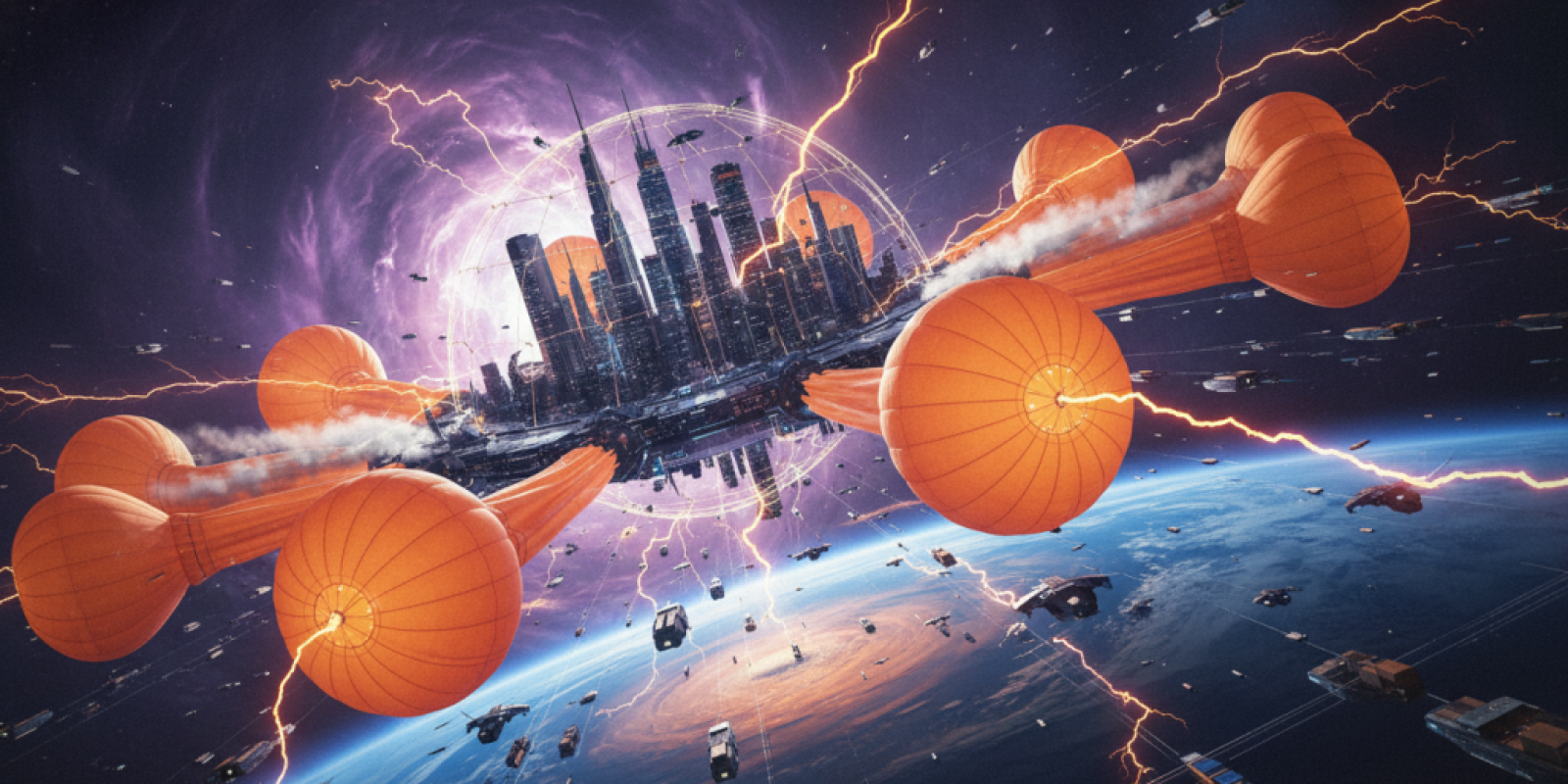
Orbital Airbag Could Shield Earth From Devastating Solar Storms — and What That Means for Cyberpunk Culture and Industry
A fleet of canisters in geosynchronous orbit, a few hundred tons of sodium or lithium, and the possibility of turning a Carrington-scale blackout into a manageable outage.
A technician in a neon-lit control room watches a solar wind forecast spike on a console, then reaches for the remote that could jettison an artificial plasma cloud into space. The moment feels cinematic and dangerous in equal measure: humanity preparing to tinker with the magnetosphere like a hacker patching a planetary firewall. That scene is the obvious take: a high-tech safety net born from peer-reviewed physics and university labs.
The underreported angle is not the novelty of the physics but who gains and who loses when a global space-geoengineering capability exists. For cyberpunk creators and infrastructure firms the real question is not whether it works but who controls the trigger, how quickly it can be deployed, and what it does to power, data sovereignty, and the market for resilience. Much of the early coverage leans on the new peer-reviewed paper and university press materials, which frame feasibility and timelines but gloss over governance and economic second order effects. (eurekalert.org)
Why a planetary airbag is suddenly plausible
The proposal, labeled StormWall by its authors, models placing a constellation of spacecraft in geosynchronous-like orbits that would release neutral gases such as lithium, barium, or sodium into the dayside magnetosphere when an extreme coronal mass ejection is inbound. The particles photoionize, mass-load the magnetopause, and in simulations reduce major geomagnetic storm intensity by roughly 50 percent or more. The method is described in a recent Space Weather paper that includes global magnetohydrodynamic modeling and sensitivity runs. (agupubs.onlinelibrary.wiley.com)
Deploying hundreds of tons of material sounds like science fiction, but the authors calculate that modern heavy-lift rockets could loft the hardware within months, and the plasma would disperse in hours so the intervention is reversible. The practical framing here matters because reversible interventions are easier to sell politically than permanent geoengineering. Singularity Hub and other outlets ran accessible explainers that translated the math into the airbag metaphor most readers will remember. (singularityhub.com)
The competitive landscape that matters to cyberpunk firms
This is not the only shielding idea in circulation. Proposals range from magnetic coil concepts at the Sun Earth L1 point to distributed hardening of ground infrastructure and hardened satellite design. The novelty of StormWall is its operational posture: active, on demand, and global. For firms that build satellite constellations, power electronics, or cyber-physical systems, StormWall would be a new variable to model into risk calculations and service-level agreements. The media framing so far has emphasized physics and cost to launch rather than market effects, which is where the disruptive potential lives. (phys.org)
The core science and timeline, with the numbers you can cite at a board meeting
The Space Weather simulations argue that releasing roughly 400 tons of neutral gas across a coordinated set of spacecraft could cut a Carrington-scale storm’s impact by more than half on metrics like polar cap potential and auroral electrojet indices. The model shows mass-loading effects peak within hours and then fade as the solar wind carries the material away. The authors name realistic orbit geometries and materials, and sketch an implementation path that assumes six to a dozen heavy-launch missions and prepositioned satellites. (agupubs.onlinelibrary.wiley.com)
Media coverage has already translated those numbers into timelines: launch and emplacement could be achieved in under two months given available lift, while operational readiness requires accurate multi-day space weather forecasts. Space.com’s reporting notes the reliance on timely forecasting and the practicalities of commanding a global shield at short notice. (space.com)
A planetary airbag is only as safe as the hand that pulls the ripcord.
What this does to cyberpunk aesthetics and real-world industry behavior
Cyberpunk culture has always loved fail-safe tech and the moral hazard it creates: a visible planetary cushion rewrites power fantasies. Corporations in the skinsuit era may advertise resilience-as-a-service, offering clients guaranteed uptime even through space weather crises. That will change procurement language for everything from autonomous farms to fintech ledgers. Expect narrative beats in fiction where megacorps own deployment keys, and practical shifts in how insurers price space weather risk. Dry observation: nothing sharpens dystopian branding like selling security to those already secure.
Practical implications for businesses with 5 to 50 employees (with concrete math)
A small tech firm with 20 employees and average revenue per employee of 150,000 per year generates roughly 3,000,000 per year; that is about 8,220 per day. A multi-day grid outage during a severe storm equals direct lost revenue plus recovery and reputational costs. If a StormWall-style deployment reduces probability of a catastrophic outage from 1 percent to 0.5 percent annually, expected annual loss avoided can be estimated and compared to resilience spend. For these numbers that’s an expected annual saving on the order of tens of thousands of dollars, depending on dependency on cloud services and backup power. Translate that into a subscription for enhanced continuity or into a one-time investment in local microgrid gear. The math favors dual strategies: buy redundancy and push for public governance of planetary shields to avoid vendor lock. Yes, one more vendor to manage; peak irony: resilience becomes another SaaS contract. (agupubs.onlinelibrary.wiley.com)
The cost nobody is calculating for small teams
Most calculators focus on launch and hardware. They forget conditional costs: legal liability for a misfired release, the need for internationally interoperable command and control, and the secondary market in “rapidly deployable mitigation” services. For a 10 to 50 person company, legal and compliance budgets could need to expand, and procurement teams will have to weight counterparty control over critical triggers. That added institutional friction is a real cost of living under an orbital umbrella.
Risks, governance problems, and open technical questions
There are credible technical concerns about induced electromagnetic waves, unforeseen plasma instabilities, and side effects to other satellites that the Space Weather paper flags as requiring more study. International law and space governance currently lack clear rules for temporary global interventions in the space environment. Who gets veto power? What safeguards prevent asymmetric manipulation of effects? These are not science questions alone but geopolitical ones, and the existing discourse in press releases and media summaries leaves governance as an afterthought. (agupubs.onlinelibrary.wiley.com)
Why small teams should watch this closely
Small teams build infrastructure that assumes predictable connectivity. If operators of a StormWall-style system can guarantee partial mitigation, those teams will change architectural bets: leaner redundancy, more reliance on remote-first workflows, and different insurance products. Or they will double down on independence with local microgrids; either path reshapes vendor ecosystems and developer tooling. Also, nothing says cyberpunk like a startup pivoting from app to municipal-level resilience consultancy. Someone will sell that pivot in a pitch deck and sound utterly sincere about saving the world between funding rounds.
Forward-looking close
StormWall reframes space weather from an unmanageable natural hazard into an operational engineering problem with social and commercial implications. For cyberpunk storytellers and industry practitioners alike the interesting question is not whether the airbag works but how control, cost, and culture will bend around it in the coming decade.
Key Takeaways
- StormWall would use prepositioned spacecraft to release photoionizable gas that simulations say can cut major geomagnetic storm intensity by roughly 50 percent. (agupubs.onlinelibrary.wiley.com)
- The proposal is technically plausible with current heavy-lift rockets but requires rapid, accurate space weather forecasting and international coordination. (space.com)
- Small businesses should model both reduced catastrophic risk and new governance costs when planning continuity and insurance strategies. (agupubs.onlinelibrary.wiley.com)
- Cyberpunk culture will find rich conflict in the politics of who controls a planetary shield and how that power is monetized. (singularityhub.com)
Frequently Asked Questions
How soon could a StormWall system be built and ready to use?
The academic proposal suggests emplacement could be done in a matter of months if sufficient launch capacity is available and satellites are prebuilt, but operational readiness also depends on validated command procedures and forecasting lead time. Real world timelines will be determined by funding, international agreements, and testing cycles. (agupubs.onlinelibrary.wiley.com)
Would a StormWall deployment permanently change Earth’s environment?
No. The modeling indicates the introduced plasma would be carried away by the solar wind within hours to a day, so effects are transient rather than permanent. However, temporary plasma can create secondary electromagnetic phenomena that need further study. (agupubs.onlinelibrary.wiley.com)
Could one country use the system to help only its own satellites and infrastructure?
The magnetosphere is global, so an intervention would affect the whole planet; technically selective shielding of parts of the globe is not straightforward. That makes the governance question a geopolitical issue, not merely a technical one. (eurekalert.org)
How should a small tech company change its resilience plan now?
Model worst case downtime using conservative revenue per day figures, invest in basic local backup power and offline modes, and track developments in public governance that could create new service offerings or compliance requirements. Balancing local redundancy with market solutions will be the pragmatic path. (space.com)
Related Coverage
Readers may want to explore the politics of space governance, technical proposals for L1 magnetic shields, and the insurance market response to systemic space weather risks. Coverage of autonomous systems that depend on GNSS and the redesign of grid infrastructure for climate and space resilience will also be directly relevant to teams planning for the next decade.
SOURCES: https://doi.org/10.1029/2025SW004846 https://www.space.com/astronomy/earth/scientists-propose-spraying-chemicals-into-earths-magnetic-field-to-protect-us-from-powerful-solar-storms https://singularityhub.com/2026/06/08/orbital-airbag-could-shield-earth-from-devastating-solar-storms/ https://phys.org/news/2026-06-space-weather.html https://www.eurekalert.org/news-releases/1130717