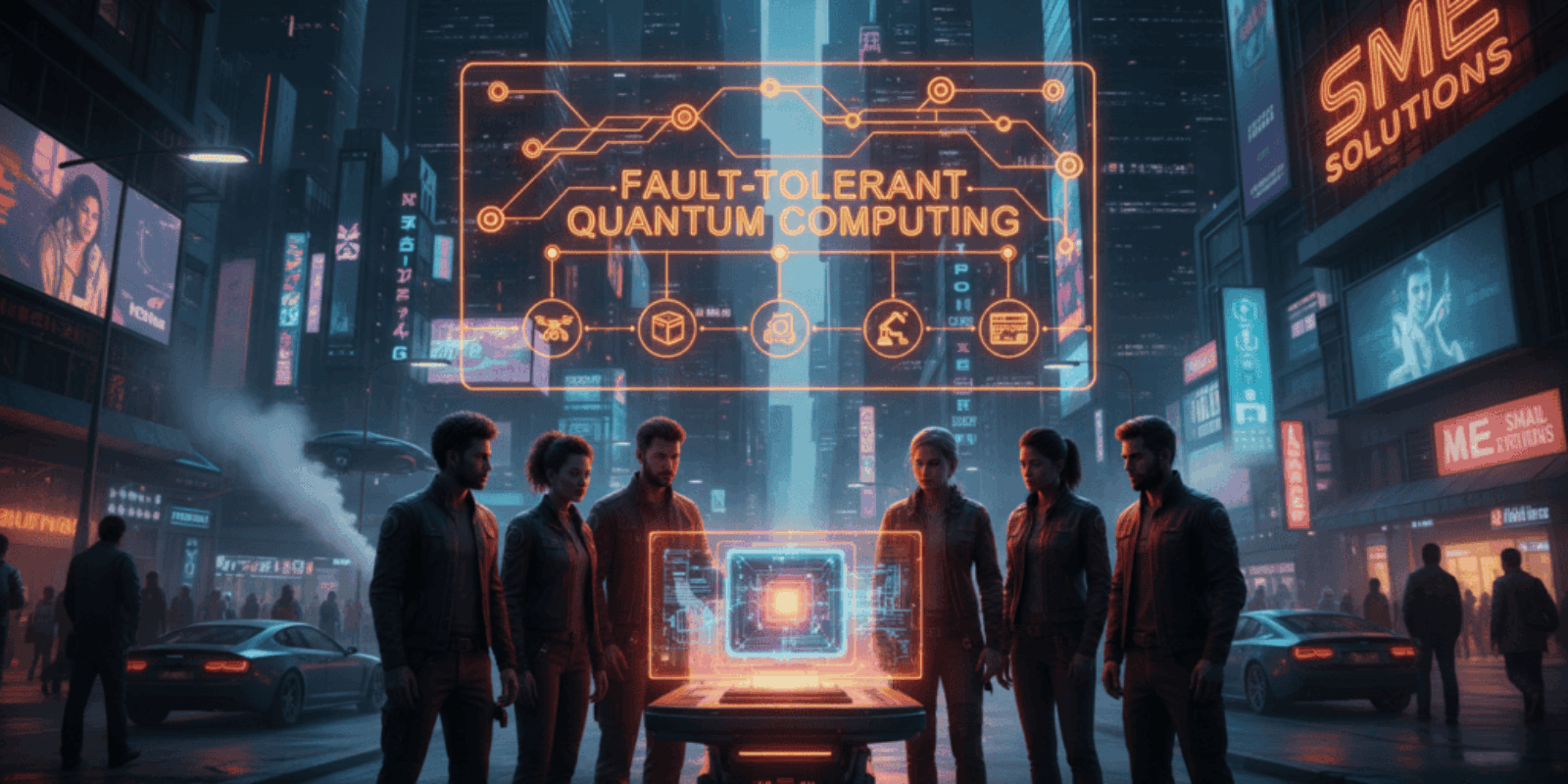
The First Fault-Tolerant Quantum Computer by 2028: How a Quiet Engineering Victory Will Rewire Cyberpunk Cities and Businesses
A neon datacenter hums under rain; a glassy rack counts qubits the way a night market counts shoppers. The machine does not yell. It corrects itself.
The headline read like another lab milestone, and most readers will treat it as incremental science made flashy. The more consequential story is not that a machine exists but that error correction moved from physics demo to engineering product, creating a new set of leverage points for corporations, governments, and the small teams that populate cyberpunk economies.
This reporting leans heavily on vendor roadmaps and press materials, which are useful but optimistic by design. According to IBM’s public roadmap and research blog, the company plans a rigorous path to a large scale, fault-tolerant quantum computer by 2029 with key decoder and module milestones arriving in 2028. (ibm.com)
Why 2028 feels less like a date and more like a deadline for CTOs
The simple reading is that one vendor or another will flick a switch and quantum problems get solved overnight. A more consequential reading is that 2028 marks the moment when error correction becomes an industrial engineering problem rather than a laboratory curiosity, which invites supply chains, certifications, and attack surfaces into the conversation. Live Science documented the processor-level moves that make that shift plausible, showing how new coupler designs and modular chips will support the high gate counts needed for error correction at scale. (livescience.com)
Who is actually racing and why the roster matters
Big names are positioning for the leap: IBM leads with a documented roadmap, while smaller hardware specialists pitch photonic or neutral atom alternatives that promise different tradeoffs in scaling and energy. Quandela, for example, explicitly positions a photonic architecture as a path to fault-tolerant machines by 2028, arguing that industrialized photonics changes manufacturability and timelines. (quandela.com)
The technical pivot that changes everything
The core technical change is not raw qubit count but error correction coupled with fast classical decoding and modular assembly. When quantum systems can detect and correct errors during computation, they stop being fragile research monsters and start being infrastructure you can lease, certify, and insure. Industry analysis groups and expert surveys show 2028 to 2033 as a window for early fault-tolerant systems, while reminding readers that practical usefulness will roll out in stages and not as a single event. (thequantuminsider.com)
What the machines will actually do first
Early fault-tolerant systems will likely handle specialized workloads, for example quantum chemistry or optimization problems with modest logical qubit counts and deep gate budgets. That means the first commercial wins will come in materials, batteries, and certain simulation tasks, not instant decryption of the internet. However, the infrastructure changes required for those simulations create new points of concentration for value and control.
This is a plumbing revolution disguised as a performance upgrade.
Why cyberpunk scenes should stop romanticizing privacy and start budgeting for technical reality
Cyberpunk culture thrives on asymmetry: talented outsiders bending systems built by giants. Fault tolerance removes one form of asymmetry by making quantum compute reliable enough to be a service rather than a research trophy. That shifts the power back toward those who control access, who verify results, and who certify trust, which will often be large cloud providers and national labs. Smaller players still matter, because the first applications will be niche and domain specific, and clever engineers always find ways to monetise small, repeatable wins. Also, if data exfiltration is ever automated at scale, it will prefer predictable targets, not messy back doors; predictability sounds boring until it is used to automate surveillance contracts. A startup can be both revolutionary and overly caffeinated about its market fit; either outcome is equally plausible.
Practical implications for businesses with 5 to 50 employees
Small teams should treat 2028 as a planning horizon, not a panic button. First, inventory cryptographic exposure by listing public keys, code signing keys, and VPN endpoints that rely on classical public-key crypto. If a company has 20 employees, two cloud servers, and uses three third-party SaaS integrations, a conservative remediation plan might budget 40 hours of engineering time at an internal or contractor rate of 100 US dollars per hour, totaling 4,000 US dollars, plus incidental expenses for certificate renewals or managed service changes. Second, for product firms using simulation driven design, a single early access quantum job could cost from thousands to tens of thousands of dollars depending on provider and runtime; assume a pilot budget of 10,000 US dollars to explore one high-value material or chemical simulation over six months. These numbers are practical scenarios for planning, not hard limits; smaller teams can defer heavy investment by partnering with universities or consortia.
The cost nobody is calculating
Beyond engineering hours and pilot budgets, the invisible costs are certification, legal review, and insurance. Quantum-ready certification for APIs and code signing procedures will create recurring compliance cost centers for SMBs that handle regulated data. Those costs will be small for many businesses but will be disproportionately painful for creative studios and boutique firms that thrive on lean operations. Think of it as a new line item in the budget, like anti piracy but with a slightly more apocalyptic press release.
Risks and open questions that stress-test the claims
Major technical risks remain: error correction requires orders of magnitude more physical qubits per logical qubit in some schemes, classical decoders must scale in real time, and thermal and supply constraints could slow deployment. Roadmaps are optimistic and useful as project management tools but not certainties; independent analysis suggests a range from early demonstrators to longer timeframes depending on the platform. Market risks include vendor lock in and concentration of access with a few providers, which could reshape the competitive landscape faster than market entrants can adapt. (arstechnica.com)
How to behave if the culture you love depends on plausible deniability
For artists, journalists, and small firms that prize opacity, the useful moves are mundane: adopt post-quantum cryptography where available, segregate sensitive keys behind hardware modules, and use multi party compute or threshold signing to spread risk. These measures preserve operational privacy without dramatic infrastructure refactors. Also, community-run testbeds and shared tooling are the natural habitat for the cyberpunk DIY ethic, which means there will be meaningful grassroots responses even as corporations build the big boxes.
Short forward-looking close
Fault tolerance arriving as an engineering problem means quantum computing will be something cities budget for and startups sell to, not just a laboratory spectacle; plan budgets and governance now, and build partnerships that let small teams access capability without surrendering autonomy.
Key Takeaways
- Fault-tolerant quantum computing is moving from lab demonstration to roadmap engineering, which shifts control to operators and certifiers.
- Small teams should budget modest remediation and pilot funds now, for example a 4,000 US dollar engineering contingency and a 10,000 US dollar pilot line for simulations.
- Vendor roadmaps matter because they set procurement and compliance timelines, but technical uncertainty means multiple scenarios remain plausible.
- Cyberpunk culture will adapt via shared testbeds, threshold cryptography, and creative market responses, not by a single dramatic exploit.
Frequently Asked Questions
How soon should a small business start migrating to post-quantum cryptography?
Begin with inventory and threat modeling now and schedule incremental updates to cryptographic libraries over the next 12 to 36 months. For most small businesses the migration is a routine maintenance task rather than an emergency replacement.
Will a fault-tolerant quantum computer in 2028 immediately break my customer data encryption?
No, early fault-tolerant systems will focus on niche workloads and will not instantly render symmetric encryption obsolete; however planning for eventual migration and adopting hybrid quantum resistant protocols is prudent.
Can a small studio afford to use quantum computing for materials or design R and D?
Yes, by partnering with research consortia or leasing pilot access; budget roughly 10,000 US dollars for an exploratory six month program depending on problem complexity and provider pricing.
What services should a 10 person company prioritize to reduce risk from future quantum threats?
Prioritize key management hygiene, multi factor authentication, and vendor contracts that specify cryptographic agility so software and integrations can update easily when standards change.
Are there open source tools to help test quantum exposure?
Yes, a growing set of community tools can scan codebases for classical public-key usage and simulate migration paths; joining a consortium or local university program accelerates access to these resources.
Related Coverage
Readers who want practical next steps should explore post-quantum cryptography adoption guides and city level infrastructure planning for advanced compute facilities. Also consider coverage of photonic and neutral atom platforms to understand how different hardware decisions shape accessibility and energy use.
SOURCES: https://www.ibm.com/quantum/blog/large-scale-ftqc https://arstechnica.com/science/2023/12/ibm-adds-error-correction-to-updated-quantum-computing-roadmap/ https://www.livescience.com/technology/computing/ibm-unveils-two-new-quantum-processors-including-one-that-offers-a-blueprint-for-fault-tolerant-quantum-computing-by-2029 https://thequantuminsider.com/2026/03/16/understanding-quantum-error-correction-physical-logical-qubits/ https://www.quandela.com/technology/roadmap/