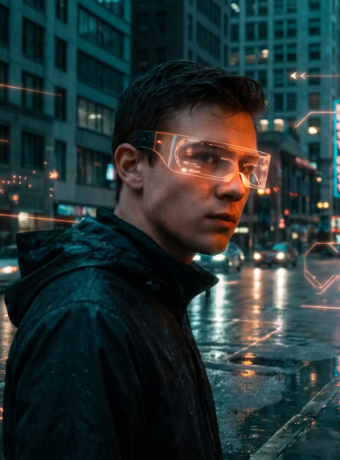
The Moon Astronauts Brought Along USB Stick-Sized Living Samples of Their Own Tissue: What Cyberpunk Culture and Industry Should Be Watching
Tiny glass rectangles, living cells, and a trajectory that reads like a back-alley biotech heist — but this one has a NASA logo.
A gloved hand lifts a translucent rectangle no larger than a thumb drive and for a moment it reads like a prop in a cyberpunk film: living human tissue, grown from an astronaut, riding shotgun around the Moon. The obvious headline is novelty and spectacle: humans and their microscopic doubles, side by side in deep space. That reporting is true, and NASA press materials form the backbone of what follows. According to those materials, the real business story is not just that this happened but how modular human biology is being reimagined as data, commodity, and design element for next generation products and services. NASA Science
Why the scene looks like a cyberpunk tableau and why that matters beyond aesthetics
Cyberpunk fans recognize the iconography immediately: miniaturized biohardware, corporate labs, individualized data streams. This experiment remixes those tropes into the mainstream by turning an astronaut into both subject and data provider, creating personalized biological proxies that can be transported, analyzed, and commercialized. The move from fiction to infrastructure rewires cultural signals into business opportunities for design studios, immersive storytellers, hardware startups, and biotech vendors.
What exactly is riding the Orion capsule and how small is small
The devices are organ-on-a-chip systems that contain bone marrow related cells derived from crew blood draws. They are roughly the size of a USB thumb drive and are engineered to mimic tissue function under stressors such as deep space radiation and microgravity. NASA plans molecular level analysis after splashdown to see which genes and cellular pathways changed while in deep space. Space.com
The underreported business pivot that actually matters
The mainstream reading focuses on scientific novelty and astronaut bravery. The overlooked angle is infrastructure: these chips validate a production model where human cells become interoperable modules that travel, integrate with sensors, and feed analytics pipelines. That changes procurement and IP models for biotech IP, and it changes creative supply chains for cyberpunk media that now license scientifically credible assets rather than inventing them from scratch. Sellers of microfluidic hardware, cloud bioanalytics, and narrative IP stand to gain contractual footholds around the protocols that make these chips useful and repeatable.
Who’s building the hardware and where competition will show up
This mission is a collaboration between government labs and commercial partners who provide the chips and flight hardware. The vendor ecosystem that supplies organ chips, automated incubation, and return analysis is competitive and includes specialized firms and university spinouts. That multiactor model guarantees rapid iteration, and where there is iteration there will be startups offering verticalized services for entertainment, defense, and medical simulation. Planetary Society
What this means for cyberpunk media and product design teams
Narrative authenticity just jumped. Designers can now base props and story beats on functioning organ-on-a-chip tech rather than crude analogies. For immersive experiences, studios can license anonymized datasets or partner with lab-as-a-service providers to generate near-real physiological responses for interactive installations. This is not just a vanity detail; audiences reward plausibility and investors fund teams that reduce concept risk by leaning on validated science.
These tiny chips are less prop and more portable truth, a quiet biotech revolution that fits in a flight suit pocket.
Small business scenarios with real math for teams of 5 to 50
A boutique studio of 10 people wants to create an AR exhibition that simulates real-time cellular responses for a ticketed event. Option A is to license a dataset or simulation engine from a lab partner for 30,000 to 50,000 spread over a year, plus 10,000 to 15,000 in creative integration and hosting costs. Option B is to prototype in-house using open software and a cloud GPU pipeline at roughly 2,000 to 5,000 for compute and licensing over six months, plus 20,000 in staff time valued at typical small-studio rates. Either approach should budget 6 to 12 weeks for compliance checks if any real biological data is used. For a 50 person creative agency converting a one time exhibition into a touring product, multiply those baseline costs to account for regional compliance and logistics and add 15 to 25 percent for travel and hardware redundancy. These numbers are illustrative but concrete enough to plan capital allocation and cash flow for the next two product cycles.
The regulatory and ethical risks that will bleed into brand strategy
Once living tissue becomes a data asset that can be shipped, questions of consent, provenance, and chain of custody follow. There is a reputational cost if a creative product appears to trade in identifiable human biological material without robust anonymization and transparent licensing. In addition, lunar samples and biological payloads trigger complex policy regimes; companies that build experiences around this technology will need legal and bioethics counsel. Treat accidental realism the way a company treats malware: prepare a response plan and budget an insurance line for liability.
The cost nobody is calculating yet
Beyond procurement and compliance there is operational trust. Maintaining the fidelity of biological simulations over time requires ongoing calibration against real-world datasets that will be expensive to curate. Clients who buy “space-validated” authenticity will expect refreshes every 12 to 24 months, not a one time fidelity stamp. That recurring cost is where subscription models, not one off sales, will lock in revenue for vendors who can supply continuous validation.
Risks and open questions that stress-test the claims
Key unknowns include durability of organ chip behavior over longer missions, how representative a piece of bone marrow is for systemic human responses, and whether space radiation effects scale linearly to longer voyages. There are also governance gaps: who owns derivative models trained on astronaut-derived tissue data and how will jurisdictions regulate crossborder transfers of that training data. These gaps are not just academic; they are commercial vectors for dispute.
Practical next steps for cyberpunk entrepreneurs
License the aesthetics and the datasets separately. Negotiate trial terms with lab partners that include a clear audit trail and anonymization protocol. Invest in a small compliance retainer that covers informed consent, biosafety level assessment, and data governance. Build a product roadmap that treats scientific validation as an ongoing service cost, not a one time certification. Also budget for creative freedom; science provides constraints, not a script.
Looking forward with a pragmatic lens
These organ-on-a-chip experiments move the conversation from speculative fiction toward infrastructural reality, creating new categories of cultural capital and commercial work. Firms that treat biological plausibility as an operational requirement rather than a marketing flourish will convert authenticity into a competitive advantage.
Key Takeaways
- NASA sent USB-sized organ chips derived from astronauts to fly around the Moon, creating portable biological proxies that return for molecular analysis.
- Cyberpunk creators and small tech firms can monetize authentic experiences by partnering with lab service providers, but must budget for recurring validation and compliance.
- The business opportunity centers on infrastructure for data, licensing, and validation rather than a single experiment or one off spectacle.
- Ethical and regulatory overheads are real costs that should be built into product pricing and brand risk assessments.
Frequently Asked Questions
What exactly did NASA send to the Moon and why should an indie studio care?
NASA sent organ-on-a-chip devices containing living cells grown from astronaut blood to study radiation and microgravity effects. Indie studios can use validated science to increase narrative credibility and unlock partnerships with labs for licensed datasets and simulations.
Can a small company legally use real astronaut-derived data in a commercial product?
Yes if the data is properly anonymized and the company secures licenses and consent agreements that specify commercial use. Legal review and clear data governance clauses are essential to avoid future disputes.
How much should a 5 to 50 person firm budget to build an experience based on this tech?
Budgeting depends on licensing versus in-house simulation. Expect baseline project costs starting in the low tens of thousands for a single event prototype and scaling upward with touring, compliance, and data refresh costs over time.
Are there safety risks in using organ-on-a-chip imagery or data in entertainment?
Imagery and simulated datasets pose low biosafety risk if no live samples are handled. The main concerns are ethical optics and legal compliance around the provenance and consent associated with any real biological data.
Will this change how biotech startups position themselves in the next 5 to 10 years?
Yes. The experiment validates a product model where biological modules are portable, verifiable, and monetizable, encouraging startups to package biological fidelity as a subscription service for media, defense, and healthcare markets.
Related Coverage
Readers curious about adjacent developments should explore how microfluidics are reshaping drug discovery, the commercialization of space-based R and D infrastructure, and the rise of lab-as-a-service models that let creative firms access living datasets. Each topic connects directly to how biological authenticity becomes a marketable, regulatable asset in the near term.
SOURCES: https://science.nasa.gov/BIOLOGICAL-PHYSICAL/INVESTIGATIONS/AVATAR/ https://futurism.com/space/nasa-astronauts-organ-chips https://www.space.com/space-exploration/missions/what-do-scientists-hope-to-learn-from-nasas-historic-artemis-2-moon-flyby https://www.planetary.org/planetary-radio/2026-avatar-and-sungrazer https://www.nature.com/articles/d41586-026-00964-4