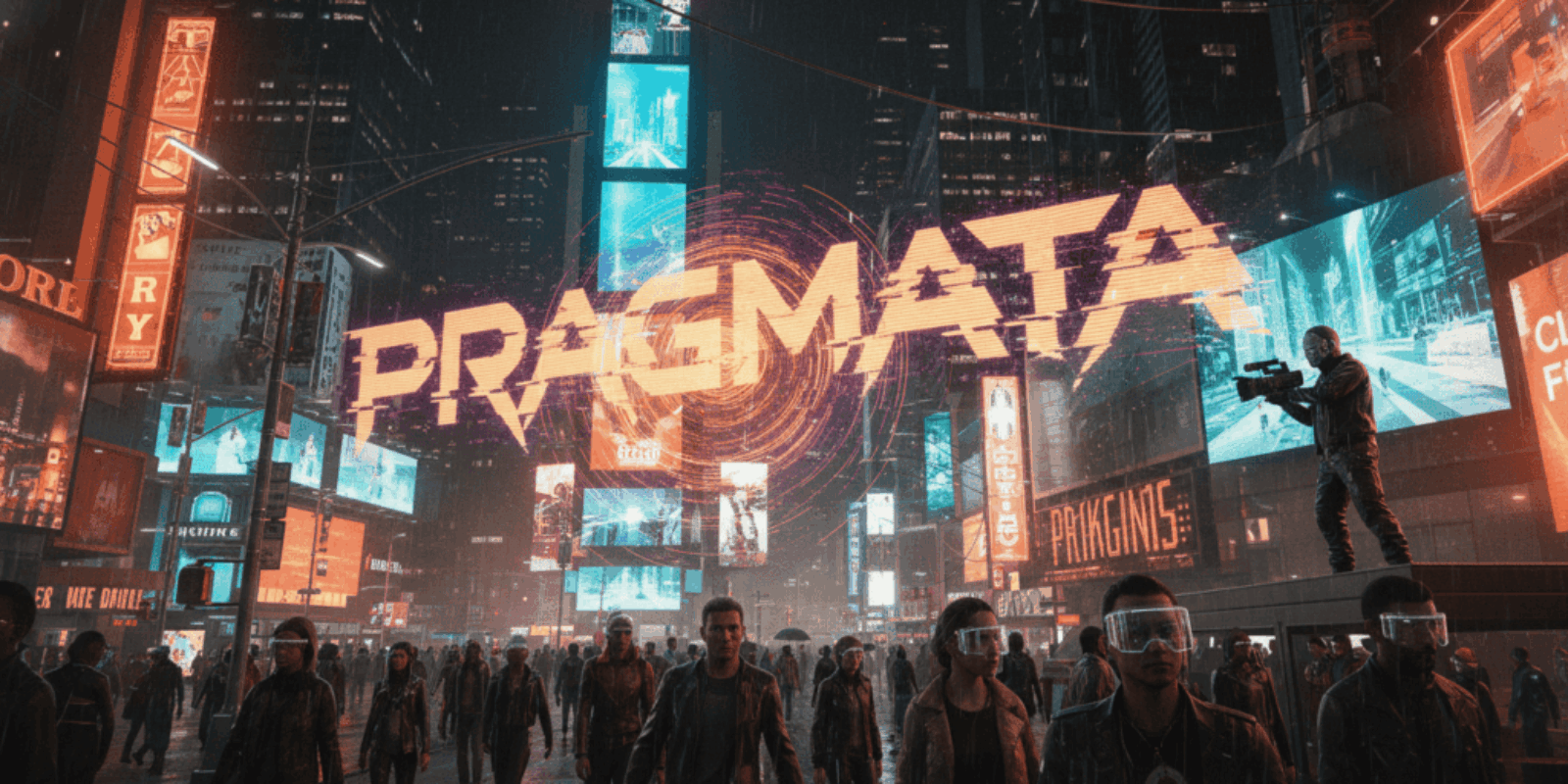
Why Pragmata’s New York-Like City Was Made to Look AI-Generated and What That Means for the AI Industry
A simulated Times Square is both uncanny and deliberate; the design choice reveals more about the future of datasets, studio economics, and trust than it does about one game.
The trailer opens on a city that feels familiar and wrong. Neon signs read like fragments of memory, facades bleed into one another, and crowds are suggested by blur rather than shown; for a few seconds the scene is both postcard and hallucination. A player watches and can almost hear someone off camera say that the place looks like an AI dreamed it, which turns out to be the point and the product.
Most coverage treats the aesthetic as a cinematic flourish or clever marketing that signals a game world that is uncanny by design. That reading is true, but incomplete. The stronger story is how a major studio using a deliberately AI-inflected look reframes industry expectations about how visual datasets are curated, how audiences are conditioned to accept synthetic imagery, and how toolmakers and regulators will respond when “AI style” becomes a category unto itself.
This account relies mainly on press materials and developer interviews released around the trailer and demo, and it reads those statements against the broader shift in generative tools in media. According to NicheGamer, the new footage explores a distorted cityscape that recreates a Times Square-like environment using in‑world materials and fabrication technologies meant to feel manufactured. (nichegamer.com)
Why a studio would intentionally mimic the errors of generative models
Designers chose distortion as a language. By making a cityscape feel superficially synthetic, the game signals narrative themes about simulation and control while also providing a shorthand that players already recognize from AI imagery. That visual shorthand reduces exposition, which developers sometimes call fast costume changes for worldbuilding. It explains a lot while wasting little time, and it also makes the environment feel contemporary to audiences who have seen similar “glitch” aesthetics in user feeds.
The choice also helps mask constraints. When a scene is meant to look wrong, rendering shortcuts and reused assets become stylistic rather than accidental, which can save time and money during polish without breaking immersion. For studios, that is an attractive tradeoff that will not be described as frugality in focus groups, even if it behaves like one at the spreadsheet level. The developers themselves acknowledged that the game’s visual scope and mechanics required extra work across many iterations. (thegamer.com)
What this signals about content pipelines and datasets
When a major publisher leans into an AI aesthetic it does two things for the downstream AI industry. First, it normalizes the presence of synthetic-looking assets in mainstream media, which changes how dataset curators classify and filter imagery. Second, it creates a marketplace signal to tool vendors: clients will pay for controllable “synthetic authenticity” that evokes AI without actually coming from one. That is a profitable niche, and expect tooling to follow.
Developers told interviews that they did not plan for real-world AI to explode the way it has, and that their original concepts predate the current wave of generative tools. Yet the dialogue between studio intent and public perception is not neutral. TechRadar reported developers saying real-life AI’s growth outpaced their original thinking, which means design choices made earlier are now read through a new cultural lens. (techradar.com)
Competitors are watching, and not everyone will copy the look
Other studios are already experimenting with generative techniques for prototyping, texture creation, and idea iteration; the difference here is the deliberate aesthetic choice to celebrate a synthetic look. Some competitors will adopt the style for branding reasons while others will use the same cues to hide generative processes in production. Studios with big franchises will face pressure to adopt or resist the aesthetic depending on audience expectations and brand risk management. Games press that covered the trailer placed it in the context of a long development cycle and careful visual iteration. (gameshub.com)
When a blockbuster makes a fake city look like an LLM sketched it, the AI industry is no longer just a backstage toolset; it becomes a public design language.
The economics in concrete terms
Consider a hypothetical mid sized environment team producing a Times Square‑style block. Hiring three senior environment artists at a blended fully loaded cost of 100,000 to 150,000 USD each over one year equals 300,000 to 450,000 USD. If a studio uses generative tools to prototype 1,000 environmental variants in a single week for tooling cost plus human curation labor of 10,000 to 30,000 USD, that accelerates iteration by months and reduces risk in greenlight decisions. The goal is not to replace artists but to shift expensive human time from iteration to curation and storytelling.
That math explains why some teams treat generative tools as production accelerants rather than replacements, while other parts of a project remain hand crafted for fidelity and brand protection. Studios will continue to mix both approaches, which creates new value for companies that can provide controllable generation with clear provenance.
Risks that the industry must confront
There is a downstream risk that deliberately AI‑like aesthetics will blur the legal and ethical lines around training data provenance. If audiences learn to accept distorted, hallucinatory visuals as intentional art, it becomes easier for firms to slip generative outputs into media without clear attribution, eroding trust. There is also a detection problem; defenses built to flag manipulated imagery rely on artifacts that artists can replicate deliberately, complicating misuse detection for newsrooms and platforms.
Regulators and toolmakers will need clearer provenance standards and watermarking protocols if this becomes common practice. The studio commentary around pragmatic production choices should not be read as a substitute for industry standards about dataset consent and licensing. PushSquare and other outlets documented how presentation and iteration choices drove extra development time, which matters if studios justify generative shortcuts on the basis of artistic intent. (pushsquare.com)
Where the technical debates will land
Tool vendors will be split between feature richness and provenance features. Enterprise clients will demand API controls that guarantee no proprietary IP leaks into public training sets, and platform owners will be pressured to offer certified model instances for creative work. Meanwhile researchers will study whether synthetic aesthetics change human perception in ways that alter trust in photographic evidence.
A dry aside for the reader who loves certainty: algorithms do not have taste, they have tendencies, and tendencies still need an editor with better coffee than patience.
What businesses should do now
Product teams should treat AI style as a strategic choice. If the brand wants to signal human authorship, avoid deliberate synthetic cues. If the goal is narrative ambiguity or faster iteration, factor in the curation cost and the need for provenance logs. Procurement teams should negotiate model licenses that include no‑derivative guarantees and audit rights. Marketing teams should test audience responses in small A to B experiments to measure whether AI aesthetics increase engagement or decrease perceived authenticity.
Forward looking close
Pragmata’s choice to make a city feel like an AI dream is a small creative decision with outsized industry consequences, because it crystallizes an aesthetic that will ripple through tooling, datasets, and regulation. Studios, vendors, and regulators need to move from reactive statements to operational rules that protect creators and consumers while allowing fast experimentation.
Key Takeaways
- Major studios deliberately using an AI aesthetic normalizes synthetic visuals and changes dataset curation incentives.
- Treat generative tools as iteration accelerants; plan for curation costs and provenance logging to avoid legal risk.
- Procurement and legal teams must negotiate clear training data and nonreuse guarantees when licensing models.
- Detection and regulatory regimes must adapt as intentional stylistic choices make manipulation harder to flag.
Frequently Asked Questions
Will making visuals look AI-generated damage a game studio’s reputation?
It can, if audiences expect photographic realism from the franchise. Reputation risk depends on brand positioning and transparency. Studios that disclose design intent and provenance manage backlash more effectively.
Does this mean generative models will replace environment artists?
No. Generative models accelerate prototyping and reduce repetitive tasks but human artists remain essential for creative judgment, integration, and final fidelity. Most studios will reallocate roles rather than eliminate them.
How should an AI vendor price controllable synthetic aesthetic features?
Vendors should price by usage, curation tools, and provenance guarantees rather than raw token counts. Clients will pay premiums for deterministic outputs and audit logs that protect IP.
Will regulators ban this kind of aesthetic choice?
A ban is unlikely; regulation will focus on provenance, attribution, and deceptive use cases rather than aesthetics. The bigger policy question concerns dataset consent and commercial training leakage.
How quickly will other media copy this visual language?
Adoption will be fast in short form media and marketing where the aesthetic communicates quickly. AAA production will be more deliberate because of brand risk and legacy expectations.
Related Coverage
Readers interested in the intersection of creative production and model governance should explore reporting on provenance standards for generative models and case studies of game studios using AI for asset pipelines. Coverage of model licensing disputes and platform responsibilities will also illuminate the commercial pressures that push aesthetics from novelty into standard practice.
SOURCES: https://nichegamer.com/pragmata-introduces-world-view-in-new-trailer/, https://www.techradar.com/gaming/pragmata-dev-says-they-didnt-anticipate-ai-becoming-so-popular-when-first-writing-the-game-we-really-couldnt-predict-that-ai-would-be-this-big-from-where-we-started-from-what-you-see-now, https://www.thegamer.com/pragmata-director-explains-long-delay-doesnt-regret-revealing-early/, https://www.gameshub.com/news/article/pragmata-gameplay-trailer-2806335/, https://www.pushsquare.com/news/2025/09/pragmata-devs-explain-why-the-ps5-game-has-taken-so-long-to-make